

Commentary
Aron Lund
{
  "authors": [
    "Aron Lund"
  ],
  "type": "legacyinthemedia",
  "centerAffiliationAll": "dc",
  "centers": [
    "Carnegie Endowment for International Peace",
    "Malcolm H. Kerr Carnegie Middle East Center"
  ],
  "collections": [
    "Arab Awakening"
  ],
  "englishNewsletterAll": "menaTransitions",
  "nonEnglishNewsletterAll": "",
  "primaryCenter": "Carnegie Endowment for International Peace",
  "programAffiliation": "MEP",
  "programs": [
    "Middle East"
  ],
  "projects": [],
  "regions": [
    "Middle East",
    "Syria",
    "Levant"
  ],
  "topics": [
    "Political Reform",
    "Democracy",
    "Security",
    "Military",
    "Foreign Policy"
  ]
}
Source: Getty
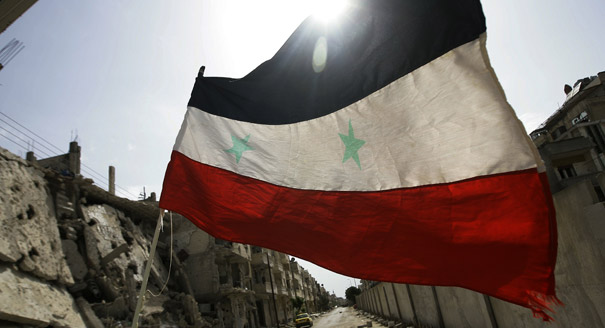
The biggest developments in Syria in 2016.
Source: Century Foundation
Looking back at 2016, it is clear that the Syrian civil war is going President Bashar al-Assad’s way. His Damascus government has been boosted by the Russian military intervention that started in autumn 2015, a surge in Iranian support, the weakening of the Islamic State (ISIS, or IS) and of rival opposition forces trapped in a spiral of sectarian extremism and infighting.
A year ago, I published a fairly long and detailed list of what I felt were the most important events in 2015, with a view to their likely impact in 2016, at Joshua Landis’ Syria Comment blog (still worth reading in my view, and useful background to this commentary).
Back then, the conflict trend also seemed to be running in Assad’s favor, though there were exceptions like the continuing economic and institutional decay of the Syrian state. Huge uncertainties remained, particularly regarding the efficiency of the Russian intervention, the economic situation, and Assad’s ability to flexibly play politics and capitalize on his military gains. Some of those questions have since been resolved, mostly though not exclusively in Assad’s favor, but other uncertainties remain—and the Syrian war is proving very resistant to predictions.
With all that in mind, here is another list, in order from least to most important...
Former Nonresident Fellow, Middle East Program
Aron Lund was a nonresident fellow in the Middle East Program and the author of several reports and books on the Syrian opposition movement.
Recent Work
Aron Lund
Aron Lund
Carnegie does not take institutional positions on public policy issues; the views represented herein are those of the author(s) and do not necessarily reflect the views of Carnegie, its staff, or its trustees.

By fueling the arguments of both supporters and opponents of Armenian Prime Minister Nikol Pashinyan, Azerbaijan wants to ensure he is re-elected with a weaker mandate.

Bashir Kitachaev

A much-discussed disagreement over internet restrictions in Russia was never an existential threat for Putin: It was about elite groups protecting their interests.

Alexandra Prokopenko
By reminding the world that Lukashenko is a threat to NATO and Ukraine, Kyiv is trying to return the focus to why the Belarusian regime needs to be contained rather than rewarded.

Artyom Shraibman

The demands of the Kremlin’s war in Ukraine, demographic problems, and public hostility toward Central Asians mean Russia does not have enough workers.
Salavat Abylkalikov
Minsk’s faith in the future of its larger neighbor’s economy is fading as Belarusian firms in Russia see record losses.
Olga Loiko