

Paper
Chung Min Lee
{
  "authors": [
    "Chung Min Lee"
  ],
  "type": "legacyinthemedia",
  "centerAffiliationAll": "dc",
  "centers": [
    "Carnegie Endowment for International Peace"
  ],
  "collections": [
    "Inside Korea"
  ],
  "englishNewsletterAll": "asia",
  "nonEnglishNewsletterAll": "",
  "primaryCenter": "Carnegie Endowment for International Peace",
  "programAffiliation": "AP",
  "programs": [
    "Asia"
  ],
  "projects": [],
  "regions": [
    "East Asia",
    "South Korea"
  ],
  "topics": [
    "Political Reform"
  ]
}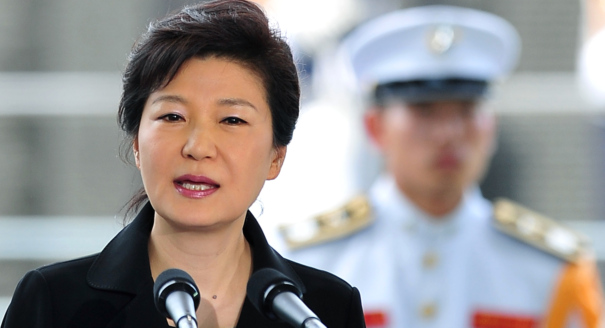
Source: Getty
South Korea, arguably one of the world’s 10 most strategically consequential countries, faces four major challenges.
Source: Washington Post
In the heat of the unprecedented political drama in South Korea that has led to President Park Geun-hye’s downfall, virtually all of the leading presidential aspirants have paid scant attention to what really ails South Korea. Asia’s fourth-largest economy, a de facto G-10 country and arguably one of the world’s 10 most strategically consequential countries, faces four major challenges.
First, South Korea suffers from an unsustainable social contract spurred by politicians promising ever-bigger welfare packages, despite the fact that South Korea is rapidly running out of its ability to deliver on these promises. As one of the world’s fastest-aging societies with virtually irreversible low birth rates, South Korea faces declining labor pools, lower productivity gains and decreasing tax revenues.
Second, South Korea continues to sustain an organizational culture that is hierarchic, often authoritarian, which leads to an inability to devolve power, foster open communication channels or avoid the pitfalls of groupthink. Such an organizational DNA is hardly limited to the presidency or the central government; it permeates all levels of government, political parties regardless of their ideologies, the powerful family-run conglomerates, educational institutions, major media groups and law enforcement agencies.
Third, a potent nationalistic mind-set that accentuates the uniqueness of the Korean nation, but that also contributes to highly subjective and often distorted worldviews, is less compatible with the super-connected, borderless world of the 21st century.
And fourth, South Korea will have to overcome a profound ideological rift between the left and the right on various issues, including how to cope with the growing North Korean nuclear threat, gross human rights violations in North Korea, modernizing and upgrading Seoul’s alliance with Washington and upgrading South Korea’s irreversible economic ties with the world. This rift will become even more severe if the left regains the presidency.
All of these traits are consequences of Korea’s rapid industrialization, democratization and globalization over the past five decades, which helped to propel the nation from being one of the poorest countries in Asia to one of its richest in a span of three generations. But while the nation and the political leadership are gripped by the race for the presidency, and if political expediency wins over as is likely, South Korea will lose a golden opportunity to rebuild a national system that’s fit for the 21st century.
How could that be done? There is no magic wand, but one of the most important steps lies in inculcating and politically mandating bipartisan strategies and policies on critical national security challenges and domestic issues.
Decades of partisan bickering and a winner-takes-all attitude have severely weakened Korea’s ability to deal more effectively with its neighbors. Unless South Korea can overcome the debilitating left-right foreign policy divide, it’s only natural that foreign governments will do their best to exploit Seoul’s endemic ideological and partisan divisions. And without fundamentally fixing this ideological quagmire, South Korea offers little assurance that it can take the lead if and when prospects for genuine change erupt in North Korea.
On the domestic front, since 1987, all incoming presidents serving single five-year terms have taken apart ministries and agencies with very little thought and even less planning in order to stress their re-engineering capabilities. But the policy ramifications have been absolutely dismal whether it was the left or the right that was in power: two decades of anemic economic growth, worsening income gaps, fictitious military reforms and progressively weakening international competitiveness. Thus, parliament should pass a law whereby any major governmental reorganization blueprints by an incoming president should be first vetted by a bipartisan committee and scrutinized with rigorous independent research.
The real tragedy in the ongoing political saga is that virtually all of the presidential aspirants who are hoping to replace Park as the nation’s next chief executive are hellbent on gaining more power. But South Korea’s ability to truly re-engineer itself into a more competitive but also a more comfortable industrialized democracy no longer depends on self-proclaimed superheroes, staunch activists, or populist ideologues. Rather, it’s going to hinge on learning leadership lessons from King Jigme Khesar Namgyel Wangchuck of Bhutan, who believes that constantly reducing his own authority while devolving more powers to the Bhutanese people and the parliament is the correct way forward. Korea doesn’t need a monarchy, but the king of Bhutan should serve as an important guidepost as South Koreans search for their next leader.
This article was originally published in the Washington Post.
Senior Fellow, Asia Program
Chung Min Lee is a senior fellow in Carnegie’s Asia Program. He is an expert on Korean and Northeast Asian security, defense, intelligence, and crisis management.
Recent Work
Chung Min Lee
Carnegie does not take institutional positions on public policy issues; the views represented herein are those of the author(s) and do not necessarily reflect the views of Carnegie, its staff, or its trustees.
The Russian state has opted for complete ideological control of the internet and is prepared to bear the associated costs.

Maria Kolomychenko

After four years of war, there is no one who can stand up to the security establishment, and President Vladimir Putin is increasingly passive.

Tatiana Stanovaya
It’s true that many Armenians would vote for anyone just to be rid of Pashinyan, whom they blame for the loss of Nagorno-Karabakh, but the pro-Russia opposition is unlikely to be able to channel that frustration into an electoral victory.
Mikayel Zolyan

The front-runner to succeed Ilia II, Metropolitan Shio, is prone to harsh anti-Western rhetoric and frequent criticism of “liberal ideologies” that he claims threaten the Georgian state. This raises fears that under his leadership the Georgian Orthodox Church will lose its unifying role and become an instrument of ultraconservative ideology.

Bashir Kitachaev
Kazakhstan’s new constitution is an embodiment of the ruling elite’s fears and a self-serving attempt to preserve the status quo while they still can.
Serik Beysembaev