

Paper
Erik Brattberg, Tomáš Valášek
{
  "authors": [
    "Tomáš Valášek"
  ],
  "type": "legacyinthemedia",
  "centerAffiliationAll": "dc",
  "centers": [
    "Carnegie Endowment for International Peace",
    "Carnegie Europe"
  ],
  "collections": [
    "Transatlantic Cooperation"
  ],
  "englishNewsletterAll": "ctw",
  "nonEnglishNewsletterAll": "",
  "primaryCenter": "Carnegie Europe",
  "programAffiliation": "EP",
  "programs": [
    "Europe"
  ],
  "projects": [],
  "regions": [
    "Russia",
    "Europe",
    "Western Europe",
    "Iran"
  ],
  "topics": [
    "Security",
    "Technology"
  ]
}
Source: Getty
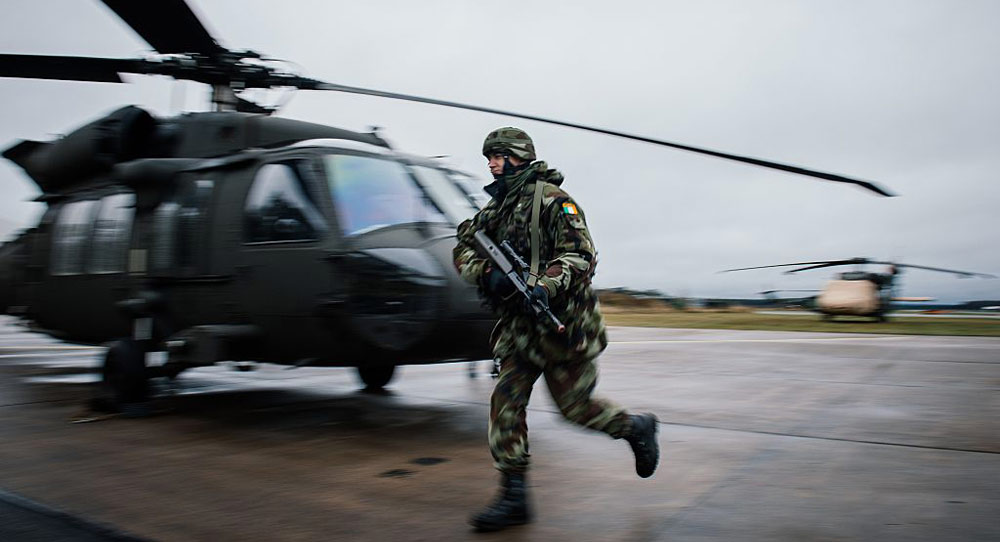
The West should be worried about Moscow obfuscating the scope of its military exercises, but fears of an attack or invasion during Zapad-17 are overblown.
Source: Politico Europe
As Russia launched its 2017 Zapad military exercise, Politico Europe’s Ryan Heath interviewed Tomáš Valášek in an episode of the EU Confidential podcast. Their wide-ranging discussion covered Russia’s war games, European defense cooperation, cybersecurity, and the EU’s East-West divide.
The interview was originally aired on Politico Europe’s EU Confidential podcast.
Former Director, Carnegie Europe
Valášek was director of Carnegie Europe and a senior fellow, where his research focused on security and defense, transatlantic relations, and Europe’s Eastern neighborhood.
Recent Work
Erik Brattberg, Tomáš Valášek
Tomáš Valášek
Carnegie does not take institutional positions on public policy issues; the views represented herein are those of the author(s) and do not necessarily reflect the views of Carnegie, its staff, or its trustees.

If the Russian-speaking community in Latvia cannot articulate their interests without being seen as disloyal, they could end up embracing a pro-Kremlin agenda.

Sergejs Potapkins

Russia’s ruling party would have benefited from Putin appearing as its distant patron, but as an active frontman imposing his views on the public, he has done nothing but harm both the party’s election campaign and the ruling system overall.

Andrey Pertsev

Depleted financial reserves and a shrinking tax base mean it is no longer possible to simultaneously deliver high defense spending, price stability, and economic growth.

Alexandra Prokopenko

Blurring the line between humans and animals is a long-standing tradition in social utopian prose. In his latest novel, Leonid Bershidsky reminds us that in social experiments, people are often treated no differently than animals.

Alexander Baunov

While France and Australia are seeking to establish the legal obligations of messaging apps like Telegram, Russia wants total subordination.

Maria Kolomychenko