

Commentary
With the growth in points of friction between the great powers, organizations like the SCO will continue to play a role in the strategic adaptation of the smaller powers caught between them.
Temur Umarov
{
  "authors": [
    "Richard Sokolsky",
    "Aaron David Miller"
  ],
  "type": "legacyinthemedia",
  "centerAffiliationAll": "",
  "centers": [
    "Carnegie Endowment for International Peace"
  ],
  "collections": [],
  "englishNewsletterAll": "",
  "nonEnglishNewsletterAll": "",
  "primaryCenter": "Carnegie Endowment for International Peace",
  "programAffiliation": "",
  "programs": [],
  "projects": [],
  "regions": [
    "North America",
    "United States"
  ],
  "topics": [
    "Security",
    "Foreign Policy"
  ]
}
Source: Getty
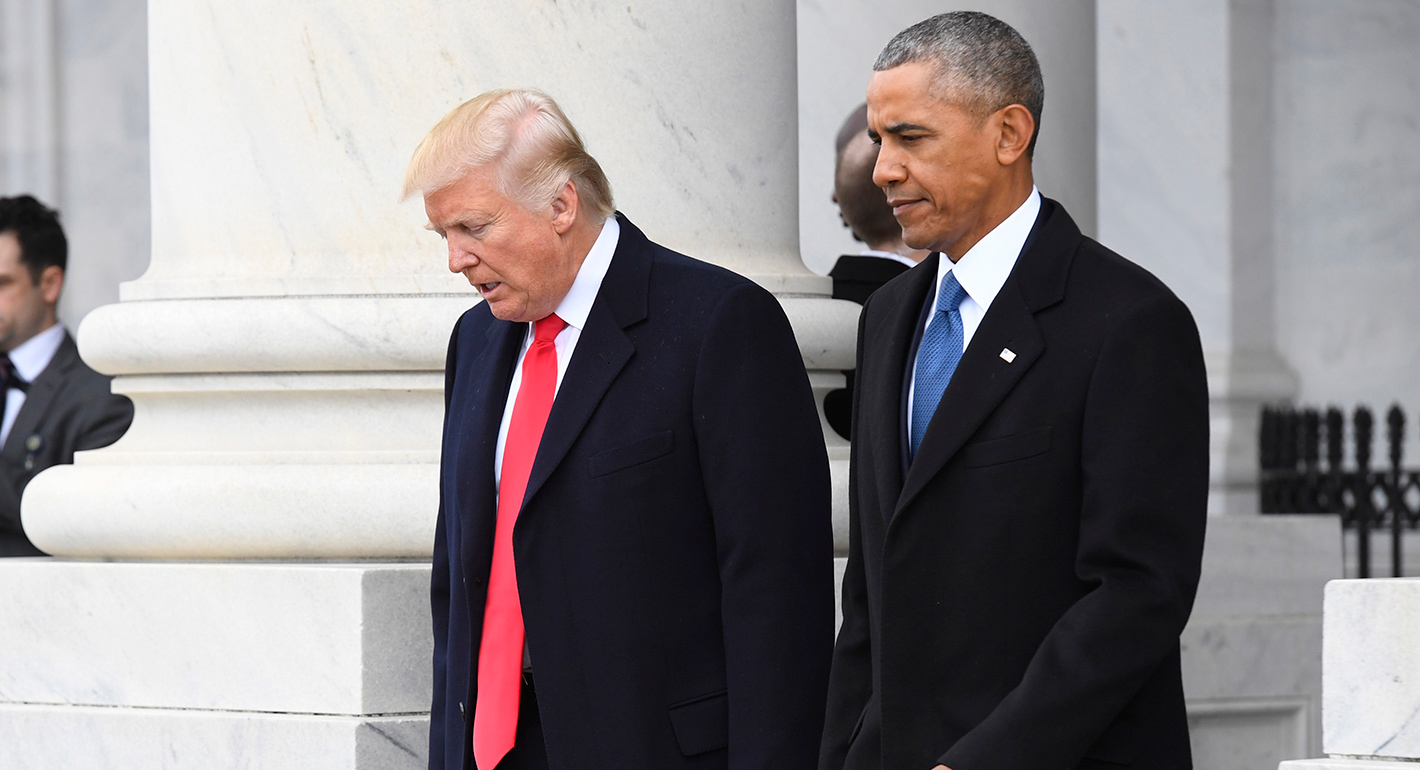
Twelve months into his presidency, far from being the un-Obama when it comes to the use of military force, Trump has behaved more like his predecessor.
Source: Newsweek
In what has to be the most over the top and stunningly reckless tweet of his short Presidency, Donald Trump earlier this week taunted North Korea’s Kim Jung-on by claiming his nuclear button was bigger than Kim’s.
And yet, for all his bluff, bravado, and bluster Mr. Trump’s bark has proven much more consequential than his bite. Indeed, twelve months into his presidency, far from being the un-Obama when it comes to the use of military force, Trump has behaved more like his predecessor.
Having worked for decades for both Republican and Democratic Administrations, we have never seen a transition quite like this one. Presidents put their unique mark on government and often seek to change—if not transform—the initiatives and policies of their predecessor.
But Trump has done this with a vengeance, both in style and substance—whether it’s withdrawing from the Trans-Pacific Partnership (TPP) and the Paris Climate accord, recognizing Jerusalem as Israel’s capital, imposing three Muslim travel bans, attacking the Iran nuclear agreement and, most recently, blasting Obama’s silence in response to Iran’s 2009 “Green Revolution” in contrast to his vocal support for the protesters in Iran.
Paradoxically, the glaring exception to Trump’s Obama is to blame for everything rule is perhaps a President’s most important and fraught responsibility: when and how to use military force.
On this question, Trump, like his predecessor, has shown more risk-aversion than risk-readiness. While the president has often engaged in blustery and bellicose rhetoric, he has been careful when it comes to putting American troops into harm’s away. His retaliation for the Syrian government’s chemical weapons attack on its own citizens was limited and proportionate, disappointing many hawks who hoped it would lead to the use of force on a much larger scale to alter the course of Syria’s civil war. In Afghanistan, he chose a minimalist military option: a very modest surge of forces to do enough to prevent the Taliban from winning, but not enough to turn the tide in the conflict. In Syria, notwithstanding his chest-thumping over the Iranian menace he has refused thus far, in the face of pressure from conservative hawks and Israel, to commit American forces to aggressively confronting Iran and its proxies, and appears content to let Assad and Putin call the shots. The administration’s successful campaign to dislodge ISIL from its proto-states in Iraq and Syria by and large followed a slightly souped-up version of Obama’s strategy. In North Korea, “fire and fury” and “locked and loaded” have not (yet) ignited a second Korean War or a mushroom cloud.
This uncharacteristic Trumpian caution seems driven by several factors. First, despite his boasts during the campaign that he knew more than his generals, Trump (although he would never admit it) seems to understand that military strategy and tactics are not in his wheel-house—and that talking tough is one thing, killing is another. Trump’s limited use of force in Syria and his military caution toward North Korea and Iran reflect the steadying hand, prudence, and influence of what he likes to refer to as his generals and Secretary of Defense Mattis.
Second, Trump sees himself as a domestic rather than foreign policy president. He clearly gets more revved up about catering to his base and enacting a traditional conservative Republican agenda—cutting taxes, shrinking the size of government, getting regulations off the backs of business, and eviscerating Obama Care—than making bold strategic moves on the international chessboard.
During the campaign, Trump often spoke out in favor of nation-building at home. He railed against the trillions of dollars America has spent on its failed wars in the Middle East and Afghanistan and opined that this money would have done a lot more good if it had been spent at home rather than on nation-building and intervention in foreign civil wars.
Even his presidential foreign speeches re-litigate his election, tout declining unemployment, brag about record stock market levels, and rail against Obama’s ruinous economic policies.
Maybe it’s giving Trump too much credit, but he probably grasps intuitively that a war, and especially an unpopular one, could derail his agenda and sink his presidency.
There would be no better way to collapse the stock market and suffer a serious defeat in the midterm election than to set off a major war on the Korean peninsula involving the three largest economies in the world (the US, China, and Japan) and South Korea, the 11 th largest.
Perhaps the president understands that the surest way to ruin a presidency is to get bogged down in an unwinnable war. If he doesn’t, he might try reading up on what happened to President Harry S. Truman with the stale-mated Korean War, President Lyndon Johnson and the Vietnam debacle, and the fiasco of President George W. Bush’s Iraq War.
It would be foolhardy to assume that Trump’s caution in using force is guaranteed. His volatile temperament, fragile ego, and reckless tweeting might still end up getting America into a war it doesn’t want or need.
Let’s hope that the saner heads around Trump will check the dark and irrational impulses that always boil just below the surface of his notoriously thin-skin.

Nonresident Senior Fellow, Russia and Eurasia Program
Richard Sokolsky is a nonresident senior fellow in Carnegie’s Russia and Eurasia Program. His work focuses on U.S. policy toward Russia in the wake of the Ukraine crisis.

Senior Fellow, American Statecraft Program
Aaron David Miller is a senior fellow at the Carnegie Endowment for International Peace, focusing on U.S. foreign policy.
Carnegie does not take institutional positions on public policy issues; the views represented herein are those of the author(s) and do not necessarily reflect the views of Carnegie, its staff, or its trustees.

With the growth in points of friction between the great powers, organizations like the SCO will continue to play a role in the strategic adaptation of the smaller powers caught between them.

Temur Umarov

When faced with fuel shortages in the past, Central Asian governments could always count on additional supplies from Moscow. That safety net no longer exists.

Galiya Ibragimova

Two divergent trends—Putin’s hardline vision of how to prosecute the war in Ukraine, and a growing desire for change in Russia—could tear the regime apart.

Tatiana Stanovaya

Andrey Melnichenko’s essay offers no answer to the fundamental question of how, under any kind of negotiated settlement, Europe can protect itself from the Russian ressentiment that is inevitable in all scenarios except for an outright victory for Putin.

Leonid Bershidsky
Despite unhappiness on the ground, Moscow is determined to use both carrot and stick to ensure there is record support for United Russia in occupied Ukraine.

Konstantin Skorkin