

Commentary
Dimitar Bechev
{
  "authors": [
    "Dimitar Bechev"
  ],
  "type": "commentary",
  "centerAffiliationAll": "",
  "centers": [
    "Carnegie Endowment for International Peace",
    "Carnegie Europe",
    "Carnegie Russia Eurasia Center"
  ],
  "collections": [],
  "englishNewsletterAll": "",
  "nonEnglishNewsletterAll": "",
  "primaryCenter": "Carnegie Russia Eurasia Center",
  "programAffiliation": "",
  "programs": [],
  "projects": [],
  "regions": [
    "Western Balkans"
  ],
  "topics": [
    "Economy"
  ]
}
Source: Getty
Even under the best of circumstances, the relationship in the Balkans between Russia, on the one hand, and the EU and the United States, on the other, is bound to be contentious. However, decisionmakers on both sides can craft policies to dial tensions down and pursue common interests where they do exist.
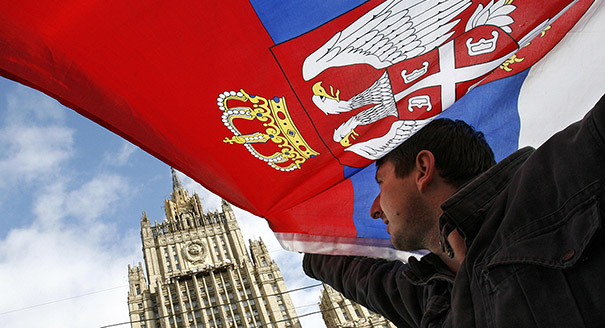
The Balkans are no doubt one of the arenas where the “hybrid war” between Russia and the West, to borrow Dmitri Trenin’s phrase, is waged. All over former Yugoslavia, Moscow is pulling strings in order to thwart the United States and its EU allies. However, in contrast to other regions, what we have at hand is not a military standoff. The Russian Federation has no troops on the ground, nor is it showing signs that deployment in Serbia or Bosnia’s Republika Srpska is imminent. By contrast, NATO or the EU oversee peacekeeping operations in Kosovo and Bosnia and Herzegovina. Furthermore, the Russian military buildup, on the upswing after the annexation of Crimea, presents no direct challenge to the Western Balkans the way it does to Black Sea nations such as Romania, Bulgaria, and Turkey.
In ex-Yugoslavia, Russia and the West compete over influence on countries’ domestic politics and on cross-border issues with wider regional ramifications such as Kosovo. Thus, Montenegro, Bosnia and Herzegovina, and Macedonia are polarized between pro-Western and pro-Russian constituencies. The rifts partly overlap with ethnic divides and identity fractures (e.g., between those Montenegrins who consider themselves Serbs and their kinsmen who embrace the concept of Montenegrin nationhood). Russian meddling is on the lips of commentators in Kosovo and Albania who view Moscow’s ties with Belgrade as a menace.
Local politicians are part of the problem, too. They tend to resort to nationalism and reach out to Russia in order to shield themselves from Western pressure, outmaneuver opponents, and shift the agenda away from socioeconomic issues. A case in point is Republika Srpska’s President Milorad Dodik and his periodic threats to hold an independence referendum. There are examples to the opposite effect as well, making Russia a scapegoat. In Montenegro, NATO’s most recent entrant and frontrunner for EU membership, the government has used the threat from Russia and the ongoing trial concerning the alleged coup on the eve of the parliamentary elections in October 2016 to defang parts of the opposition.
What can the West and Russia do to dial down tensions?
First, Moscow should recognize that former Yugoslavia is part of the Western sphere of influence. This is not such a radical move given that the area is largely integrated into the EU economically and in terms of institutional and human ties. All countries of the region queue to join the union. Yugoslavs have been migrating in high numbers to western Europe and beyond since the early 1960s; a large percentage of Albania’s citizens reside in the EU as well.
Second, the United States and Europe should accept that Russia will remain opposed to NATO, even if it tones down its rhetoric against the EU. In any event, the Alliance might struggle expanding further than Montenegro. The new pro-Western government in Macedonia is doing the best it can to resolve the long-standing “name issue” and persuade Greece to lift the veto on NATO accession. There is no guarantee, however, that Athens and Skopje will reach a settlement. Serbia and Bosnia and Herzegovina, two countries where Moscow wields influence, are not to join the Alliance anytime soon.
Third, Russia and the West could do more to safeguard the stability in Bosnia and Herzegovina. Though the recurrent crises add to Moscow’s leverage as a power broker, a collapse of the Dayton status quo is hardly in the Russian interest, a point made by Sergey Lavrov. Bogged down in eastern Ukraine and working hard to craft a successful exit strategy in Syria following the victory on the battlefield, Russia can ill afford another security crisis straining its scarce resources and generating further unpredictability in relations with the United States and the EU. As a key member of the Peace Implementation Council, the Russian Federation can do more to curb Dodik’s brinkmanship. Moscow’s newly reinvigorated relationship with Ankara, even if it draws strength from shared anti-Western grudges, can be harnessed to constructive ends in Bosnia and Herzegovina, too.
Fourth, Russia and the EU should look for a modicum of common ground on Kosovo. Russia would continue to support Serbia as it sees fit, notably by blocking Kosovo’s membership in global organizations. Yet it should come to terms with the fact that the EU is in charge of resolving the issue and that Serbia actually views NATO as a guarantor of Serbian communities. Moscow should refrain from actions that would obstruct the normalization talks, e.g., forging a common cause with radical actors in the Serb-populated north. To build confidence, Russia should reach out to the Kosovar leadership, using its diplomatic representation in Prishtina. Kosovo leaders, in turn, should tone down anti-Russian rhetoric.
Fifth, looking at Southeast Europe as a whole, the EU and Russia should restore dialogue on energy. In strategic terms, the region matters to Moscow as a conduit of natural gas to customers in Central Europe and Italy. The possible extension of TurkStream, whether via Bulgaria or Greece, gives a strong incentive to the European Commission and Gazprom to find a solution to their long-standing regulatory dispute. Where there is a will, there is a way. For instance, Gazprom could use spare capacity on the future Trans Adriatic Pipeline (TAP), which is expected to ship Caspian gas after 2019–2020. In that way, the Russian state-owned major would be in compliance with EU rules. In general, the energy trade should be transformed from a highly charged geopolitical issue to a matter to be directed by transnational markets and the forces of supply and demand.
Shifting gears from competition to cooperation is a daunting task. Even under the best of circumstances, the relationship in the Balkans between Russia, on the one hand, and the EU and the United States, on the other, is bound to be contentious. However, decisionmakers on both sides can craft policies to dial tensions down and pursue common interests where they do exist.


Senior Fellow, Carnegie Europe
Dimitar Bechev is a senior fellow at Carnegie Europe, where he focuses on EU enlargement, the Western Balkans, and Eastern Europe.
Recent Work
Dimitar Bechev
Carnegie does not take institutional positions on public policy issues; the views represented herein are those of the author(s) and do not necessarily reflect the views of Carnegie, its staff, or its trustees.

Russian strikes are weakening the economy sustaining Ukraine’s war effort. Closing the growing funding gap will require more European support and politically contentious reforms in Kyiv.

Balázs Jarábik

For every ruble allocated to social policy, health, and education in 2027, double that amount is earmarked for the army, the police, and the security services.

Alexandra Prokopenko

Depleted financial reserves and a shrinking tax base mean it is no longer possible to simultaneously deliver high defense spending, price stability, and economic growth.
Alexandra Prokopenko

A much-discussed disagreement over internet restrictions in Russia was never an existential threat for Putin: It was about elite groups protecting their interests.
Alexandra Prokopenko

The demands of the Kremlin’s war in Ukraine, demographic problems, and public hostility toward Central Asians mean Russia does not have enough workers.

Salavat Abylkalikov