

Commentary
Japan’s long-term security policy is driven by concerns about China, and there is little appetite for (or interest in) pursuing a confrontation with Moscow.
James D.J. Brown
{
  "authors": [
    "Richard Sokolsky",
    "Yuri Lee"
  ],
  "type": "legacyinthemedia",
  "centerAffiliationAll": "",
  "centers": [
    "Carnegie Endowment for International Peace"
  ],
  "collections": [],
  "englishNewsletterAll": "",
  "nonEnglishNewsletterAll": "",
  "primaryCenter": "Carnegie Endowment for International Peace",
  "programAffiliation": "",
  "programs": [],
  "projects": [],
  "regions": [
    "North America",
    "United States",
    "East Asia",
    "South Korea",
    "North Korea"
  ],
  "topics": [
    "Nuclear Policy",
    "Arms Control",
    "Global Governance",
    "Foreign Policy"
  ]
}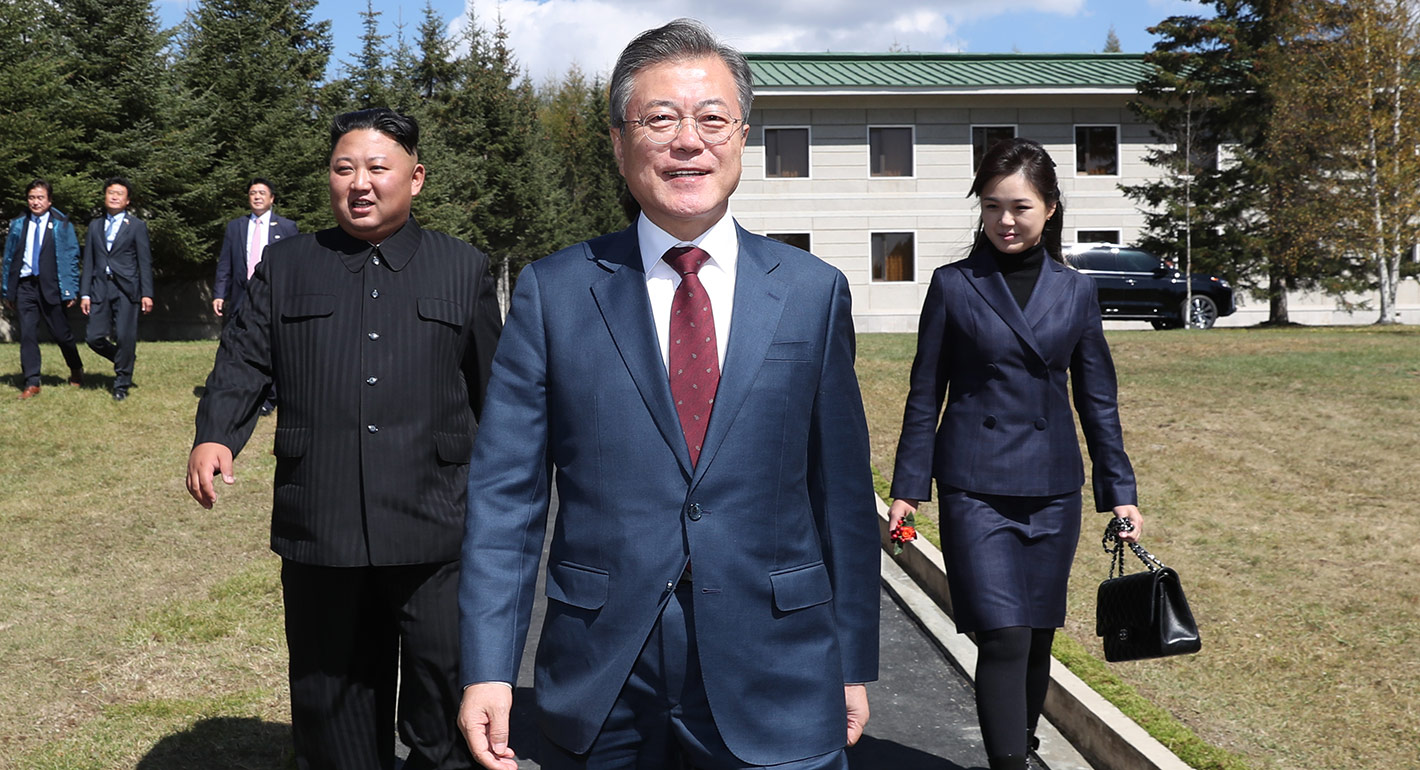
Source: Getty
In the event a peace and security regime for the Korean Peninsula leads to North Korean agreement to reduce its conventional weapons and equipment, Kim may want to convert portions of the North’s defense industries to production of civilian goods.
Source: 38 North
Kim Jong Un is committed to North Korea’s economic development and has prioritized this goal over military modernization. In the event a peace and security regime for the Korean Peninsula leads to North Korean agreement to reduce its conventional weapons and equipment, Kim may want to convert portions of the North’s defense industries to production of civilian goods. Re-purposing these facilities for civilian uses could give a boost to North-South normalization and reconciliation as well as present opportunities for closer North-South economic cooperation and possibly multinational participation in the conversion program. To date, Pyongyang and Seoul have not given much thought to cooperative North Korean defense conversion. But if inter-Korean relations move forward this subject could assume greater importance on their agenda for normalization and reconciliation.

Nonresident Senior Fellow, Russia and Eurasia Program
Richard Sokolsky is a nonresident senior fellow in Carnegie’s Russia and Eurasia Program. His work focuses on U.S. policy toward Russia in the wake of the Ukraine crisis.
Yuri Lee
Yuri Lee is a research freelancer supporting 38 North Director Joel Wit. Prior to her freelance work, she was a Research and Program Intern at the US-Korea Institute at Johns Hopkins School of Advanced International Studies. She currently works at Asian Americans Advancing Justice, a legal advocacy nonprofit dedicated to protecting the rights of immigrant communities and communities of color. She holds a B.A. in History from Dartmouth College.
Carnegie does not take institutional positions on public policy issues; the views represented herein are those of the author(s) and do not necessarily reflect the views of Carnegie, its staff, or its trustees.

Japan’s long-term security policy is driven by concerns about China, and there is little appetite for (or interest in) pursuing a confrontation with Moscow.

James D.J. Brown

Russia’s AI-driven propaganda campaigns operate in a fragmented, chaotic, and often illogical manner. That’s not necessarily a problem for the Kremlin, though: It’s much easier to mimic genuine public debate that way.

Ilya Klishin

Without a ceasefire with Ukraine on attacking each other’s energy infrastructure—to which the Kremlin is unlikely to agree—the diesel agreement between Putin and Trump is largely for show, rather than representing a genuine increase in the volumes of Russian diesel on the global market.

Sergey Vakulenko

Despite a new textbook, an influx of Russian teachers and managers, and an end to the teaching of Ukrainian, the Kremlin is unlikely to have “reprogrammed” locals.

Konstantin Skorkin

Cargo traffic through Russia’s Northern Sea Route has increased because of the disruption caused by the conflict in the Middle East, the Ukraine war, and U.S.-China tensions.

Mikhail Korostikov