

Article
- +1
Rudra Chaudhuri, Tejas Bharadwaj, Konark Bhandari, …
{
  "authors": [
    "Shruti Sharma"
  ],
  "type": "commentary",
  "centerAffiliationAll": "",
  "centers": [
    "Carnegie Endowment for International Peace",
    "Carnegie India"
  ],
  "collections": [
    "Coronavirus"
  ],
  "englishNewsletterAll": "",
  "nonEnglishNewsletterAll": "",
  "primaryCenter": "Carnegie India",
  "programAffiliation": "",
  "programs": [],
  "projects": [],
  "regions": [
    "South Asia",
    "India"
  ],
  "topics": [
    "Technology"
  ]
}
Source: Getty
As its number of coronavirus cases grows, India is just beginning to expand diagnostic and manufacturing capacities. The road ahead will be long.
In light of the continued spread of the new coronavirus across India, Prime Minister Narendra Modi announced a nationwide lockdown and acknowledged that the virus poses an especially great challenge “for a developing country like India with a huge population.” As of March 27, India has reported 724 cases, including 17 deaths, with the highest numbers seen in the states of Kerala and Maharashtra. While New Delhi has ramped up its preparedness and response, there remains much room for improvement.
The Indian government has declared COVID-19, the disease caused by the new coronavirus, a “notified disaster” under the 2005 Disaster Management Act. This enables the government to provide assistance and increase spending to fight the pandemic. All states and union territories have been advised to invoke provisions of Section 2 of the Epidemic Diseases Act of 1897, which empowers them to formulate regulations to contain an outbreak. Following this advisory, several states have ramped up measures to ensure social distancing. Most state governments have encouraged employees to work from home, banned mass gatherings, and shut down schools, colleges, malls, movie theaters, and other recreational sites.
Soon after the World Health Organization (WHO) declared COVID-19 a pandemic, India’s Ministry of Health and Family Welfare began to limit border crossings. Severe travel restrictions have been issued that ban all international flights until April 14 and all domestic travel until March 31, subject to further government review. Passenger movements have also been suspended through all immigration checkpoints along India’s borders with Bangladesh, Bhutan, Myanmar, Nepal, and Pakistan.
While India has taken significant measures to restrict entry, it has not been equally proactive in testing suspected cases. Following the WHO’s guidance to test as many people as possible, most countries moved quickly to expand their testing facilities. Although India has the theoretical capacity to conduct close to 20,000 tests a day, it had tested only 27,688 samples from 26,798 people as of March 27—an abysmally low rate of nineteen tests per million people.
These delays may be due partly to inaccessible test kits. Currently, India has only 150,000 diagnostic kits, though it has ordered an additional million. The Indian Council of Medical Research (ICMR) explains this low testing rate as a conscious decision intended to avoid unnecessary testing and panic. Until very recently, the ICMR only approved testing of people who are displaying symptoms and have traveled abroad or come in contact with others who have traveled to high-risk countries. However, a new strategy released by the ICMR has expanded the eligibility criteria to include all hospitalized patients with severe acute respiratory illness. Even the new testing regime is likely too restrictive, however, and it could allow the virus to continue to spread while poorly detected.
India is trying to expand its diagnostic capacity to 121 government labs and additional private labs across the country, but most can perform only preliminary tests insufficient to confirm a COVID-19 diagnosis. As a result, the majority of test samples are being sent to the National Institute of Virology, an ICMR laboratory that can turn around test results within two to three days. Until the arrival of test results, patients with serious symptoms are admitted to isolation wards and those with milder symptoms are advised to enter at-home quarantine. The latter option increases the chance of community transmission, a process the ICMR is still struggling to detect and measure through randomized testing of patients with influenza- or pneumonia-like symptoms.
To reduce the turnaround time for test results, ICMR has accredited 44 private labs (as of March 27) that will have the capacity to perform both preliminary and confirmatory tests for the coronavirus. The government has also appealed to these private labs to offer free COVID-19 tests. But the government would still need to acquire many more testing kits, through both importation and ramped-up domestic manufacturing. Commercial production of rapid point-of-care test kits would be a big help, as would scaled-up capacity to make the necessary reagent chemicals for the kits.
Meanwhile, the government should issue testing licenses to more diagnostic labs, fast-track regulatory changes to facilitate the development and commercialization of diagnostics, share standards and protocols with personnel for safe handling of samples, and train workers to ensure the kits are properly disposed of once contaminated. If India witnesses an exponential increase in cases, it should also consider setting up drive-through testing stations.
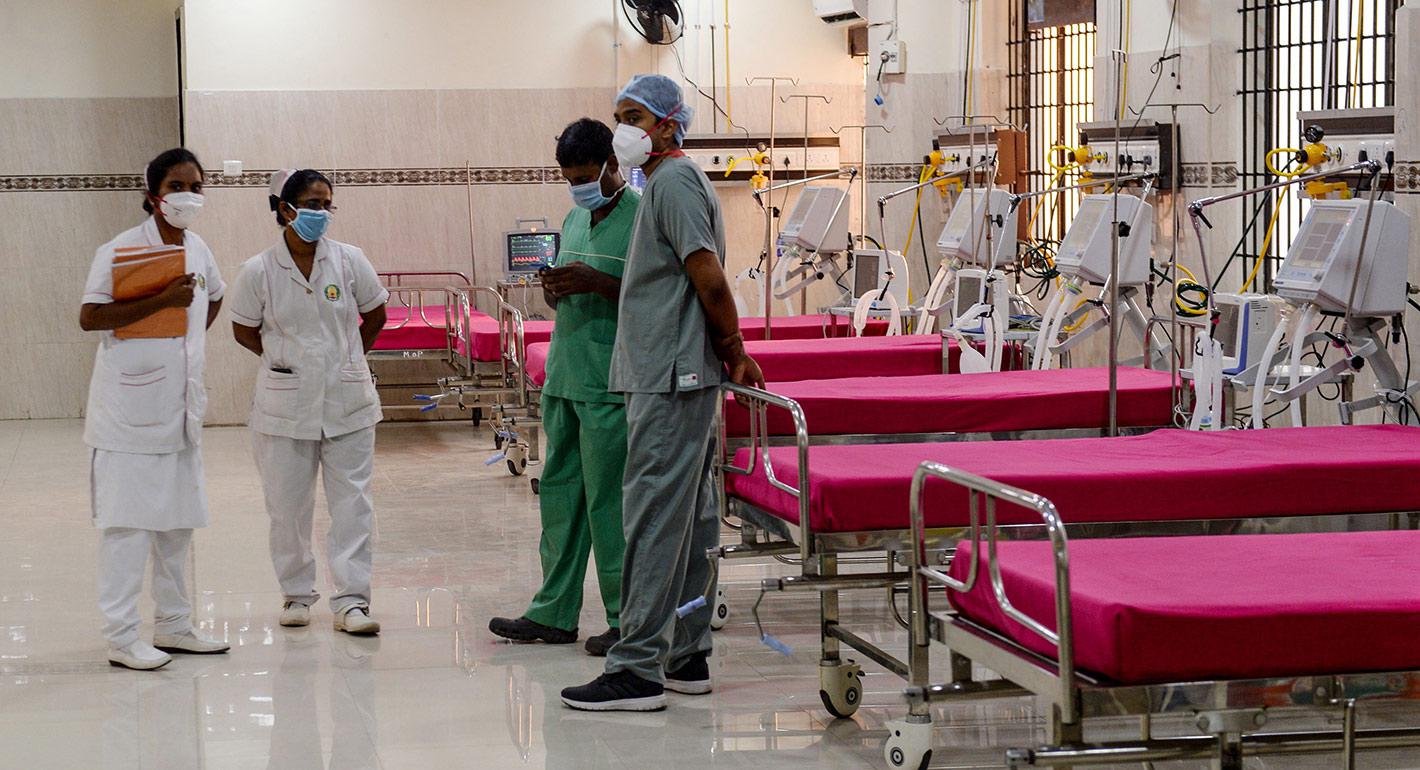
In addition to building a robust diagnostic network and instituting social distancing measures, India must encourage public-private partnerships to manufacture personal protective equipment such as medical masks, gowns, and goggles for frontline medical workers. Such partnerships are also instrumental for rapidly tracing the spread of the contagion and testing widely to detect community transmission. It is also essential to build hospital infrastructure that can handle a rapid rise in the number of cases and especially to set up isolation wards in every hospital. Schools and stadiums may have to be converted into wards. Arrangements for more ambulances, beds, respirators, ventilators, and medical-grade oxygen must be made in advance of the anticipated spike in community transmission.
If the experiences of other countries offer any indication, India likely faces a steep road to recovery. Despite aggressive containment measures, even countries like China, Singapore, and South Korea that have now largely controlled the virus’s spread are witnessing a surge in imported coronavirus cases, showing that the virus is expected to come in waves. Like those countries, India must prepare for both the immediate threat and a daunting long haul.

Former Associate Director, Fellow, and Chief Coordinator, Global Technology Summit, Technology and Society Program
Shruti Sharma was an associate director and a fellow with the Technology and Society Program at Carnegie India, where she is currently working on exploring the challenges and opportunities in leveraging biotechnology to improve public health capacity in India. Additionally, she is the Chief Coordinator of Carnegie India's Global Technology Summit.
Recent Work



Rudra Chaudhuri, Tejas Bharadwaj, Konark Bhandari, …
Shruti Sharma
Carnegie does not take institutional positions on public policy issues; the views represented herein are those of the author(s) and do not necessarily reflect the views of Carnegie, its staff, or its trustees.

While France and Australia are seeking to establish the legal obligations of messaging apps like Telegram, Russia wants total subordination.

Maria Kolomychenko

With the growth in points of friction between the great powers, organizations like the SCO will continue to play a role in the strategic adaptation of the smaller powers caught between them.

Temur Umarov

The war in Ukraine and a change in ownership led VK to neglect its commercial ventures in favor of implementing the Kremlin’s online agenda. Now it’s been sanctioned by the EU.
Maria Kolomychenko

When political power is concentrated in the hands of a small circle of people, a country invariably ends up with technological stagnation.
Aleksei Kiselev

With its scattershot approach to enforcing internet censorship, the Russian regime risks losing a battle against the many Russians who have learned to evade online restrictions.
Maria Kolomychenko