• Research
  • Politika
  • About
Carnegie Russia Eurasia center logoCarnegie lettermark logo
  • Donate
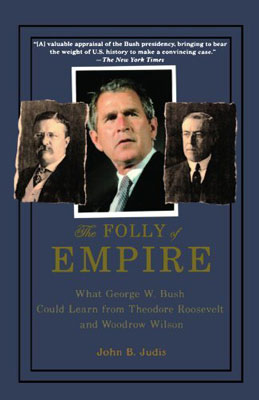
The Folly of Empire: What George W. Bush Could Learn From Theodore Roosevelt and Woodrow Wilson
Book

The Folly of Empire: What George W. Bush Could Learn From Theodore Roosevelt and Woodrow Wilson

John Judis draws sharp contrasts between the Bush administration's policies, especially with regard to Iraq, and those of every administration from Franklin Roosevelt through Bill Clinton.

Link Copied
By John Judis
Published on Aug 29, 2004

Source: Scribner

John Judis draws sharp contrasts between the Bush administration's policies, especially with regard to Iraq, and those of every administration from Franklin Roosevelt through Bill Clinton. The result is a thought-provoking look at America's position in the world—then and now—and how it has been formed, that will spark debate and controversy in Washington and beyond. Judis raises crucial questions about why the Bush administration has embarked on a foreign policy that has been proven unsuccessful and presents damning evidence that its failure is already imminent. The final message is a sobering one: Leaders ignore history's lessons at their peril.

About the Author: John B. Judis is a visiting scholar at the Carmegie Endowment for International Peace and also senior editor at The New Republic. Judis's books include The Emerging Democratic Majority, The Paradox of American Democracy: Elites, Special Interests, and the Betrayal of Public Trust; William F. Buckley: Patron Saint of the Conservatives; and Grand Illusion: Critics and Champions of the American Century. His articles have appeared in The American Prospect, The New York Times Magazine, The Washington Post, Foreign Affairs, The Washington Monthly, American Enterprise, Mother Jones, and Dissent.

About the Author

John Judis

Former Visiting Scholar

As a visiting scholar at Carnegie, Judis wrote The Folly of Empire: What George W. Bush Could Learn from Theodore Roosevelt and Woodrow Wilson.

    Recent Work

  • In The Media
    This Election Could be the Birth of a Trump-Sanders Constituency

      John Judis

  • In The Media
    Policy Chops

      John Judis

John Judis
Former Visiting Scholar
John Judis
Democracy

Carnegie does not take institutional positions on public policy issues; the views represented herein are those of the author(s) and do not necessarily reflect the views of Carnegie, its staff, or its trustees.

More Work from Carnegie Russia Eurasia Center

  • Commentary
    Carnegie Politika
    With a Controversial New Law, Georgia Invites Bids From Russia and the EU

    By adopting the law on foreign agents, the ruling Georgian Dream party is inviting Russia and the West to compete for Tbilisi’s favor.

      Vladimir Solovyov

  • Commentary
    Carnegie Politika
    Could Opposition Protests in Armenia Topple the Government?

    Armenia’s Nikol Pashinyan is known as a political survivor, but the current unrest—led by a clergyman—is his biggest domestic political challenge yet.

      • Alexander Atasuntsev

      Alexander Atasuntsev

  • Protests in Georgia against foreign agent law, 2024
    Commentary
    Carnegie Politika
    Georgia’s Foreign Agent Law Could Presage a Geopolitical Realignment

    Passage of the controversial bill may drive a wedge between Tbilisi and Brussels and pave the way for a rapprochement with Russia.

      Emil Avdaliani

  • Commentary
    Carnegie Politika
    Why Is Georgia Again Trying to Push Through an Unpopular Foreign Agent Law?

    Georgian Dream, which until recently looked certain to win another victory in this year’s elections, now risks repeating last year’s mistake—only this time, the stakes are higher.

      • Alexander Atasuntsev

      Alexander Atasuntsev

  • Commentary
    Carnegie Politika
    Bureaucracy as the Pillar of Stability: Are There Any Real Institutions Inside the Russian Political Regime?

    Russia’s ruling mechanism—bureaucratic institutions—may outlast the current personalism. This vast network of civil servants, technocrats, and administrators forms a modestly resilient framework that endures beyond individual political decisions, providing continuity and ensuring the steady day-to-day functioning of the government.

      Ekaterina Schulmann

Get more news and analysis from
Carnegie Russia Eurasia Center
Carnegie Russia Eurasia logo, white
  • Research
  • Politika
  • About
  • Experts
  • Events
  • Contact
  • Privacy
Get more news and analysis from
Carnegie Russia Eurasia Center
© 2026 Carnegie Endowment for International Peace. All rights reserved.