

Commentary
Alexander Atasuntsev
{
  "authors": [
    "Alexander Atasuntsev"
  ],
  "type": "commentary",
  "blog": "Carnegie Politika",
  "centerAffiliationAll": "",
  "centers": [
    "Carnegie Endowment for International Peace",
    "Carnegie Russia Eurasia Center"
  ],
  "englishNewsletterAll": "",
  "nonEnglishNewsletterAll": "",
  "primaryCenter": "Carnegie Russia Eurasia Center",
  "programAffiliation": "",
  "programs": [],
  "projects": [],
  "regions": [
    "Armenia",
    "Russia and Eurasia"
  ],
  "topics": [
    "Civil Society",
    "Democracy"
  ]
}
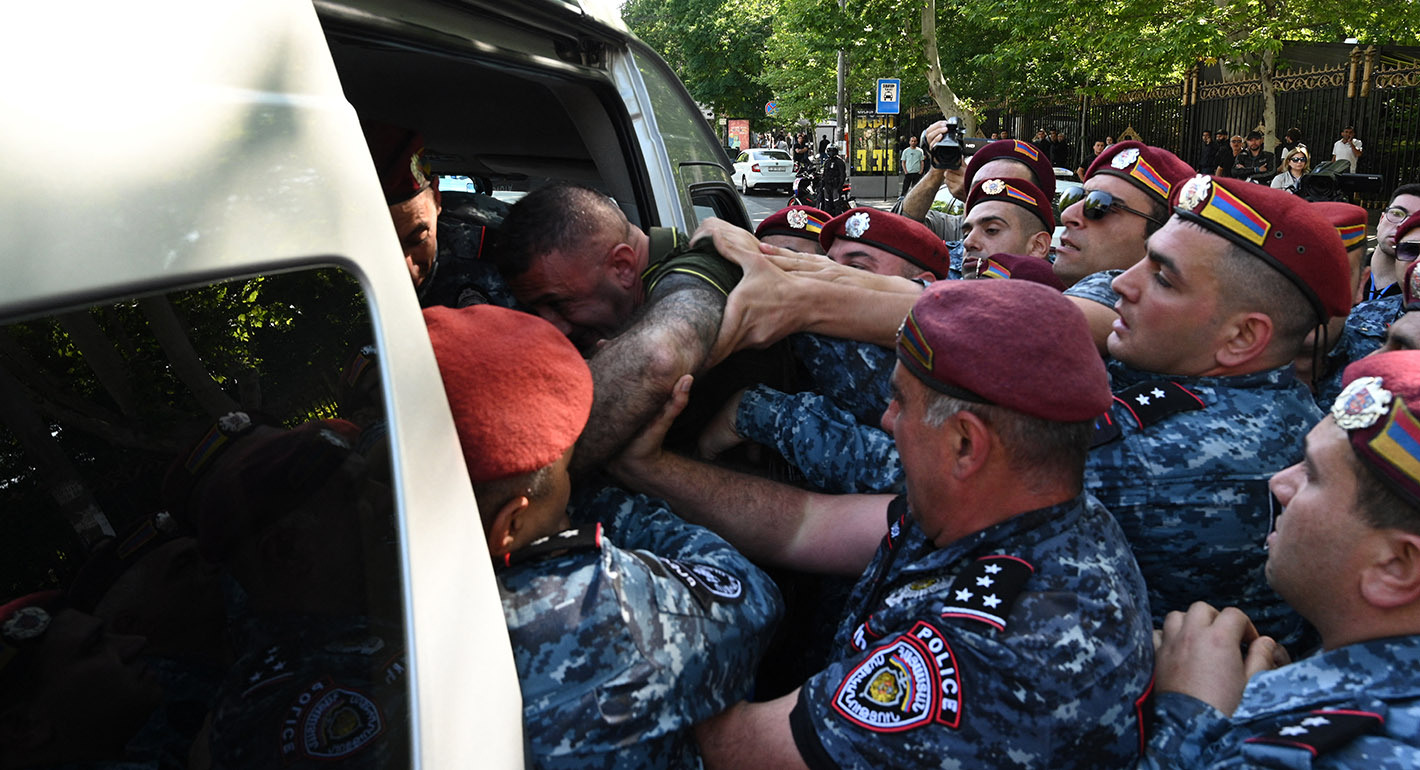
Source: Getty
Armenia’s Nikol Pashinyan is known as a political survivor, but the current unrest—led by a clergyman—is his biggest domestic political challenge yet.
For several weeks Armenia has been roiled by the biggest opposition protests since the 2018 revolution that swept Prime Minister Nikol Pashinyan to power. Thousands of demonstrators marched from the northeast of the country to Yerevan, where they are blocking roads and demanding the resignation of Pashinyan for betraying the nation and surrendering territory as part of a border delimitation process with Azerbaijan.
Notably, the ranks of the protesters have been swelled by members of the clergy and refugees from the long-disputed region of Nagorno-Karabakh, which was seized by Azerbaijan last year. However, Pashinyan has repeatedly shown himself to be a political survivor, and the outcome is far from certain. A lot will depend on whether opposition leaders are able to overcome the apathy that has gripped Armenian society in recent years.
It’s not the first time Pashinyan has faced huge street protests. After Armenia’s defeat in the Second Karabakh War in 2020, the opposition tried to force his resignation through unrest on the streets and storming government buildings, an ultimatum from the military, and snap parliamentary elections. Now, however, the situation is more serious: never before have so many people come out to denounce Pashinyan.
Significantly, the protests are not being led by a politician, but by a figure who is untarnished by past mistakes: Archbishop Bagrat Galstanyan. The protests are also being given momentum by their tactics, which echo those of the 2018 Velvet Revolution. Back then, Pashinyan and his supporters marched from Armenia’s second city of Gyumri to the capital, where they were catapulted to power. Now, Galstanyan has organized a similar march from his home region of Tavush, where several villages have been handed to Azerbaijan as part of the border delimitation.
Upon arrival in the capital, Galstanyan demanded Pashinyan’s resignation at a rally in central Yerevan that was attended by thousands of his supporters. Unrest—in the form of road closures, civil disobedience, and protests—is ongoing.
The dangers for Pashinyan have been exacerbated by the presence of more than 100,000 refugees from Nagorno-Karabakh who arrived in Armenia after the separatist region’s takeover by Azerbaijan last year. For a country with a population of just 3 million, this is a significant number. While residents of Nagorno-Karabakh were always Armenian citizens, they were previously unable to vote in elections. Now, however, they can influence politics—and there is little love lost among them for the current government.
While it’s undeniable that support for Pashinyan is among the lowest it has been (in December 2023—even before the border delimitation process began—only 17 percent of Armenians said they trusted him), it’s too early to say he is doomed. Importantly, his opponents enjoy even less support: in May, amid the current protests, only 6.7 percent of respondents to a survey said they could see Galstanyan as head of a transition government.
The picture is even bleaker for the parliamentary opposition. The second most popular candidate for the post of acting prime minister was Robert Kocharyan (president of Armenia from 1998 to 2008), who was backed by a mere 2.5 percent of respondents.
More than 50 percent of Armenians who took part in the survey said they didn’t back any Armenian politician, which indicates how much disillusionment there has been with politics since Armenia’s defeat in the second war over Nagorno-Karabakh in 2020. There is a consensus that Armenia’s current predicament is not just Pashinyan’s fault, but also that of those who came before him: those who repeatedly botched negotiations with Baku, failed to modernize the army, and made the wrong choice when it came to international allies (there is bitter disappointment with Armenia’s long-term ally Russia, which failed to take action during last year’s seizure of Nagorno-Karabakh).
Many Armenians believe that despite his flaws, Pashinyan is trying to avoid another war: indeed, his reasoning for the border demarcation process is to avoid new hostilities. It’s also clear that if the opposition came to power, it would take a tougher line with Baku—risking military escalation. Azerbaijan has not been shy about resolving disputes by force, and Baku has shown it is prepared to occupy Armenian territory.
Worries about a change of government are also fueled by Armenia’s dismal experience of revolution. The triumph of civil society in 2018 ultimately led to the biggest tragedy in the country’s modern history: the second war with Azerbaijan and the loss of Nagorno-Karabakh.
The 2018 revolution in Armenia was successful thanks to a confluence of factors that are not necessarily repeatable today. Firstly, there was a strong emotional trigger: the widely disliked President Serzh Sargsyan tried to stay in power as prime minister having already served two presidential terms. Secondly, there was a deep split in Sargsyan’s inner circle. Thirdly, the protesters had powerful external allies, including Armenia’s huge diaspora. Finally, outside powers—particularly Russia—that could have intervened decided not to get involved.
Unlike in 2018, today’s opposition—at least so far—has been unable to find the required number of votes in parliament to initiate impeachment proceedings. And it’s a long way from commanding the majority that would be necessary to force Pashinyan’s removal.
Nor does today’s opposition have influential foreign partners. Of course, pro-Russian media in Armenia openly backs the protesters, and Russian officials can barely hide their approval. But that does more harm than good for the protesters, and means they end up branded as “pro-Russian.”
For many years, Russia was considered Armenia’s sole security guarantor, but the loss of Nagorno-Karabakh has shifted attitudes toward Moscow. In a recent survey, 40 percent of respondents identified Russia as a threat (it was perceived as the third most dangerous country after Azerbaijan with 86 percent, and Turkey with 82 percent).
Amid this disappointment and anger with Russia, Pashinyan has sought to pursue closer ties with the European Union, in line with the current wishes of most Armenians. However, it’s significant that while Armenia has reduced military contacts with Russia, it still reaps the benefits of economic ties. Though Pashinyan has frozen Armenia’s membership in the Collective Security Treaty Organization, a Moscow-led security alliance, he continues to attend summits of the Russia-led Eurasian Economic Union.
All of this means the current opposition leaders in Armenia—many of whom are known for their close ties to Russia—have little to go on when trying to present a viable alternative to the country’s beleaguered prime minister.

Independent journalist
Recent Work
Alexander Atasuntsev
Alexander Atasuntsev
Carnegie does not take institutional positions on public policy issues; the views represented herein are those of the author(s) and do not necessarily reflect the views of Carnegie, its staff, or its trustees.

Sergei Kiriyenko used Russia’s parliamentary vote to further hone his strategy of corporate mobilization that is designed to maximize votes for United Russia.

Andrey Pertsev

If the Russian-speaking community in Latvia cannot articulate their interests without being seen as disloyal, they could end up embracing a pro-Kremlin agenda.

Sergejs Potapkins
A regime founded on force, coercion, and repression does not want its propaganda, with all its flaws of logic, omissions, and outright lies, to be competing with the most simple of all messages: Thou shalt not kill.

Leonid Bershidsky
With his public call for new elections in Ukraine, ex-defense minister Mykhailo Fedorov has opened Pandora’s box.

Konstantin Skorkin
In the discussions made possible by the State Duma election campaign, one question is being asked more and more loudly. “What next?”
Andrey Pertsev