

Article
Thomas Carothers
Source: Getty
By abandoning past U.S. pro-democracy policies and adopting several lines of pro-autocratic action, the Trump administration has fundamentally repositioned the United States vis-à-vis democracy in the world.
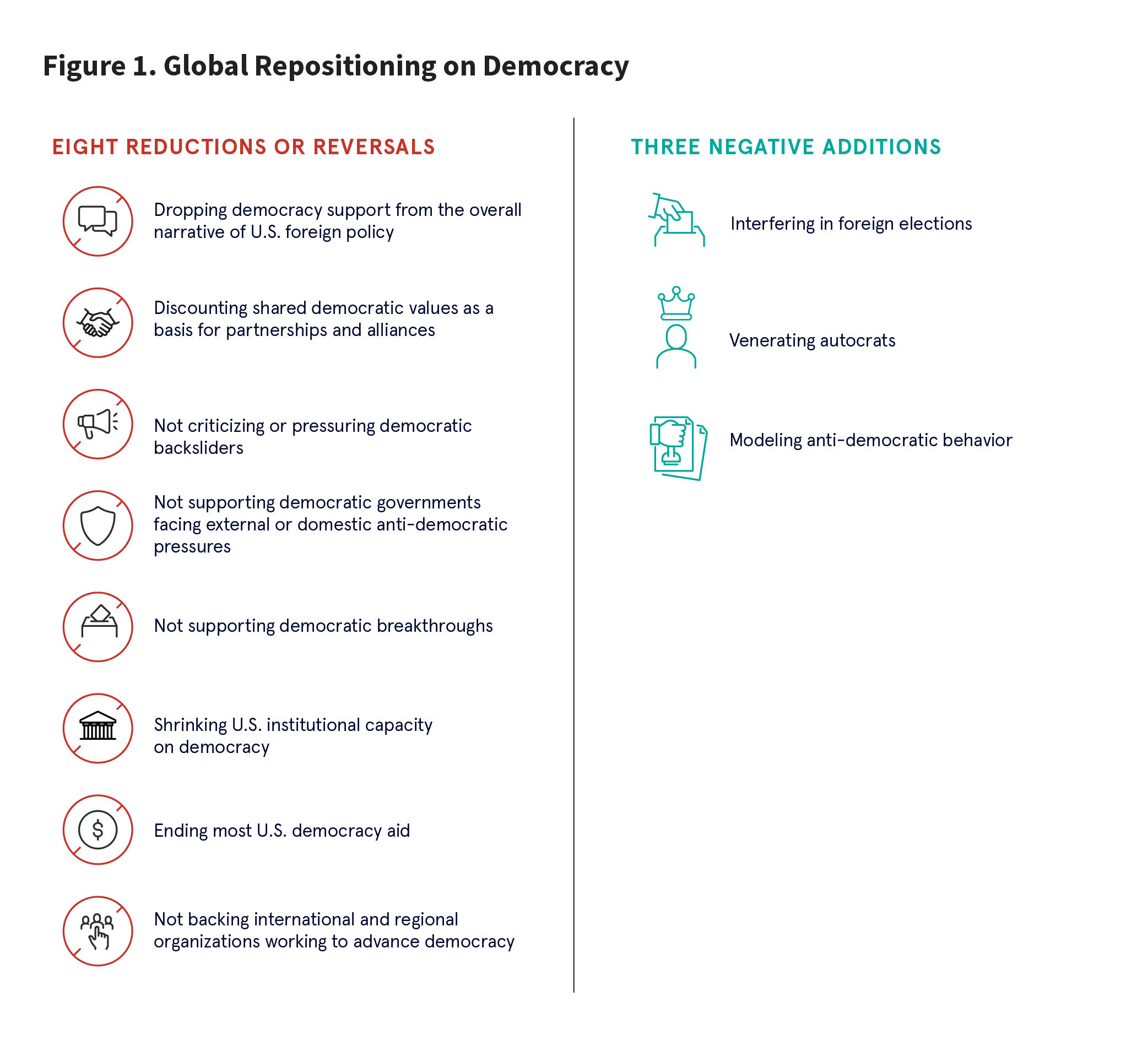
As part of their overall America First reset of America’s role in the world, President Donald Trump and his foreign policy team have turned away from a fifty-year bipartisan U.S. commitment to advancing democracy in the world. They have done so by significantly reducing or reversing eight main elements of past pro-democratic policies:
Several Trump-led policy shifts in democracy-adjacent fields are also reducing U.S. support for democracy globally, including on technology regulation, anti-corruption efforts, and economic development.
In addition to pulling away from these many long-standing areas of U.S. democracy support, the Trump administration is taking several new types of actions that actively undercut democracy abroad:
This Trump-led abandonment of the United States’ long-standing position as a supporter of global democracy comes at a pivotal time. After twenty years of democratic recession in new and old democracies alike, and ever-greater assertiveness by major autocratic powers, democracy hangs in the balance throughout the world. Although the United States was not the only force for democracy globally, it was the most powerful and influential one. The consequences of the U.S. turn away from supporting democracy around the world are starting to be widely felt and will accumulate over time. How deep the damage to democracy’s global fortunes ultimately becomes will depend greatly on how long this changed U.S. orientation lasts.
The latest in analysis and developments from Carnegie's Democracy, Conflict, and Governance Program.
President Donald Trump’s resetting of America’s relations with the world is often a chaotic, unpredictable process. Early indications that second-term Trump would ratchet up pressure on China gave way in 2026 to Trump traveling to Beijing in a cooperative frame of mind, praising Chinese President Xi Jinping in glowing terms, and deferentially telling him that “it is an honor to be your friend.”1 What initially looked like a sustained run of extremely warm relations between Trump and Israeli Prime Minister Benjamin Netanyahu hit rocky patches this year over differing views of Iran and Lebanon, such as in June 2026 when Trump called the Israeli leader “fucking crazy” in an acrimonious call between the two.2 Also in June, Trump declared that Iran’s new leaders were “very rational people” who were “nice to deal with.” Two weeks later, he characterized them as “scum” and “sick people.”3 On the first day of a NATO summit in Istanbul in July 2026, Trump excoriated leaders of other NATO countries for what he regarded as insufficient loyalty. On the second day he talked in gauzy terms of the “tremendous love” he felt while being with them.4
Yet below the level of Trump’s mercurial day-to-day perspectives and opinions, his America First foreign policy has a clear, consistent directionality, at least rhetorically: prioritizing America’s near-term economic and security interests in its engagement with other countries and using America’s military and economic power in assertive, often confrontational ways to maximize those interests, with little regard for past patterns of U.S. behavior, long-standing relations with other countries, international norms, international public opinion, or a longer-term strategic vision.
Below the level of Trump’s mercurial day-to-day perspectives and opinions, his America First foreign policy has a clear, consistent directionality.
How the administration specifically defines these short-term interests remains volatile at times, such as Trump’s frequently changing articulations of the goals of the 2026 U.S. military campaign against Iran.5 And whether the administration is in fact consistently focused on these interests, as opposed to sometimes giving significant attention to matters not related to the U.S. national interest, such as the personal business interests of Trump and his family and friends, is the subject of debate. Yet at least one part of this picture is clear: Trump and his foreign policy team do not regard protecting and advancing democracy globally as a major priority. They have pulled back from or in some cases pointedly terminated or reversed the major elements of America’s long-standing efforts to support democracy internationally. And they have adopted several new types of U.S. international engagement that lean in a pro-autocratic direction.
This repositioning of the United States vis-à-vis democracy globally is a turn away from fifty years of bipartisan policy continuity. Although each U.S. administration since those of Jimmy Carter and Ronald Reagan cast the U.S. commitment to global democracy in varying terms and pursued different specific priorities within that overall umbrella, all embraced the idea. The lofty U.S. pro-democracy rhetoric almost always outpaced policy reality, as successive administrations balanced the democracy goal inconsistently against other competing and often contradictory priorities. Yet the United States was for many decades, on the whole, a major net contributor to democracy’s global fortunes. The new U.S. stance under Trump thus represents both an enormous policy shift by the United States and a thunderclap of troubling news for democracy globally.
This Trump-led shift has attracted attention, but only sporadically when specific parts of the story have emerged.6 It has happened with such speed and improvisation, in so many different places and ways at once, that the full picture has not yet been assembled, nor its longer-term implications assessed. This paper aims to fill those gaps. It identifies and examines the many policy elements that comprise the abandonment of U.S. pro-democracy diplomacy and aid. This includes changes in the U.S. approach to autocratic powers, backsliding democracies, and democratic breakthroughs, as well as to overall foreign policy messaging, democratic alliances, pro-democracy aid, and multilateral organizations. The paper also examines several new areas of U.S. policy under Trump that cut against democracy, including the administration’s interventionism in foreign elections, veneration of autocracy, and anti-democratic political modeling. The paper considers what case the administration might or sometimes does make for being a supporter of democracy. It concludes by examining what the effects of the new U.S. stance will be on the advance or retreat of democracy around the world in the years ahead.
Over the past fifty years, successive administrations built up U.S. democracy support through an interlocking set of diplomatic and aid policies. The Trump administration has significantly weakened or abandoned all of them, through eight major policy reductions or reversals:
All U.S. presidents from Jimmy Carter through Joe Biden put forward an overall narrative of the United States as a supporter of democracy globally. In some cases, such as Ronald Reagan and George W. Bush, this was done in expansive, assertive terms; in others, such as Barack Obama, more cautiously. As mentioned above, U.S. pro-democratic rhetoric often outstripped the realities of U.S. policy in practice. Yet this rhetorical positioning was nevertheless a meaningful signaling of overall intent, and a globally recognized throughline in U.S. foreign policy. It created global expectations about where the United States stands internationally and represented an overarching orientation which many people within the U.S. government across successive administrations used to design and implement specific pro-democracy policies and programs.
The Trump administration has ended this. It does not include democracy support in its general statements of U.S. foreign policy goals. For example, unlike national security strategies from prior administrations, Trump’s 2025 National Security Strategy does not include reference to U.S. support for democracy abroad, and specifically notes that the administration is seeking good relations with other countries “without imposing on them democratic or other social change.”7 The only exceptions in that document are a statement of concern about the state of democracy in Europe and the danger of “civilizational erasure” stemming from European policies on migration and regulation of free speech, and a statement of optimism about “the growing influence of patriotic European parties” that oppose those policies.8 In his own many declarations and messages, Donald Trump does not express any interest in or concern for the state of democracy in the world and does not say that he or his administration supports democracy. As discussed at greater length below, he has replaced this positioning with frequent statements of admiration and support for autocratic leaders, and for their methods of autocratic governance.
A linchpin of U.S. security policy since World War Two has been a set of partnerships and alliances with fellow democracies in which shared democratic values serve as a foundation for a high degree of trust, which has helped make these ties unusually stable and deep. The initial circle of these partners and allies included the democracies of Western Europe as well as Australia, Canada, Japan, and New Zealand. As other democracies emerged during democracy’s Third Wave, this circle expanded to include the Baltic states, multiple countries in Central and Eastern Europe, and more democracies in Asia. Trump’s America First approach to other countries fundamentally resets this approach. The administration assesses alliances, partnerships, and friendships with other countries, primarily, and often exclusively, on the basis of what they can do in the near term for U.S. security and economic interests. The administration discounts the importance of shared democratic values in U.S. relations with other countries, or disparages it openly, such as when Secretary of Defense Pete Hegseth declared during a trip to Asia in May 2026, that “the bedrock of a durable partnership is not based on idealistic values.”9
A significant element of the global democratic recession of the past twenty years has been the dismantling of democratic institutions and processes by democratically elected leaders. Prior U.S. administrations used diplomatic and economic carrots and sticks to try to stop or slow at least some of these leaders from going down the path of democratic erosion. The partial U.S. cold shoulder toward Turkish President Recep Tayyip Erdoğan after he intensified his autocratic drive in the mid-2010s was one example. The current Trump administration has changed course. When Erdoğan escalated his anti-democratic drive last year through the detention and prosecution for alleged fraud of his main political rival, Ekrem İmamoğlu, the U.S. administration did not raise any objection. Similarly, when El Salvador’s strongman, President Nayib Bukele, took a significant autocratizing step last year by guiding his legislature to modify the constitution and allow him to rule indefinitely, the administration’s response was neutral, or in some interpretations positive.10
The 2025 directive by Secretary of State Marco Rubio telling State Department staff they “should avoid opining on the fairness or integrity of an electoral process, its legitimacy, or the democratic values of the country in question” highlights the administration’s diminished inclination to challenge backsliding leaders.11 Manipulating and undercutting electoral processes is a common tactic of such leaders, and criticizing such steps was for decades a major element of U.S. democracy support in such contexts.
Bolstering democratic governments that were subject to attack or pressure by autocratic powers—principally the Soviet Union and China during the Cold War, and Russia and China in recent decades—was a vital component of U.S. pro-democratic policy across the decades. The Trump administration shows significantly less attachment to this imperative, particularly with regard to Russia’s assault on Ukraine. Trump has also provoked at least some doubts about his commitment to Taiwan’s security.
Although Trump’s policy toward Ukraine has not always been clear or consistent, overall it has involved a reduction of support for the country in its war against Russia. This has entailed pausing military aid and intelligence sharing at various times; not pursuing any new military aid for Ukraine; terminating or significantly reducing non-military aid to Ukraine, such as for health, infrastructure, humanitarian needs, and education; not standing up for Ukraine diplomatically, publicly, or in relevant international forums; and often talking in relatively positive terms about Vladimir Putin.12 It has also meant no efforts to increase economic sanctions on Russia, with one exception in October 2025, and several pauses in or weakening of existing economic measures.13 In July 2026, Trump suddenly seemed to be leaning toward providing more help to Ukraine, stating he was planning to grant Ukraine a license to build Patriot missiles domestically. But he reversed course within the month.14
On Taiwan, the administration has officially maintained the same line of nuanced but significant U.S. support as prior administrations. Yet Trump’s overall shift in 2026 from his relatively hawkish earlier stance on China toward an open search for new forms of Washington-Beijing cooperation has caused some observers to ask if he is softening the U.S. commitment to Taiwan’s security. This question arose after a May 2026 interview in which Trump appeared to accept Beijing’s view of who is to blame for tensions in the Taiwan Strait and to signal that he is willing to negotiate with Beijing about a planned $14 billion weapons package for Taiwan.15
Similarly, the Trump administration has shown diminished interest in helping governments beat back domestic threats to democracies. For example, the administration did not just walk away from prior U.S. efforts to support Brazilian democracy against anti-democratic pressures, which included steps by the Biden administration to head off a possible coup by elements of the Brazilian military sympathetic to Jair Bolsonaro in the lead up to the 2022 election pitting Bolsonaro against Luiz Inácio Lula da Silva. Trump’s administration actually punished Brazil for the successful conviction of Bolsonaro on charges of coup-plotting, imposing high tariffs against the country in response.16 In Guatemala, the administration appears to be moving away from the earlier line set out by the Biden administration to support the government of President Bernardo Arévalo against illiberal forces on the right, as part of its wider embrace of right-wing political actors around the region.17
Despite the negative overall tide of democracy globally, some positive developments have also taken place in recent years, including some pro-democratic breakthroughs. These have usually come through turnaround elections, sometimes preceded by major pro-democratic protests that put democratically challenged governments on the ropes. Prior administrations have sought to support these breakthroughs, usually through a combination of diplomatic support, economic aid to help new pro-democratic governments deliver positive changes, and democracy aid to bolster domestic political reforms. The United States Agency for International Development (USAID) created the Office of Transition Initiatives in 1994, for example, to furnish short-term aid in fast-moving contexts of political transition. The Biden administration built on this pattern through its Democracy Delivers Initiative for countries turning a democratic corner. Although the Biden team struggled to add meat to that bone, it did extend extra economic support to some democratizing governments, such as those in Armenia, Ecuador, and Moldova.18 There is little sign of any similar commitment on the part of the Trump administration. The drastic reduction in U.S. foreign aid has meant much less aid for some post-breakthrough governments, such as in Bangladesh, Nepal, and Syria. The administration has not made any effort to help extend diplomatic or economic support to the new government in Hungary that is seeking to rebuild Hungarian democracy after the many years of erosion under the rule of Viktor Orbán and his Fidesz party.
The drastic reduction in U.S. foreign aid has meant much less aid for some post-breakthrough governments, such as in Bangladesh, Nepal, and Syria.
In parallel with developing multiple lines of diplomatic and economic engagement to support democracy globally, successive U.S. administrations built up institutional capacity within the government to plan and implement such policies and programs, and to advocate for democratic causes in policy deliberations, especially at the White House, the State Department, and USAID. The Trump administration has eliminated or significantly weakened the three main legs of this capacity. It eliminated the NSC directorate devoted to democracy and human rights, as part of its overall radical shrinking of the NSC staff. It has seriously degraded the State Department’s Bureau of Democracy, Human Rights, and Labor, letting go of a significant share of its staff and reorienting its mission away from democracy support to supporting right-wing political forces in Europe and other issues supported by the Make America Great Again movement that forms Trump’s political base.19 And as part of its overall demolition of USAID, his administration disbanded the Bureau for Democracy, Human Rights, and Governance at USAID, which had served as a source of ideas and advocacy on democracy within the interagency policymaking process.
The Trump administration has gone well beyond not employing democracy aid in various specific contexts mentioned above—such as to help new, reformist governments emerging from democratic breakthroughs—to mounting a frontal assault on the entire U.S. practice and capacity for such aid.
Beginning with the establishment of the National Endowment for Democracy (NED) in 1983 and then continuing through the creation and substantial growth over the decades of democracy aid programs administered by USAID and the State Department, the United States became not only the largest provider of democracy aid globally, but a model for many other democracies to develop their own programs of democracy aid. In the space of less than six months after Trump returned to power, his new administration eliminated close to 90 percent of U.S. democracy aid.20 By closing USAID, it shut off the largest source of such support. As part of its restructuring of the State Department’s democracy bureau, it largely dismantled the second main pillar of democracy aid. This decimation of a body of aid practice rooted in more than forty years of experience and bipartisan continuity was not a side effect of the administration’s larger devastation of the U.S. aid landscape. It was a targeted action in which the administration specifically went after democracy aid, viewing it as a cover for advancing “woke” values, like gender equality and sociopolitical inclusiveness, and being hostile to some friendly right-leaning governments.21
Thanks to continued congressional support, the NED has survived the Trump attack on democracy aid, including repeated efforts by the administration to zero out its budget. Valuable though the continued work of the NED is, it represents only around 10 percent of pre-2025 U.S. democracy aid.
This drastic reduction in U.S. democracy aid has meant a sudden cutting off of funding for innumerable pro-democratic activities in many countries around the world, including in fully autocratic countries, backsliding countries, shaky democracies struggling to hold on in the face of rising pressures, and turnaround countries seeking to consolidate new democratic gains.22 This funding has traditionally supported three overarching goals: (1) bolstering freer and fairer elections, both through capacity building of electoral management bodies and domestic election monitoring; (2) enhancing democratic institutional capacity, especially relating to the rule of law, parliamentary capacity, and local government strengthening; and (3) helping civil society survive, or where possible thrive, including human rights defenders, media free from government control, anti-corruption watchdogs, and community-based organizations. Although some other providers of democracy aid, like major European governments, have been trying to make up for some of the lost U.S. assistance, the amount of aid lost exponentially exceeds their capacity to compensate for it.23 Alongside all these cuts, the Trump administration has also sought to eliminate or drastically reduce U.S. global broadcasting, which has long been an additional way in which the United States promotes democratic values abroad. In 2025, the administration issued an executive order mandating the elimination of the U.S. Agency for Global Media and has undertaken a relentless effort to close Voice of America, a mainstay among the stable of broadcasters overseen by that agency.24
A vital part of the international democracy community over the years has been the growth of support from international and regional organizations, usually via diplomatic engagement, aid programming, and norm-building. Before 2025, the United States was the leading supporter of this growth, through a combination of diplomatic advocacy and financial support, often well-coordinated with democratic allies, across countless public international forums and processes. The Trump administration has taken a hatchet to this element of U.S. democracy support as well.
For example, the Trump administration has withdrawn from the UN Human Rights Council, the Universal Periodic Review (on human rights), the UN Democracy Fund (that the United States co-founded with India in 2005), the International Institute for Justice and the Rule of Law, the Open Government Partnership (which the United States helped found in 2011), and the International Institute for Democracy and Electoral Assistance (where the United States, though never a member, had become an observer in the Biden years).25 And it has reduced the U.S. contribution to the United Nations Development Programme, which is a major multilateral source of democracy aid.
On the regional organization front, the Trump administration has demanded of the Organization for Security and Cooperation in Europe that it curtail its work relating to monitoring elections and other democracy issues in its member states.26 The administration proposed reducing to zero its contribution to the Organization of American States and has pushed the organization to move away from its long-standing focus on democracy building.27 A statement by a senior State Department official about the Trump administration’s policy toward the African Union, which has given significant attention to democracy issues on the continent for many years, stressed that the administration has no interest in “lecturing on democratic norms” and instead emphasizes “respecting differences on . . . governance” and “making commercial diplomacy a top priority.”28
The above eight areas of policy reduction or reversal represent the core but certainly not the totality of how the Trump administration’s repositioning of the United States in the world bears on democracy globally. Other policy shifts, on issues not typically labeled as democracy policy per se but clearly bearing on it, are also relevant. Take the following three examples:
First, the administration’s hostility to the regulation of new technologies works against policy approaches that could help protect democracy in different ways. Rather than seek to regulate the use and dissemination of new digital surveillance technologies, for example, the administration’s decision to have the U.S. Immigration and Customs Enforcement and some other U.S. agencies use these technologies emulates the digital repression tactics wielded by autocratic regimes like China.29 Trump’s many attacks on the European Union’s Digital Services Act potentially undercut the value of that act for helping preserve information integrity and counter disinformation. More generally, the administration’s go-it-alone approach to global digital policy means a retreat from the previous U.S. commitment to working closely with democratic allies to preserve and advance pro-democratic principles like respecting digital sovereignty and online rights.30
Second, the administration has done an about-face on anti-corruption policies and aid, reversing a strong path of progress on anti-corruption that over the past ten to fifteen years put the United States in the forefront of combatting corruption in other countries.31 Governmental corruption in democracies corrodes accountability and alienates citizens from the political system, sometimes opening the door to anti-democratic populist alternatives, such as Bolsonaro’s rise in Brazil in 2018 in the wake of the country’s massive corruption scandals. Corruption in autocratizing countries centralizes power further and empowers dark elements, like criminal groups with loose ties to the state, that are often used for undemocratic purposes. Thus, the greatly reduced U.S. role in fighting corruption has negative spillover effects on democracy abroad (and domestically).
Third, although there is no simple straight line between economic development and democratic development, the overall improvement in economic conditions of many countries in the Global South in the past fifty years contributed to the overall rise of democracy in them. The administration’s vastly diminished commitment to economic development assistance to other countries may thus have negative long-term effects on democracy around the world. More specifically, core elements of the traditional development aid agenda, like advancing education, improving health, and reducing economic marginalization, promote values like inclusivity, fairness, and citizen participation that align with and often undergird democratic politics. In addition, the hollowing out of U.S. development aid weakens one of the economic “carrots” that the United States was long able to use to support and reward democratic reformers that come to power.
A large share of Trump’s repositioning the United States on global democracy consists of no longer doing things that the United States used to do—walking away from the policies and aid that supported democracy. But it also entails several stepped-up actions particular to the second Trump presidency that actively undercut democracy. These include overtly interfering in foreign elections, repeatedly holding up autocrats as desirable political figures, and relentlessly modeling anti-democratic behavior within the United States.
Trump and his team openly interfere in other countries’ elections with some frequency, intervening on behalf of particular candidates or parties in the hope of increasing their chances of winning. Most of this interference has been directed at elections in Europe and Latin America, two regions where politics tracks along a clearly identifiable left-right axis (unlike the politics of many African, Asian, and Middle Eastern countries). The Trump team believes that supporting candidates on the right helps advance their interests in those countries and boosts the overall cause of MAGA politics globally.32
In the majority of such cases, interference takes the form of written or spoken statements of support. Trump usually issues his endorsements on his Truth Social account, often formulated as his “COMPLETE AND TOTAL ENDORSEMENT.” Since January 2025, he has endorsed, among others, Nasfry Asfura in Honduras’s November 2025 election, Takaichi Sanae in Japan’s February 2026 election, Orbán in Hungary’s April 2026 election, and Abelardo de la Espriella in Columbia’s June 2026 election. Members of Trump’s team have also made statements of support for candidates in foreign elections. During a trip to Poland a week before its May 2025 presidential run-off election, then U.S. homeland security secretary Kristi Noem urged Poles to vote for Karol Nawrocki, the conservative candidate, and disparaged his opponent.33 In the week before Hungary’s April 2026 election, Vice President JD Vance traveled to Budapest where he made multiple strong statements of support for Orbán, including beseeching Hungarians to vote for him in order “to stand for Western civilization.”34
At least in some cases, however, the interference goes beyond statements to include diplomatic or economic carrots and sticks. The administration gave a White House visit to Karol Nawrocki in the lead up to the Poland’s May 2025 elections, a valuable gift to the candidate given the Polish electorate’s strong pro-America orientation.35 Shortly before Argentina’s October 2025 legislative elections, Trump declared that his promise of a $20 billion currency swap for the country was conditional on the elections coming out in favor of Trump favorite Javier Milei.36 In the lead up to Honduras’s presidential election in November 2025, Trump said that U.S. financial aid to Honduras might be suspended if the conservative contender, Nasry Asfura, did not come out on top.37
The United States has certainly interfered in other countries’ elections before. During the Cold War, the United States gained global notoriety for trying to sway elections through covert means against left-wing candidates or parties in favor of anti-communist leaders. Since the end of the Cold War, different administrations have sometimes tried to influence elections abroad, such as the George W. Bush administration using economic aid measures in Palestine to support the Fatah party in its 2006 electoral contest against Hamas.38 But Trump and his team are interfering much more frequently, openly, and assertively than any administration of recent decades, arguing that it is natural for them to express their preferences for candidates they like. When Trump was asked in an interview in December 2025 about his endorsements of candidates in foreign elections, he treated it as a normal thing for him to do.39 Vance repeated this idea when asked about his pro-Orbán intervention in the Hungarian election, stating that “it was the right thing to do to stand behind a person who had stood by us for a very long time.”40
Trump and his team are interfering much more frequently, openly, and assertively than any administration of recent decades, arguing that it is natural for them to express their preferences for candidates they like.
This interference works against democracy and for autocracy in two ways. First, in some cases, the administration is backing candidates, like Orbán, who have clearly illiberal or even openly anti-democratic qualities. Helping them get into power or maintain power thus potentially contributes to democratic decline in these countries. While the record of success of the Trump interventions is mixed, in some cases, like Poland and Argentina, a plausible case can be made that the U.S. thumb on the scale meaningfully contributed to the outcome the administration sought.
The more important negative effect stems from the damage this interference does to election integrity. Routinely intervening in elections in other countries undercuts the credibility of elections globally at a time when this credibility is badly needed as a bulwark against further backsliding. It undermines the global norm of external non-interference in elections, a norm crucial for election integrity. It effectively declares open season for powerful international actors to try to shape the outcome of other countries’ elections—effectively putting the United States on the same plane with Russia and other autocratic powers that have been stepping up interference in others’ elections in recent years.
Trump regularly venerates autocrats, or leaders with strong illiberal tendencies. He praises them fulsomely, expressing deep admiration, even love for them. Based on his public statements, his favorite current or former leaders worldwide are Bukele, Erdoğan, Milei, Netanyahu, Orbán, Putin, and Xi, along with North Korea’s Kim Jong Un and Saudi Arabia’s Mohammed bin Salman. To cite just two of countless examples of such statements, when he met with Xi in Beijing in May 2026, as part of a deferential stance toward the Chinese leader, he stated that “it’s an honor to be your friend.”41 And in his remarks after the first day of the NATO summit in Ankara in July 2026, Trump talked about a broad range of leaders, criticizing various democratic allies while singling out for praise only Erdoğan, Netanyahu, and Xi.42
U.S. presidents have long praised undemocratic leaders of other countries, especially in contexts of bilateral meetings with such leaders during a visit or summit meeting. But at least in the past several decades, such praise is typically connected with the benefits those leaders are giving the United States regarding specific strategic or economic interests, not for their governing methods. In contrast, Trump comes back again and again to his admiration for how these leaders rule their countries, for their being “strong.”43 It is their autocratic, or illiberal, nature that attracts him much more than their helpfulness to the United States. Democratic leaders, especially European democratic leaders, only sporadically come in for praise from Trump, almost never for their democratic qualities, and he often excoriates them for what he believes to be their weakness.
Trump has criticized a few undemocratic leaders, such as those of Iran and Venezuela (prior to the U.S. intervention there), that have long been seen as U.S. adversaries. But if they show themselves willing to bend to his wishes, he is quick to praise them for being “very reasonable.”44
Trump’s frequent, widely publicized veneration of autocrats sends a powerful global message about political norms: The leader of the most powerful country in the world admires autocracy and believes it is a key source of national strength. The global forces of autocracy could hardly wish for better rhetorical support.
Trump and his administration’s undemocratic behavior radiates out globally, serving as a model and a cover for other similarly inclined leaders. Key pillars of this behavior include: attacking the media in response to adverse coverage and elevating partisan media; attacking judges who rule against the administration; questioning the overall idea of judicial constraint on executive action; punishing independent organizations that refuse to comply with administration demands for political conformity; seeking retribution against former officials associated with policies Trump dislikes; engaging in systemic corruption that enriches Trump and his family; and calling into doubt unfavorable elections and politicizing electoral administration.45
Drawing direct causal lines between the Trump administration’s anti-democratic behavior and similar steps in other countries is inevitably difficult as foreign leaders do not typically specify the sources of new undemocratic steps they are taking. Nevertheless, given how influential the United States is, from cultural trends to economic innovations, and how closely many people in the world follow U.S. politics, it seems very likely that the assertive, relentless anti-democratic behavior on the part of a publicity driven U.S. president is having modeling effects on other leaders with similar political inclinations. As a New York Times headline put in in 2025, “Trump Inspires Wannabe Authoritarians Everywhere.”46 There are many specific indicative cases, a small sampling of which includes the following:
With regard to attacks on media, in July 2025, the New York Times reported on a “pattern of escalating attacks against journalists by the right-wing libertarian” President Javier Milei of Argentina, such as using the X social media platform to personally attack journalists—including “posting at least 65 messages that targeted the journalist, Julia Mengolini, a radio host who has been critical of his government.” Milei used the slogan “We don’t hate journalists enough,” emulating “language popular among supporters of President Trump, whom the Argentine president likes to fashion himself after.”47
After the Trump administration halted U.S. assistance for media abroad in 2025, Serbian President Aleksandar Vučić ramped up his assault on its domestic independent media. According to Reporters Without Borders, the government was “emboldened by Donald Trump’s toxic rhetoric” to step up its attacks, including through police raids and accusations of foreign influence tied to USAID.48
Trump’s disregard for judicial constraints has had strong echoes in Israel. After Netanyahu’s heightened efforts to tame the judiciary in March 2025, the New York Times reported that “Netanyahu no longer needs to contend with Mr. Biden’s opposition to a long-planned overhaul of the courts, which many Israelis view as an attempt to control and politicize the judiciary.” That month, Netanyahu’s allies held a vote of no confidence against Israel’s attorney general and, in the legislature, “voted to give themselves more power over the selection of Israel’s judges. The vote came after the prime minister gave a speech echoing Mr. Trump and saying that the action meant that ‘the deep state is in danger.’”49
Foreign leaders have picked up on several of the specific tactics employed by the Trump administration to launch their own attacks on civil society.
Foreign leaders have picked up on several of the specific tactics employed by the Trump administration to launch their own attacks on civil society. For example, then Hungarian prime minister Viktor Orbán announced in September 2025 that he would also designate antifa a “terrorist organization,” following Trump’s model. And he used the Trump administration’s demonization of USAID to justify his own crackdown on and funding cuts for civil society organizations in Hungary, after praising “Trump’s slash of funding, claiming such aid had been used to fund organisations that sought to ‘topple’ his government.”50
In Azerbaijan, President Ilham Aliyev was emboldened by the Trump administration in his government’s own crackdown on civil society organizations. He “seized the opportunity to tighten his grip on power by shuttering aid and development groups” at what analysts called: “Perfect timing for Aliyev when no one is able to criticise him.”51
Milei’s verbal attacks against political opponents employ language similar to Trump’s own style of personal attacks: “Milei has labeled economists who question his policies ‘econochantas’ (‘economic quacks’), trade unionists ‘garcas’ (‘crooks’) and political opponents are ‘mandrills’ (a type of monkey), ‘rats’ and ‘parasites.’”52 In a March 2026 speech in which he spoke about his friendship with Trump and called to “create the century of the Americas” and “Make Americas Great Again,” he also shouted “at opposition lawmakers, who he described as ‘thieves,’ ‘murderers’ and ‘ignorant.’” His style and substance appeared to be inspired at least in part by Trump’s tactics and intolerance for the opposition.53
Regarding attacks on unfavorable elections, in May 2025, far-right Romanian candidate and avowed Trump supporter George Simion used very similar language to Trump to try to claim that the Romanian presidential election, which he had lost, had been fraudulent. He claimed that “there was vote buying” and that “dead people voted,” among other arguments.54 Simion during this time also stated that he was “perfectly aligned with the MAGA movement.”55
Trump’s comments about a possible third term for himself may have contributed to the decision by Salvadoran President Nayib Bukele and his allies amending the constitution to eliminate term limits and permit Bukele to run for a third term.56
Although the Trump administration does not make general statements about its policies relating to democracy globally, it is likely that at least some senior administration officials, particularly Rubio, would, if asked, make the case that they are supporting democracy in the world in multiple ways.
They might point, for example, to Trump policy relating to Latin America, specifically, the removal of Nicolás Maduro as president of Venezuela and the severe economic pressure they are exerting on Cuba’s autocratic government. Venezuela offers a complex, ambiguous picture. The removal of Maduro represents a meaningful change in a political situation that was deeply stuck in an authoritarian mold. Yet it is not clear whether the new political equilibrium centered around the leadership of Delcy Rodríguez will stabilize in its current configuration of softened autocracy combined with some economic reform, or lead to significant political liberalization, or even democratization, over time. Nor is it clear whether the Trump administration has any serious interest in Venezuela beyond gaining access to the country’s oil. Rubio has at times expressed an interest in pushing for deeper, longer-term political change. Yet Trump appears to be setting the larger direction of travel for U.S. engagement in the country and is highly attached to Rodríguez, a leader with no democratic background and no visible democratic intentions.57 The administration’s sidelining of opposition leader María Corina Machado in favor of Rodriguez’s continued rule underlines for some observers the administration’s doubtful interest in a democratic transition.58
Regarding Cuba, the U.S. blockade against oil supplies to the country has created severe economic pressure on the government. Trump stated in March 2026 that “I do believe I’ll be . . . having the honor of taking Cuba.”59 It is not clear whether the pressure will succeed in causing the government to fall, and if it doesn’t, what more the Trump administration will do. It is also uncertain whether the Trump administration might end up accepting a limited form of political change that falls short of a democratic opening, as long as it is accompanied by an opening to U.S. businesses interested in entering Cuba, in a version of what the administration has pursued thus far in Venezuela.
One other autocratic country where the administration has at least said it seeks to encourage democratic change is Iran, where at the start of the U.S. military action against the country in February 2026, Trump called for Iranians to take advantage of the moment to “take over your government.”60 Yet this was not a carefully planned strategy and ran immediately up against the predictable rallying around effect that the U.S. attack produced vis-à-vis Iranian citizens and their government, and the fact that after the massacre of thousands of Iranians during the protests two months before, the ability and inclination of Iranians to mount further large protests was greatly diminished. Trump quickly abandoned that objective as the war proceeded and became focused on achieving a negotiated accord with the new Iranian leaders relating to the Strait of Hormuz and Iran’s nuclear program.
The Trump administration sees itself as intervening on behalf of democracy in Europe. Trump and senior members of his administration have criticized and in some cases sought to punish various European governments and institutions for technology regulations they see as limiting free speech in Europe, and for some practices limiting the role of far-right parties in government coalitions.61 From the MAGA perspective, this U.S. engagement on speech issues in Europe is one part of a broader Trump administration goal to stave off “civilizational erasure” in Europe, and thus save European democracy. This is to be achieved by promoting parties of the far right that favor strict limits on immigration and conservative social values.62 European governments targeted by these U.S. actions view them as political interference relating to policy choices that are their prerogative, and thus a violation of their democratic sovereignty, not in any sense democracy support.
As part of their reconfiguration of the U.S. role in the world in line with a sweeping America First imperative, Trump and his foreign policy team have fundamentally repositioned the United States vis-à-vis democracy globally. They have walked away from or terminated most of the long-established elements of pro-democracy diplomacy and aid while introducing several new forms of global political engagement that work against democracy. Through these actions they have moved the United States into a neutral or sometimes pro-autocratic position in the fraught global contest between autocracy and democracy. Moreover, the U.S. repositioning means that for the first time in modern history, none of the top international powers is committed to supporting democracy beyond its borders—the overall balance of global geostrategic power now leans distinctly in the pro-autocratic direction.
This shift takes place at an especially significant moment for democracy. As has been amply documented and widely discussed, democracy has been in retreat globally for twenty years.63 More than a few observers worry that this long negative run means that democracy is in fundamental global decline. Yet at the same time, pro-democratic turnarounds have been increasing in recent years, usually driven by citizens determined to have a genuine political voice.64 Democracy is very much hanging in the balance globally.
Of course, the fate of democracy does not depend exclusively or even primarily on the United States, or international factors generally. Democracy in every country is a domestic story first and foremost. Countries can make notable democratic progress, even in the case of significant adverse international pressure. This was demonstrated recently by Hungary, where the United States, Russia, and China all strongly favored a continuation of the anti-democratic rule of Orbán, but Hungarian citizens still chose a pro-democratic path. In addition, despite the disappearance of a strong democracy champion among the superpowers, there remains an important community of international democracy supporters, made up of numerous democratic governments, pro-democracy foundations and institutes, transnational and domestic civic groups and multilateral organizations. It is a dazed and wounded community, struggling to adjust to the loss of the United States as its largest, most powerful member, but it is still active in many places.
Nevertheless, the U.S. repositioning means many damaging things for democracy in the world: less pushback against Russia and China in their pro-autocratic ambitions; a weakening of the Western alliances rooted in shared democratic values; less pressure on backsliding leaders around the world to limit their anti-democratic moves; less support for countries that have achieved a pro-democratic breakthrough and are trying to rebuild democracy; a weakened set of international organizations supporting democracy; and much less financial and diplomatic support for thousands of organizations and people working in small but impactful ways all around the world to support democracy.
The effects will be numerous, often iterative forms of setback and decay across the broad democratic landscape. They will often be hard to see initially, and it will be difficult to trace their precise causes. But given that democracy is on a knife’s edge in so many places, the removal of U.S. pro-democratic diplomatic engagement and aid for democracy will undoubtedly weaken democracy’s already troubled global fortunes in meaningful ways. How consequential this weakening will be over time will depend greatly on how long the new U.S. policy stance lasts. If it ends up as a long-term turn for the United States, the effects will almost certainly become a serious drag on democracy around the world. If it proves to be relatively short-lived, the damage will be less deep though still very real.
The author thanks McKenzie Carrier for research support and Frances Brown and Steve Feldstein for helpful comments on a draft.

Harvey V. Fineberg Chair for Democracy Studies; Senior Fellow, Democracy, Conflict, and Governance Program
Thomas Carothers, a senior fellow in the Carnegie Endowment for International Peace’s Democracy, Conflict, and Governance Program, is a leading expert on comparative democratization and international support for democracy.
Recent Work
Thomas Carothers
Thomas Carothers
Carnegie does not take institutional positions on public policy issues; the views represented herein are those of the author(s) and do not necessarily reflect the views of Carnegie, its staff, or its trustees.
Experts from throughout Carnegie’s global network assess the stark humanitarian toll, the regional ramifications, and the diplomatic challenges posed by the Taliban’s takeover of Afghanistan.


Saskia Brechenmacher, Rudra Chaudhuri, Ryan Crocker, …
American democracy has been deeply damaged by a president’s refusal to concede power and his supporters’ use of violence and intimidation to pressure political officials—problems fueled by polarization and an antidemocratic faction of the Republican Party. Here’s where the fault lines come from—and how to begin patching them.

Rachel Kleinfeld
Despite a checkered past record, U.S. programs to promote democracy abroad should not be equated with systemic Russian attempts to interfere with other nations’ politics.
Thomas Carothers
Based on the data, policymakers and practitioners need to ask hard questions about whether the terrorist threat justifies a continuing U.S. military buildup in Africa.

Steve Feldstein
U.S. democracy policy is under severe strain, but writing off the United States as a key supporter of global democracy is premature.
Thomas Carothers