

Paper
James L. Schoff, Douglas E. Rake, Joshua Levy
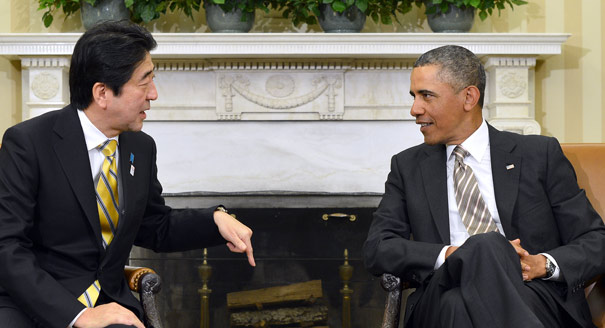
Source: Getty
Obama and Abe need to privately hammer out a coordinated response to a possible skirmish between Japan and China over the Senkaku/Diaoyu Islands.
U.S. President Barack Obama is preparing for his first trip to Japan in nearly three and a half years. The late April summit meeting with Japanese Prime Minister Shinzo Abe will cover a great deal of pressing business and attract media attention. But the most important private conversation these allied leaders can have this month is about a possible skirmish between Japan and China over the Senkaku (or Diaoyu, in Chinese) Islands in the East China Sea.
Conflict is not likely, but it is possible. And if it occurs, the U.S.-Japan alliance will face its toughest test in a fifty-four-year history. The only way to pass that test—and perhaps even avoid it—is for U.S. and Japanese leaders to personally develop a compatible vision for a coordinated response.
The public aspects of Obama’s Japan visit will dwell on economics and alliance modernization. Both countries are striving to bolster their economies, cope with an unpredictable and missile-happy North Korea, and manage potentially destabilizing global developments involving Russia, Iran, and Syria.
Notably, multilateral talks aimed at liberalizing trade in the region under the Trans-Pacific Partnership (TPP) initiative—a key component of the Obama administration’s rebalance to Asia—have stalled. This topic, the most politically sensitive, is particularly deserving of presidential attention given the transformative role it can play regarding U.S. engagement in Asia. The two leaders will invest a considerable amount of time in this issue, but a significant breakthrough will be difficult to achieve in the near term.The United States and Japan are also in the middle of a historic project of revising their bilateral guidelines for defense cooperation, a process that will eventually require top leadership input and approval but that is not even halfway complete. This particular meeting can only provide broad guidance to the negotiators. Other summit topics include the realignment of U.S. military bases in Japan, energy cooperation, and the promotion of new bilateral efforts to better coordinate overseas development aid.
Amid all of this, the area in which there is no substitute for personal leadership attention is the admittedly small chance that China and Japan could slip into a military conflict over the Senkaku Islands. A frank conversation about how Washington and Tokyo would approach this situation is a much-needed ounce of prevention that can make the difference between a response that is well-coordinated and reassuring or confused and destabilizing.
The Senkaku Islands themselves are relatively insignificant—only about 7 square kilometers (2.7 square miles) of land, no people, and modest exploitable resources—but they have become the focal point of a geostrategic struggle between Japan and China in the East China Sea, with important implications for the United States.
The islands fell under U.S. administrative control along with the rest of Japan’s Okinawa Prefecture after World War II, and for a time U.S. forces had firing ranges on them and paid rent to a Japanese owner. When the United States returned Okinawa to Japan in 1971, administration of the Senkakus transferred as well, even as U.S. officials noted the competing claims by China and Taiwan and refrained from taking sides on the historical sovereignty question.
However, because the United States officially recognizes Japan’s sole administration of the islands, it has pledged to “act [with Tokyo] to meet the common danger” if Japan were to come under some kind of attack there, as described in the bilateral security treaty. U.S. Secretary of Defense Chuck Hagel reconfirmed this point in early April in Tokyo. Lamentably, China continues to challenge Japan’s administrative control, increasing the risk of military conflict.
China does not seem to actually want a military conflict with Japan over the islands, but it is intent on trying to establish its own administrative control and thus intimidate and pressure Japan to acknowledge the territorial dispute and open up bilateral talks. Beijing pursues this aim by regularly sending Chinese coast guard vessels into the territorial waters around the Senkakus, while its navy ships loiter over the horizon. This cat-and-mouse game has gone on ever since Japan’s government bought some of the islands from a Japanese citizen in late 2012. It led to nearly 200 incursions by Chinese vessels into Senkaku territorial waters in 2013, compared to two in 2011 and none in 2010. China has supplemented this maritime pressure by flying surveillance aircraft close to the islands, contributing to a record number of air-defense scrambles by Japanese fighter jets in the area (more than 300 in 2013).
Both sides pledge caution and vow to manage escalation. But the situation has already led to accusations by Japan that the Chinese navy’s fire-control radar “locked on” to Japanese targets, suggesting intent to attack and risking preemptive return fire by Japan. In recent months, some respected Japanese defense analysts have called on authorities to prepare to “retake” the islands if Chinese forces (or fishermen) try to land there.
If a conflict did erupt—intentional or accidental, large or small—Japan would have the initial frontline responsibility for defending itself and the islands, but the incident would trigger immediate alliance consultations regarding what form of U.S. involvement is desired and appropriate. While a U.S. ally usually wants to showcase U.S. support and firepower early and often in a crisis for its deterrent effect, U.S. officials might worry that this could seem escalatory to Beijing or contribute to Japanese overconfidence and tempt Tokyo to make excessive demands. If Washington is too careful and equivocal, however, it could lead to a Chinese miscalculation that the allies are not willing or able to defend their position, perhaps causing Beijing to gamble on a Senkaku takeover or otherwise sharper military conflict.
The worst situation would have the United States appearing to hold back Japan from defending itself or urging it to concede, which would no doubt create serious cracks in the oft-cited alliance “cornerstone” for U.S. security policy in the Asia-Pacific. Japanese confidence in U.S. security commitments would plummet, and the same effect would echo in Seoul and Manila.
Clearly, U.S. political and operational support for Japan will be required in such a crisis. But the U.S. president and the Japanese prime minister must strike the right balance between resolve and restraint, and this can only come from mutual understanding and clear communication. Any misunderstanding at the highest levels could have serious adverse consequences for the alliance.
The United States faced a similar situation in 2010 when North Korea shelled the Republic of Korea’s Yeonpyeong Island, killing four South Koreans and wounding nineteen. The two sides traded fire until Seoul threatened “enormous retaliation” if the North continued and North Korean officials responded by insinuating they might use nuclear weapons if the South escalated. All the while, the U.S. and South Korean governments coordinated closely and calibrated their public statements, the proper amount of overt U.S. military support, and some less visible preparations in case the conflict did escalate.
Though the allies managed this incident in Korea reasonably well, it was difficult, even for an alliance designed for warfighting. It also prompted Seoul and Washington to seek alliance improvements by negotiating an official “counterprovocation plan” to clarify response parameters, responsibilities, and communication channels.
In contrast, the U.S.-Japan alliance has virtually no experience responding jointly to a military crisis with Japan in the lead. What’s more, the political, diplomatic, and economic stakes with China are much higher and more complex than with North Korea. Further complicating matters is Japan’s establishment earlier this year of a new National Security Council and crisis management structure, which necessitates the shaping of new patterns of crisis communication and coordinated decisionmaking. Any military conflict between Japan and China would sorely test the current U.S.-Japan alliance.
To move forward, the first priority is to seek practical ways to reduce Japan-China tensions over the Senkakus. This will certainly be a part of Obama and Abe’s summit agenda. Moreover, Obama will impress upon Abe the strategic value of curbing his cabinet’s tendency to push a revisionist historical narrative that downplays the regional suffering caused by Japan’s past imperialism. China portrays such self-righteous nationalist sentiment as a political provocation deserving of Beijing’s pushback on the Senkaku issue, and it undermines allied efforts to promote regional security cooperation. But Obama should be clear that U.S. treaty commitments are not affected by the history debate or China’s anti-Japan public relations campaign. Physical and political provocations are not equivalent.
The question of how to respond to Chinese physical provocations should be the subject of a private Obama-Abe conversation. The point is not to treat China like North Korea or suggest that a formal counterprovocation plan is required at this time. But the two leaders should deliberately sketch out a basic framework or principles to guide their response and cooperation during a potential crisis involving China. Ideally, Japan would clearly be on the front lines in defense of the Senkakus and accordingly assume the primary risk so that it is never a question of whether the U.S. administration would “fight China over a bunch of rocks.” The United States would have a visible support role in the early stages to provide surveillance, reconnaissance, and logistical support to Japan. The military presence could also signal to Beijing that additional support will follow if China escalates the confrontation.
At the same time, Tokyo and Washington need to clarify their high-level communication channel to make sure that their strategy and public communications would be in sync in a crisis. Their efforts should tend toward de-escalation as long as the key principle of Japan’s administrative control is not sacrificed.
Obama’s Tokyo trip can expand the scope of the allies’ cooperation, and it should showcase what has become an increasingly diverse bilateral agenda of regional and global collaboration. Yet, the two leaders must also remain faithful to the central tenets of their alliance bond forged over many decades—the principles of democracy, individual liberty, and the rule of law.
This partnership has served both countries and the Asia-Pacific region well. Substantively reaffirming the alliance on the Senkaku issue will contribute to sustained peace and stability.

Former Senior Fellow, Asia Program
James L. Schoff was a senior fellow in the Carnegie Asia Program. His research focuses on U.S.-Japan relations and regional engagement, Japanese technology innovation, and regional trade and security dynamics.
Recent Work
James L. Schoff, Douglas E. Rake, Joshua Levy
James L. Schoff
Carnegie does not take institutional positions on public policy issues; the views represented herein are those of the author(s) and do not necessarily reflect the views of Carnegie, its staff, or its trustees.

China’s banking crisis in the 2000s was resolved by transferring the costs to households through financial repression—a decision that recapitalized the banks while exacerbating the structural imbalances that continue to shape the Chinese economy today.

Michael Pettis

Chinese biotech companies have been on the receiving end of U.S. economic coercion. Yet their responses have differed significantly because firm and state interests are not uniformly aligned. For Washington, treating all Chinese tech firms the same, irrespective of their actual interests, risks pushing them farther into Beijing’s corner.

Xue Gong

China’s latest energy plan explicitly calls for integrating data centers into the electricity system, particularly connecting them to green energy. It appears Beijing wants to use compute as a source of domestic demand to absorb renewables excess capacity.

Damien Ma

But their "principal to principal" model will only be as effective as the political strength of each leader back home.
Damien Ma

U.S. unpredictability has allowed China to capitalize on its positioning as the “responsible great power”. Paradoxically, the more China wins the perception game, the more likely expectations will rise for Beijing to deliver not just words but to demonstrate with its deeds.

Chong Ja Ian