

Report
- +2
George Perkovich, Jessica Tuchman Mathews, Joseph Cirincione, …
{
  "authors": [
    "Joseph Cirincione"
  ],
  "type": "legacyinthemedia",
  "centerAffiliationAll": "dc",
  "centers": [
    "Carnegie Endowment for International Peace"
  ],
  "collections": [
    "U.S. Nuclear Policy"
  ],
  "englishNewsletterAll": "ctw",
  "nonEnglishNewsletterAll": "",
  "primaryCenter": "Carnegie Endowment for International Peace",
  "programAffiliation": "NPP",
  "programs": [
    "Nuclear Policy"
  ],
  "projects": [],
  "regions": [
    "United States"
  ],
  "topics": [
    "Security",
    "Nuclear Policy"
  ]
}
REQUIRED IMAGE
Source: Carnegie
Reprinted with permission from The Boston Globe, September 18, 2001
The horrific Sept. 11 attacks will change forever the way the United States assesses threats. This catastrophe crossed the line from conventional terrorism to terrorism with weapons of mass destruction. The terrorists caused thousands of casualties not with chemical, biological, or nuclear agents, but with aviation fuel. As the victims are recovered and remembered, the attacks should force a painful reappraisal of the threats all nations face in the 21st century.
No one had anticipated or predicted attacks on the scale and with the coordination of the explosions in New York and Washington. But experts have warned of similar possibilities for years. The Hart-Rudman Commission on National Security in the 21st Century warned this year that ''the United States will become increasingly vulnerable to hostile attack on the American homeland, and US military superiority will not entirely protect us.'' But their report was largely ignored.
In February, Admiral Thomas Wilson, director of the Defense Intelligence Agency, told Congress that over the next 12 to 24 months, he feared ''a major terrorist attack against US interests, either here or abroad, perhaps with a weapon designed to produce mass casualties.'' But the prediction was lost in a long list of other concerns.
What most experts meant by mass casualties, moreover, focused on terrorist use of chemical, biological, or nuclear weapons. Terrorism expert Frank Cilluffo, for example, warned in Senate testimony on Sept. 5 that ''there is a real danger of being overwhelmed - two simultaneous bombings of the magnitude of Oklahoma City or a large-scale release of sarin or VX nerve gas - that could strain our current system to the point of bursting.'' The ultimate fear was use of a ''suitcase bomb'' stolen from or built with nuclear material from Russia.
Separately, military researchers here and elsewhere have constructed ''fuel-air'' bombs that, by spraying and igniting a ball of fuel, can produce explosions with the power of a small nuclear device. The September terrorists created this effect by using airplanes loaded with fuel that exploded with an estimated force of one kiloton of TNT in a dense population center. The explosions themselves undoubtedly killed hundreds, but the collapse of the buildings sent the casualties soaring past any previous historical experience.
This should be a transforming event in the way America evaluates its national security threats. We worried about expensive, sophisticated weapons developed by powerful nations during the Cold War, fearing others would now acquire and use them. But the terror came low-tech. The terrorist studied flight manuals not chemistry, biology, or physics. They didn't build missiles; they stole what they needed and turned our own technological marvels against us.
The day before the attacks, Senator Joseph Biden, chairman of the Senate Foreign Relations Committee, almost prophetically warned of an exclusive focus on missile defenses. He cited the Joint Chiefs to support his view that a strategic nuclear attack ''is less likely than regional conflicts or major theater wars or terrorist attacks at home and abroad.'' If we spend billions on missile defense, he feared, ''we will have diverted all that money to address the least likely threat while the real threats come into this country in the hold of ship, or the belly of a plane or are smuggled into a city in the middle of the night in a vial in a backpack.''
Sadly, he can now add, ''in a kamikaze attack.''
As the nation mourns, this should be a moment when experts and political leaders forge a common cause - to compromise individual agendas for the sake of a unified response to those who attack this country.
Surely, there is a way to pursue missile defense research, while shifting some funds to airport security, emergency management, and counter-intelligence operations. We can carefully monitor rogue nations, but focus now on the few, small groups of transnational terrorists. We can update treaties where necessary, but still reinforce international alliances to isolate those who operate beyond the pale. We can pursue and punish those responsible, while reengaging in efforts to resolve the underlying conflicts that breed terrorists.
Tragically, some are using the tragedy to justify their existing programs, slapping an ''antiterrorism'' label on missile defense and across-the-board budget increases. We should be big enough and bold enough to redefine finally and thoroughly what we mean by national security, to suspend divisive debates, to compromise so that we can act decisively against the real and present dangers.
Former Senior Associate, Director for NonProliferation
Recent Work


George Perkovich, Jessica Tuchman Mathews, Joseph Cirincione, …
Joseph Cirincione
Carnegie does not take institutional positions on public policy issues; the views represented herein are those of the author(s) and do not necessarily reflect the views of Carnegie, its staff, or its trustees.

But their "principal to principal" model will only be as effective as the political strength of each leader back home.

Damien Ma

U.S. unpredictability has allowed China to capitalize on its positioning as the “responsible great power”. Paradoxically, the more China wins the perception game, the more likely expectations will rise for Beijing to deliver not just words but to demonstrate with its deeds.

Chong Ja Ian

For Malaysia, the conjunction that works is “and” not “or” when it comes to the United States and China.

Elina Noor

Regulation, not embargo, allows Beijing to shape how other countries and firms adapt to its terms.
Alvin Camba
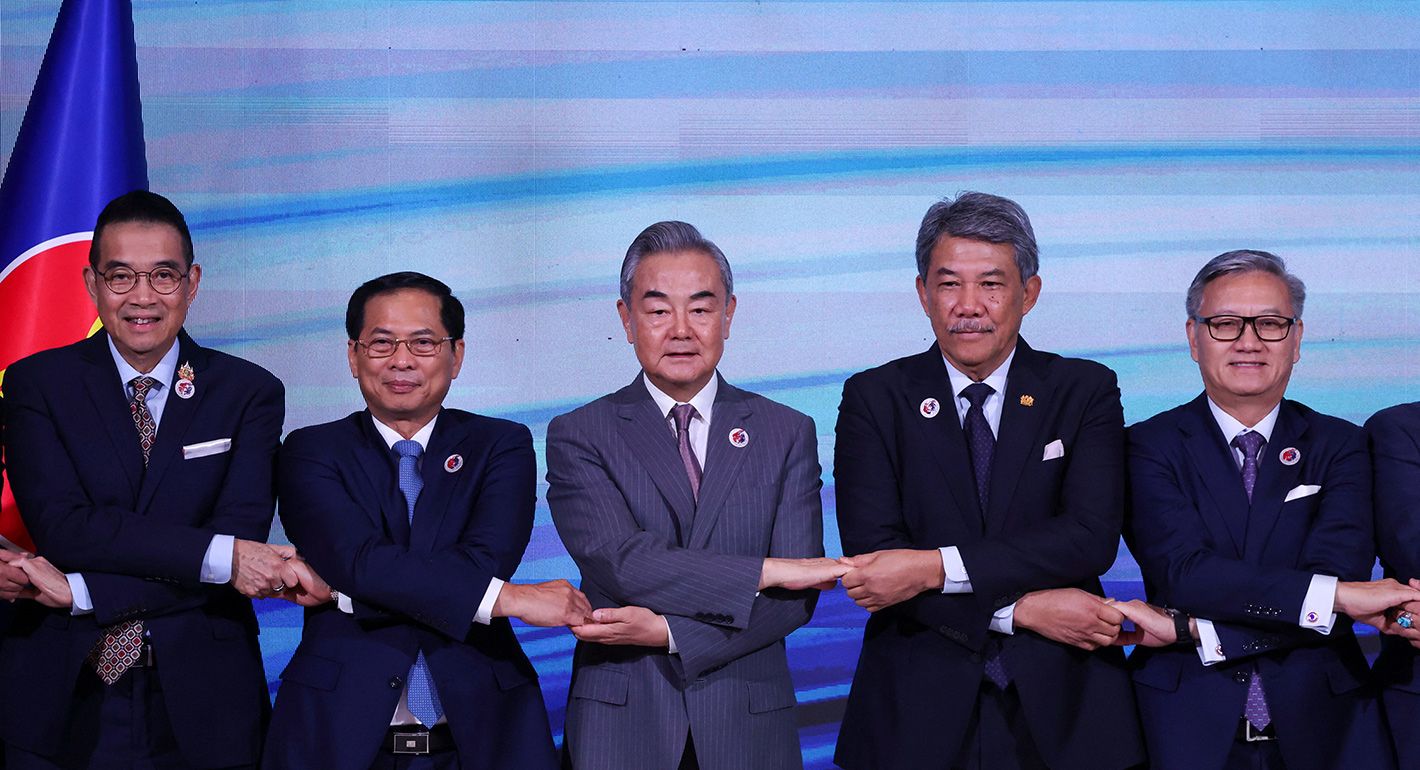
The Thai-Cambodian conflict highlights the limits to China's peacemaker ambition and the significance of this role on Southeast Asia’s balance of power.

Pongphisoot (Paul) Busbarat