

Commentary
But their "principal to principal" model will only be as effective as the political strength of each leader back home.
Damien Ma
{
  "authors": [
    "Alexey Arbatov"
  ],
  "type": "other",
  "centerAffiliationAll": "",
  "centers": [
    "Carnegie Endowment for International Peace",
    "Carnegie Russia Eurasia Center"
  ],
  "collections": [],
  "englishNewsletterAll": "",
  "nonEnglishNewsletterAll": "",
  "primaryCenter": "Carnegie Russia Eurasia Center",
  "programAffiliation": "",
  "programs": [],
  "projects": [
    "U.S.-Russia Bilateral Presidential Commission"
  ],
  "regions": [
    "North America",
    "United States",
    "Caucasus",
    "Russia"
  ],
  "topics": [
    "Security",
    "Military",
    "Foreign Policy",
    "Nuclear Policy",
    "Nuclear Energy"
  ]
}
Source: Getty
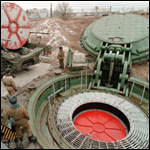
Disarmament cooperation between Russia and the U.S. has stalled. Negotiations must be renewed, for inaction could revive an arms race.
This brief examines the disarmament vacuum that has emerged, focusing on the deadlock over the Russian-American Strategic Arms Reductions Treaty (START-1). The treaty expires in 2009 and no agreement has been reached on a legally binding treaty to replace it. Arbatov emphasizes that for the first time in 40 years there is a danger that a legal vacuum and growing uncertainty over each other’s strategic capability and intentions could arise in the crucially important area of Russia’s and America’s military and political security. He points out that the system of laws and agreements on military security put together through many decades of exhausting and unbelievably complex negotiations has been almost completely dismantled today. As he states, “winds reminiscent of the Cold War have begun to stir once again and signs of a renewed arms race are ever clearer.”
Arbatov sets out several reasons why Russia and the United States have failed to find common ground and draw up a new treaty. One of the main factors as far as America is concerned is that “Washington’s priority is to agree on a broadly transparent regime incorporating as many of the START-1 verification measures as possible, in order to maintain mutual trust and predictability. Given the prevailing negative attitude in the U.S. towards arms control treaties, the proposal is to conclude a legally binding new treaty but with only a politically binding agreement.” As for Russia, “The new Russian political elite that came to power after the Cold War has no historical and institutional memory of the decades of exhausting efforts, successes and failures of disarmament as one of the most important areas of national and international security.”
Based on the history of strategic relations between the two countries over the last 15 years, Arbatov proposes ways to break the current deadlock. One of the best solutions would be a legally binding agreement in this area concluded with the current U.S. administration before it hands over the reins to its successor in January 2009. Arbatov suggests that the best base on which to draft a new agreement would be the 2002 Strategic Offensive Reductions Treaty (SORT) and not a reworked version of START-1.
In conclusion, Arbatov writes: “Once they have propped up the ‘supporting pillar’ of Russian-American relations and global security, the two powers could then work at a calmer pace over 3-4 years to draw up a more radical agreement – SORT-2 – for the post-2012 period.”

Alexey Arbatov
Alexey Arbatov is the head of the Center for International Security at the Primakov National Research Institute of World Economy and International Relations.
Carnegie does not take institutional positions on public policy issues; the views represented herein are those of the author(s) and do not necessarily reflect the views of Carnegie, its staff, or its trustees.

But their "principal to principal" model will only be as effective as the political strength of each leader back home.

Damien Ma

U.S. unpredictability has allowed China to capitalize on its positioning as the “responsible great power”. Paradoxically, the more China wins the perception game, the more likely expectations will rise for Beijing to deliver not just words but to demonstrate with its deeds.

Chong Ja Ian

Hanoi and Beijing have long treated each other as distant cousins rather than comrades in arms. That might be changing as both sides draw closer to hedge against uncertainty and America’s erratic behavior.

Nguyễn Khắc Giang

Across Asia, China is better positioned to withstand energy shocks from the fallout of the Iran war. Its abundant coal capacity can ensure stability in the near term. Yet at the same time, the country’s energy transition away from coal will make it even less vulnerable during the next shock.
Damien Ma

Malaysia’s chairmanship sought to fend off short-term challenges while laying the groundwork for minimizing ASEAN’s longer-term exposure to external stresses.

Elina Noor