

Other
Michael D. Swaine
{
  "authors": [
    "Michael D. Swaine"
  ],
  "type": "legacyinthemedia",
  "centerAffiliationAll": "dc",
  "centers": [
    "Carnegie Endowment for International Peace"
  ],
  "collections": [],
  "englishNewsletterAll": "asia",
  "nonEnglishNewsletterAll": "",
  "primaryCenter": "Carnegie Endowment for International Peace",
  "programAffiliation": "AP",
  "programs": [
    "Asia"
  ],
  "projects": [],
  "regions": [
    "North America",
    "United States",
    "East Asia",
    "China"
  ],
  "topics": [
    "Security",
    "Military",
    "Foreign Policy"
  ]
}
Source: Getty
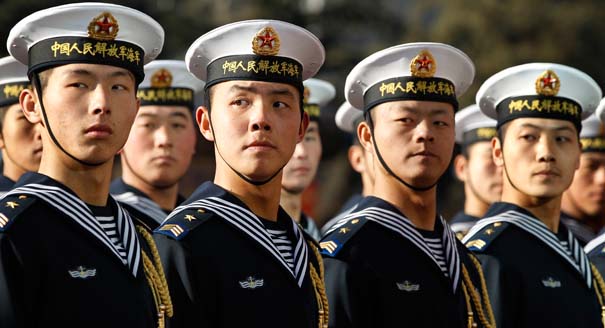
The apparent willingness of Chinese leaders to tolerate its Navy's dangerous maneuvers against U.S. vessels suggests a lack of regard for international laws governing ship and air contacts, raising broader concerns about Beijing's willingness to accept international norms.
Source: Foreign Policy

Just days after U.S. Secretary of State Hillary Clinton shook hands and pledged cooperation with China, the countries' first Obama-era spat broke out on the high seas. On March 9, the White House lodged an official complaint with Beijing: Five Chinese vessels had surrounded the USNS Impeccable south of the Chinese mainland near Hainan island, forcing the surveyor ship to take evasive maneuvers. Just five days earlier in the Yellow Sea, between mainland China and the Korean Peninsula, another U.S. ship, Victorious, was reportedly harassed by a Chinese vessel using a high-intensity spotlight. Despite slow-burning U.S. concerns about China's growing military presence, the incidents seemed to come without provocation or precedent -- an unwelcome surprise for a fresh U.S. administration.
In fact, the harassments of the underwater-survey ships were just the latest episodes in a series of face-offs between Chinese forces and the U.S. missions operating along China's coastline. In April 2001, for example, a U.S. EP-3 electronic surveillance aircraft collided with a harassing Chinese fighter, also in the vicinity of Hainan. The Chinese pilot died, and the heavily damaged U.S. aircraft was forced to make an emergency landing on the island where the U.S. crew was subsequently detained. A minor diplomatic crisis ensued. Now, Beijing is again resorting to dangerous maneuvers in close proximity to U.S. surveillance vessels. All of these incidents, along with other similar but less tense confrontations, have occurred within China's exclusive economic zone (EEZ), which extends 200 nautical miles from China's coastline.
So what is the United States looking for along China's coast, and why does China care? What's the game here?
In a word: intelligence. Since the late 1990s, the United States has increased its efforts to learn more about China's steadily improving defense forces. To do so, the U.S. military has deployed surveillance ships and aircraft in what the United States regards as international waters and airspace near the Chinese coast. Washington views such missions as essential to deterring or defeating future Chinese military aggression against Taiwan and generally keeping track of Beijing's most potentially threatening military deployments.
The Chinese government, for its part, regards such U.S. surveillance as both illegal and unjust: illegal because, in Beijing's view, the missions violate the Chinese interpretation of Article 58 of the U.N. Convention of the Law of the Sea governing the use of EEZs. (These oceanic zones, China argues, are near-sovereign security spaces for military activity as well as economic -- even foreign surveillance is prohibited.) Unjust because, to China, the U.S. actions are not just a violation of the Law of the Sea treaty but are aggressive, "in-your-face" military intimidation against a peaceful country by an arrogant superpower.
Washington insists that Article 58 permits peaceful activities within the EEZ, including surveillance and transits by military vessels. The United States has always been wedded, as a global military and economic power, to the idea of free use of the ocean and airspace beyond a country's territorial waters, which extend to a maximum of 12 nautical miles from the coastline. Washington also argues that China is violating international law by conducting dangerous maneuvers against U.S. ships.
According to the Pentagon, U.S. naval ships and aircraft regularly operate within China's EEZ without incident, and no one is sure why the Chinese chose this moment to respond in such a provocative manner. The Chinese government claims it has demanded repeatedly through diplomatic channels that Washington cease such "unlawful activities," apparently to no avail. The Impeccable's exact location may provide a clue to Chinese motivations: The ship was operating within 100 miles of a very sensitive Chinese naval base on Hainan. It is unclear whether the U.S. ship was collecting data on the activities of a new class of nuclear submarines that use the Hainan base or was simply engaged in normal underwater mapping activities within China's EEZ. China may simply be responding to what it sees as an intolerable level of surveillance, directed at one of its most secretive and sensitive military assets: submarines.
Intelligence concerns aside, Beijing's official reaction is a bit harder to fathom. The Chinese might intend to express anger over continued U.S. arms sales to Taiwan. They might also be hoping to generate support for their expansive definition of sovereignty in EEZs. It's even possible that these recent incidents could have occurred without the knowledge of China's top civilian leaders. Senior authorities such as President Hu Jintao (who also oversees military policies) are surely aware of the aggressive push back against U.S. surveillance, but it is possible that Hu is not informed beforehand about the timing and nature of specific actions taken. The Chinese Foreign Ministry bureaucracy, by contrast, is probably out of the loop from the outset, only brought in when issues become public and controversial.
There's much we don't yet understand about this latest incident. But clearly, at least some Chinese leaders regard this issue as important enough to risk a confrontation with Washington, despite a steadily improving bilateral relationship. The apparent willingness of Chinese leaders to tolerate dangerous maneuvers as a form of protest suggests a lack of regard for international laws governing ship and air contacts, raising greater concerns about Beijing's regard for internationally accepted norms.
Unfortunately, incidents at sea will undoubtedly continue. Both sides hold incompatible assumptions and have competing interests. Meanwhile, neither party looks to be interested in compromising to develop acceptable rules of the road. The situation is dangerous. These disputes over military activities could become a primary trigger for a future serious crisis -- if not conflict -- between Washington and Beijing. China's military capability will only grow, and its apparent resolve to keep the U.S. military out of its business is liable to increase accordingly.

Former Senior Fellow, Asia Program
Swaine was a senior fellow at the Carnegie Endowment for International Peace and one of the most prominent American analysts in Chinese security studies.
Recent Work
Michael D. Swaine
Michael D. Swaine
Carnegie does not take institutional positions on public policy issues; the views represented herein are those of the author(s) and do not necessarily reflect the views of Carnegie, its staff, or its trustees.

The Plaza Accord was not an externally imposed punishment of Japan but part of a broader restructuring that Japanese economists and policymakers themselves recognized was necessary. Its effects were undermined, however, when Tokyo responded to the resulting slowdown with policies that exacerbated investment, credit expansion, and the very imbalances the adjustment was intended to resolve.

Michael Pettis

The nuclear relationship between China and the United States is increasingly shaped by widening perception gaps rather than deliberate strategic design.

Tong Zhao
China’s banking crisis in the 2000s was resolved by transferring the costs to households through financial repression—a decision that recapitalized the banks while exacerbating the structural imbalances that continue to shape the Chinese economy today.
Michael Pettis

Chinese biotech companies have been on the receiving end of U.S. economic coercion. Yet their responses have differed significantly because firm and state interests are not uniformly aligned. For Washington, treating all Chinese tech firms the same, irrespective of their actual interests, risks pushing them farther into Beijing’s corner.

Xue Gong

China’s latest energy plan explicitly calls for integrating data centers into the electricity system, particularly connecting them to green energy. It appears Beijing wants to use compute as a source of domestic demand to absorb renewables excess capacity.

Damien Ma