

Article
Amel Boubekeur
{
  "authors": [
    "Amel Boubekeur"
  ],
  "type": "legacyinthemedia",
  "centerAffiliationAll": "dc",
  "centers": [
    "Carnegie Endowment for International Peace",
    "Malcolm H. Kerr Carnegie Middle East Center"
  ],
  "collections": [],
  "englishNewsletterAll": "menaTransitions",
  "nonEnglishNewsletterAll": "",
  "primaryCenter": "Malcolm H. Kerr Carnegie Middle East Center",
  "programAffiliation": "MEP",
  "programs": [
    "Middle East"
  ],
  "projects": [],
  "regions": [
    "Western Europe"
  ],
  "topics": [
    "Political Reform"
  ]
}
Source: Getty
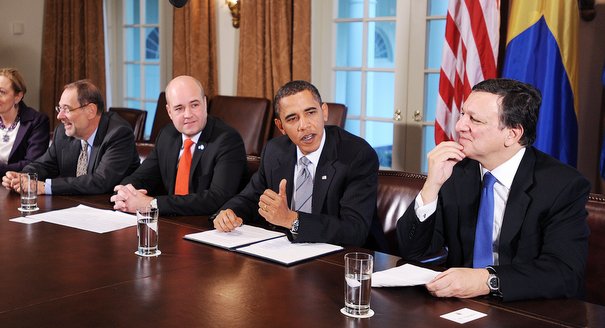
The appointment of a Muslim woman who wears the hijab (headscarf) to the White House Advisory Council on Faith-based and Neighborhood Partnerships has generated discussion in Europe over whether European Muslim women could experience greater political participation.
Source: Common Ground News Service

Of the 20 million Muslims in Europe, 12 million are women. These Muslim women are socially, economically, ethnically and politically diverse, yet all are prone to growing multi-layered discrimination which portrays them as ethnic minorities, disenfranchised women, or even “potentially radical” threats. Muslim women in Europe are often stereotyped as victims of forced marriage, domestic violence and honour killings.
However, a growing majority of these women – especially those raised in Europe – are now talking about freedom and faith, equal rights and diversity, and countering discrimination that arises from within both Muslim and non-Muslim communities.
For example, women have now begun asking for equal space in mosques and access to the same religious training that men receive. In fact, the majority of students at the Institutes of Islamic Studies – which emerged in major cities throughout Europe in the last decade – are now women who are seeking knowledge of their religious rights in order to defend their status in their own Muslim communities.
As a result, Muslim women are beginning to find solutions to the issues affecting them inside the community. Last year, a group of young Muslim associations launched the “Joining Hands Against Forced Marriages” programme in cities throughout Europe, including Brussels, Paris, Madrid, London, Berlin, Bologna and Rotterdam. Seeking to create dialogue on the issue, these groups brought together imams, parents, children and municipal officials to explain to both Muslim and non-Muslim communities alike that Islam forbids practices like this.
At the same time, Muslim women also suffer discrimination resulting from societal misunderstanding outside their communities – in schools, social and healthcare centres, political parties and housing agencies. For example, institutional discourses defining the headscarf as a sign of oppression against women have resulted in women being criticised for wearing it in the public spaces because they are seen as acquiescing to male oppression.
If discrimination has led some women to withdraw from society, the majority are trying to establish a place for themselves by investing in new channels: media and the private sector. Magazines like the British Emel or the French MWM are offering an alternative vision of Muslim women by targeting a readership that goes beyond Muslim communities. Creating their own Islamic fashion or bio-cosmetics companies is also a way European Muslim women are escaping job market discrimination.
In Denmark, Muslim women are overcoming hurdles with the help of the government and the larger public. Following the 2005 cartoons controversy, Danish society has witnessed the rise of female Muslim politicians, a television newscaster and even a national soccer player – surprisingly, all of whom wear the hijab. It is through positive models of identification like these that Muslim women today are building self-confidence.
Discrimination experienced by European Muslim women should be tackled using a multi-dimensional approach which includes building knowledge of their rights, increasing involvement in media and public institutions, and developing partnerships between Muslims and non-Muslims, and between men and women.
The way Muslim women are taking advantage of their European environment to stand up for their rights reveals that feminist, religious and ethnic identities are changing. With their demands for equal rights and equal access to the public sphere, they are confronting European policymakers with the need to adapt their strategies in an atmosphere that is rapidly expanding in terms of its diversity.
Policymakers need to shift they way they see these women – from immigrants with anti-European values who need to be “integrated”, to the active residents and citizens that they already are: women who want to feel secure, work, get an education and be visible. Discrimination against Muslim women – whether it emerges in the Muslim communities in which they are raised, or the larger public – should become an issue of common interest in the development of a more cohesive Europe.
Former Resident Scholar, Middle East Center
Boubekeur was an associate scholar at the Carnegie Middle East Center. Her research focuses on Maghreb country politics, Euro–Arab relations, and Islam in Europe.
Recent Work
Amel Boubekeur
Carnegie does not take institutional positions on public policy issues; the views represented herein are those of the author(s) and do not necessarily reflect the views of Carnegie, its staff, or its trustees.
The Russian invasion of Ukraine is a turning point in the EU-China relationship, and evolution of the China-Russia relationship will continue to impact EU-China relations.
Yifan Ding, Alice Ekman

Transactional relationships are stable but can be shallow.



Paul Haenle, Maha Yahya, Benjamin Ho, …
Recent visits by European officials highlight the EU’s lack of internal cohesion.
Paul Haenle, Chan Heng Chee, Liu Yawei, …
“It’s not so clear how we’re going to get out of this.”
Paul Haenle, Philippe Le Corre

It’s about managing oil prices, bread prices, and strategic partnerships.



Amr Hamzawy, Karim Sadjadpour, Aaron David Miller, …