China-Europe Relations, Two Years After Russia Invaded Ukraine
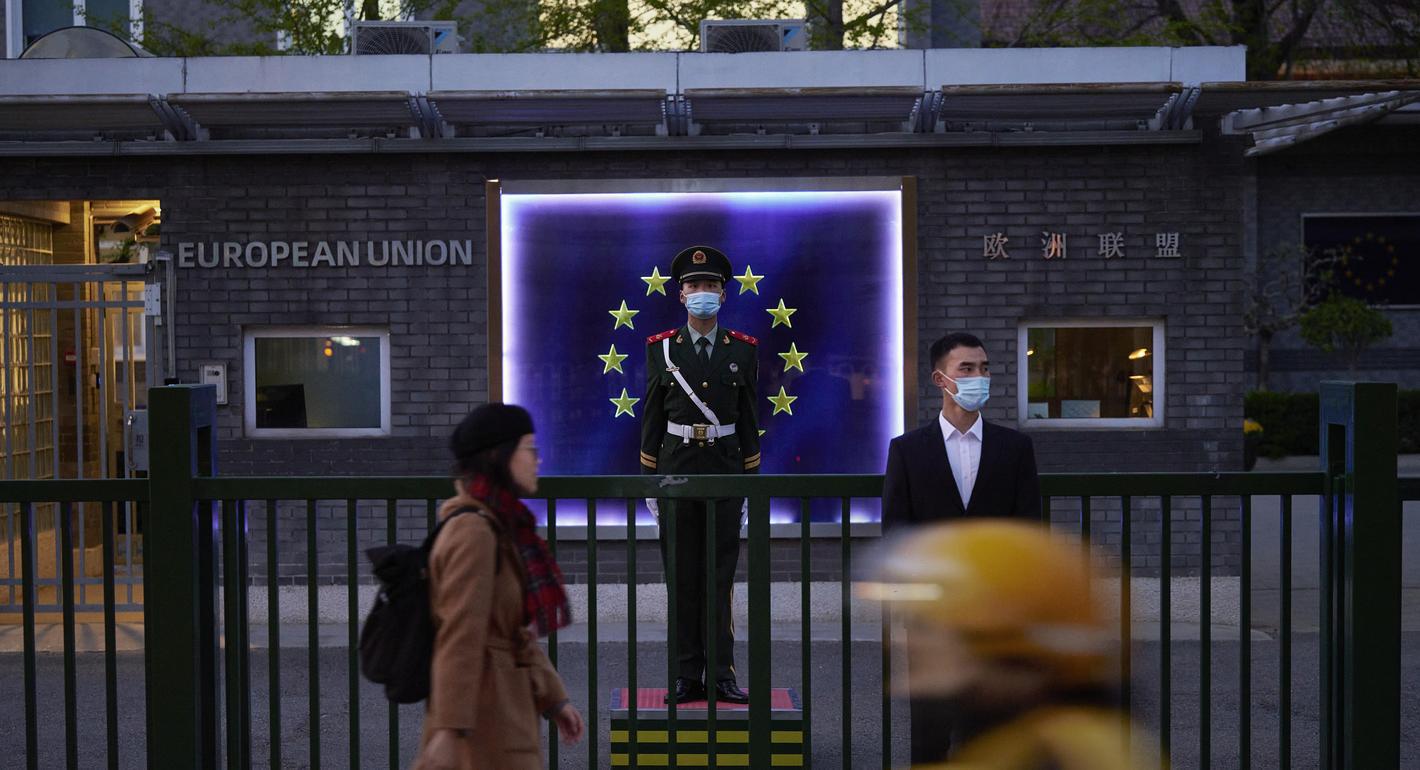
The Russian invasion of Ukraine is a turning point in the EU-China relationship, and evolution of the China-Russia relationship will continue to impact EU-China relations.
Link Copied
By Yifan Ding and Alice Ekman
Published on Mar 11, 2024
This Q&A was adapted from a Carnegie China live event assessing China–EU relations. It has been edited for clarity.
Yifan Ding: The origin of tension between Europe and China can be traced back to the European Commission’s 2019 Strategic Outlook, which for the first time described China as a cooperation partner, a market competitor, and systemic rival. The mistrust that began in 2019 was reinforced by the Russia-Ukraine war.
When U.S. President Joe Biden came to power, he tried to put China and Russia in the same basket to create a confrontation between a coalition of democracy and a coalition of authoritarianism. Although China never recognized Russia’s behavior in Crimea or in Eastern Ukraine, China did not blame Russia for its military actions. China considered the sequence of events more complicated than its appearance.
Behind the military action, there is the fact that Russia was forced into a corner by NATO’s successive enlargement and Western countries’ treatment of Russia. So China could not afford to blame Russia in the same way as Western countries. While Europeans have considered China’s attitude toward the Russia-Ukraine war as ambiguous, they also have interpreted China as providing passive support to Russia. European public opinion has considered every declaration about the war by the Chinese government as unfair and unjust because the Chinese government does not blame Russia. As a result, the Russia-Ukraine war has reinforced mistrust between Europe and China.
Alice Ekman: China’s foreign policy strategic documents tend to consider Russia and the emerging or developing world as natural partners of China. The United States is seen as China’s top rival, despite its willingness to avoid escalation of tension through channels of communication.
In between these two groups is Europe, which is seen as a gray zone for China. Europe is put in the Western basket by Beijing, which considers that by default Europe cannot truly be trusted. But Beijing also sees Europeans as potentially useful Westerners, especially when there exist divergences with the United States. That is why China appreciates expressions such as “strategic autonomy” and an “independent” foreign policy, which can fuel transatlantic divergences and isolate China’s main rival, the United States. I think Mao Zedong’s “Three Worlds” theory is a legacy here, even if the world has evolved. In a world order divided into three, Europe is seen as useful but certainly not a natural, legitimate, or priority partner. Russia is China’s most natural and key partner.
I was interested to read in the South China Morning Post a quote from Professor Ding saying that that Russia can be an example for China to manage financial and economic sanctions coming from the West in the future. China is learning from Russia’s ability to handle sanctions and maintain a rather stable economic situation.
Overall, I have the impression when I read the joint statements and communications following meetings between [Russian President] Vladimir Putin and [Chinese President] Xi Jinping that the Russia-China relationship is developing long term—independent of the evolution of the war in Ukraine and independent of Europe’s dissatisfaction with China’s position. The EU hoped that it could use its economic leverage to push China to clarify its position toward Russia’s invasion of Ukraine and possibly to distance itself from Russia. Not only has Europe not managed to push China in that direction, but on the contrary, China has reinforced rapprochement with Russia, even as Europe remains an important market. I agree that the Russian invasion of Ukraine is turning point in the EU-China relationship and evolution of the China-Russia relationship will continue to impact EU-China relations.
About the Authors
Yifan Ding
Yifan Ding is the president of the China Society for France Studies.
Alice Ekman
Alice Ekman is a senior analyst at the European Union Institute for Security Studies.
Carnegie does not take institutional positions on public policy issues; the views represented herein are those of the author(s) and do not necessarily reflect the views of Carnegie, its staff, or its trustees.
The Plaza Accord was not an externally imposed punishment of Japan but part of a broader restructuring that Japanese economists and policymakers themselves recognized was necessary. Its effects were undermined, however, when Tokyo responded to the resulting slowdown with policies that exacerbated investment, credit expansion, and the very imbalances the adjustment was intended to resolve.
The nuclear relationship between China and the United States is increasingly shaped by widening perception gaps rather than deliberate strategic design.
China’s banking crisis in the 2000s was resolved by transferring the costs to households through financial repression—a decision that recapitalized the banks while exacerbating the structural imbalances that continue to shape the Chinese economy today.
Chinese biotech companies have been on the receiving end of U.S. economic coercion. Yet their responses have differed significantly because firm and state interests are not uniformly aligned. For Washington, treating all Chinese tech firms the same, irrespective of their actual interests, risks pushing them farther into Beijing’s corner.
China’s latest energy plan explicitly calls for integrating data centers into the electricity system, particularly connecting them to green energy. It appears Beijing wants to use compute as a source of domestic demand to absorb renewables excess capacity.