

Report
- +3
James M. Acton, Alexey Arbatov, Vladimir Dvorkin, …
{
  "authors": [
    "Petr Topychkanov"
  ],
  "type": "other",
  "centerAffiliationAll": "dc",
  "centers": [
    "Carnegie Endowment for International Peace",
    "Carnegie Russia Eurasia Center"
  ],
  "collections": [],
  "englishNewsletterAll": "democracy",
  "nonEnglishNewsletterAll": "",
  "primaryCenter": "Carnegie Russia Eurasia Center",
  "programAffiliation": "DCG",
  "programs": [
    "Democracy, Conflict, and Governance",
    "South Asia"
  ],
  "projects": [
    "Eurasia in Transition"
  ],
  "regions": [
    "South Asia",
    "Afghanistan",
    "Pakistan"
  ],
  "topics": [
    "Political Reform",
    "Democracy",
    "Economy",
    "Security"
  ]
}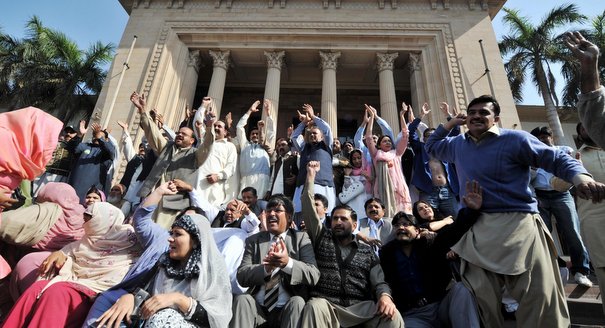
Source: Getty
Islam alone will not aid Pakistan’s political development; instead, national stability will improve with better administrative, security, economic, and social services.
This paper analyzes the current situation in Pakistan through the prism of the country’s historical experience, proposing new approaches to the threats to Pakistan’s territorial integrity and the stability and security of South Asia as a whole.
Conventional political science labels, such as authoritarianism, democracy, Islamism and secularism, are of little use when applied to Pakistan. “Pakistan’s history shows that giving priority to Islam can be combined with a democratic system of government, as well as with an authoritarian regime,” Topychkanov writes. Islam’s supremacy in Pakistani society has manifested itself primarily through Muslim nationalism and Islamic socialism, as well as through various radical forms of Islamic ideology. Experiments with Islam, which is the foundation of the country’s national identity, are therefore not the solution to Pakistan’s problems. Resolving these problems requires comprehensive solutions that encompass the political, economic and social spheres.
Pakistan’s history shows that giving priority to Islam can be combined with a democratic system of government, as well as with an authoritarian regime.
Topychkanov also notes that the external environment, particularly problems in Afghanistan, has had a negative impact on Pakistan’s political development. Protracted or failed operations of the International Security Assistance Force in Afghanistan would strengthen pro-Taliban forces in Pakistan, while stabilization in Afghanistan would help weaken these groups and stop the rise of support for religious extremism. The escalation of tensions between Pakistan and India also contributes to the spread of extremism in Pakistan.
Topychkanov proposes a number of policy approaches, suggesting that the planning and implementation of aid programs for Pakistan should meet three main criteria:
Former Fellow, Nonproliferation Program, Moscow Center
Topychkanov was a fellow in the Carnegie Moscow Center’s Nonproliferation Program.
Recent Work


James M. Acton, Alexey Arbatov, Vladimir Dvorkin, …
Petr Topychkanov
Carnegie does not take institutional positions on public policy issues; the views represented herein are those of the author(s) and do not necessarily reflect the views of Carnegie, its staff, or its trustees.

China’s banking crisis in the 2000s was resolved by transferring the costs to households through financial repression—a decision that recapitalized the banks while exacerbating the structural imbalances that continue to shape the Chinese economy today.

Michael Pettis

In the latest Five-Year Plan, the Chinese president cements the shift to an innovation-driven economy over a consumption-driven one.

Damien Ma

Rather than climate ambitions, compatibility with investment and exports is why China supports both green and high-emission technologies.

Mathias Larsen
“Involution” is a new word for an old problem, and without a very different set of policies to rein it in, it is a problem that is likely to persist.
Michael Pettis

While China's investment story seems contradictory from the outside, the real answers to Beijing's high-quality growth ambitions are hiding in plain sight across the nation's cities.
Yuhan Zhang