

Article
Henri J. Barkey
{
  "authors": [
    "Henri J. Barkey"
  ],
  "type": "legacyinthemedia",
  "centerAffiliationAll": "dc",
  "centers": [
    "Carnegie Endowment for International Peace"
  ],
  "collections": [],
  "englishNewsletterAll": "menaTransitions",
  "nonEnglishNewsletterAll": "",
  "primaryCenter": "Carnegie Endowment for International Peace",
  "programAffiliation": "MEP",
  "programs": [
    "Middle East"
  ],
  "projects": [],
  "regions": [
    "Middle East",
    "Iran"
  ],
  "topics": [
    "Political Reform",
    "Foreign Policy",
    "Nuclear Policy",
    "Nuclear Energy"
  ]
}
Source: Getty
The U.S. administration could help improve relations with Iran by unilaterally ruling out the military option. The dispersal of Iran's nuclear installations means that any bombing campaign would be of limited effectiveness.
Source: The National

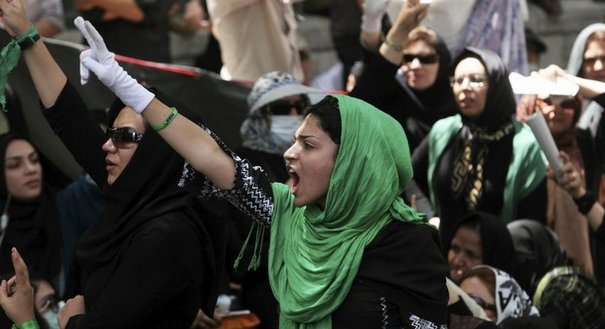
It is no longer just the country of Mahmoud Ahmedinejad and anti-western mullahs who complete their Friday prayers with calls for “death to America” and death to Israel”. Rather it is the country of millions of people who peacefully, and in many cases valiantly, stood up for their rights and are now being subjected to grotesque show trials.
More importantly, it is the country of a new heroine, Neda Agha-Soltan, who was brutally murdered in the plain view of millions of TV viewers throughout the world.
These developments require that the United States rethink its long-term strategy towards Iran’s nuclear programme. The Iranian regime is experiencing a deep legitimacy crisis; it is weak, and feels vulnerable. It would love to have seen the Obama administration wade in with support for the opposition, thereby discrediting that opposition. Wisely, Washington declined to rise to the bait.
The embattled regime in Tehran has few options: it can join the nuclear negotiating table with a serious proposal, or it can continue to prevaricate, as it has done since the appointment of Saeed Jalili as its nuclear negotiator. The second choice can easily be buttressed by upping the ante as the Iranian leadership drapes itself in the nuclear programme to solidify its support base.
But the US administration too is in a bind; how does it engage with Iran, as Barack Obama promised it would, without alienating the opposition? All sides in Iran are intently watching Washington to see what it will do next.
What Washington does not need is a repeat of history: that is, for Iranians 20 years from now being able to accuse it of having sided with an illegitimate regime, just as it did in 1953. And what does the US do with its own self-imposed deadline of September for progress? Iran’s regime lives off its confrontation with America and is constructed on a pillar of virulent anti-Americanism. It is unlikely that anything Mr Obama would offer can help to resolve that impasse.
But there is an alternative approach. The US administration ought to make it crystal clear that its struggle is with the regime, and not with the Iranian people. As a first step, it could unilaterally rule out the military option. Bombing Iranian nuclear installations is a facet of the oft-stated policy that “all options are on the table”, a position that the Iranian regime characterises – with some justification – as a clear threat.
In any case, the dispersal of Iranian nuclear installations means that any bombing campaign would be of limited effectiveness, and would certainly result in civilian casualties – including many “Nedas”. In fact, the regime in Tehran might even welcome an attack because it would help to rally people around it.
Second, the US should immediately begin discussions with all Iran’s regional neighbours to develop a robust deterrent capability. The secretary of state, Hillary Clinton, hinted at a nuclear umbrella and was criticised for it. But the cat is out of the bag: the US could discreetly, but in a manner that is evident to the Iranians, begin to deploy an array of anti-missile technology in the region.
Third, the administration should make it explicit that its policy change is a direct result of the demonstrations in Tehran and the subsequent Stalinesque show trials. Unless Iran begins genuine negotiations, the US should state that it would be determined to wait out this regime; either it changes its policies, unlikely as that may be, or with time a new Iran is likely to emerge from the post-election dust.
Fourth, the US should shy away from either provoking the regime or instituting the kind of embargos, such as one on petrol, that impoverish ordinary Iranians while enriching the Revolutionary Guards who would be running the smuggling operations. The current sanctions regime, because it reduces the regime’s margin for manoeuvre, would be maintained.
In effect, what Washington would be doing is openly siding with the Iranian public to deepen the rift and put the ball squarely back in Iran’s court. Having miscalculated, the regime is fighting for its life. Two weeks ago at Friday prayers, every time the announcer called the worshippers to shout “death to America” they responded by shouting “death to Russia” – displaying their abhorrence for Moscow’s rapid recognition of the outcome of the fraudulent elections.
The question is, without the threat of a military response, will the Iranian regime feel emboldened to continue enriching uranium and making progress on the road to weaponisation? The sad truth is that this regime has shown that no amount of US or international pressure is likely dissuade it.
This proposal aims at the long term: in the event that Iran were to develop a crude nuclear weapon, the US would have a deterrent capability already in place. More important, however, it would be in far better position to negotiate a denuclearisation agreement with a successor regime. Remember what the South Africans did after the end of apartheid; they willingly gave up their nuclear programme.

Former Visiting Scholar, Middle East Program
Barkey served as a member of the U.S. State Department Policy Planning Staff, working primarily on issues related to the Middle East, the Eastern Mediterranean, and intelligence from 1998 to 2000.
Recent Work
Henri J. Barkey
Henri J. Barkey
Carnegie does not take institutional positions on public policy issues; the views represented herein are those of the author(s) and do not necessarily reflect the views of Carnegie, its staff, or its trustees.

Across Asia, China is better positioned to withstand energy shocks from the fallout of the Iran war. Its abundant coal capacity can ensure stability in the near term. Yet at the same time, the country’s energy transition away from coal will make it even less vulnerable during the next shock.

Damien Ma

Malaysia’s chairmanship sought to fend off short-term challenges while laying the groundwork for minimizing ASEAN’s longer-term exposure to external stresses.

Elina Noor
For Malaysia, the conjunction that works is “and” not “or” when it comes to the United States and China.
Elina Noor
In July 2025, Vietnam and China held their first joint army drill, a modest but symbolic move reflecting Hanoi’s strategic hedging amid U.S.–China rivalry.

Nguyễn Khắc Giang

The Thai-Cambodian conflict highlights the limits to China's peacemaker ambition and the significance of this role on Southeast Asia’s balance of power.

Pongphisoot (Paul) Busbarat