

Paper
Ashley J. Tellis
{
  "authors": [
    "Ashley J. Tellis"
  ],
  "type": "legacyinthemedia",
  "centerAffiliationAll": "dc",
  "centers": [
    "Carnegie Endowment for International Peace"
  ],
  "collections": [],
  "englishNewsletterAll": "ctw",
  "nonEnglishNewsletterAll": "",
  "primaryCenter": "Carnegie Endowment for International Peace",
  "programAffiliation": "SAP",
  "programs": [
    "South Asia"
  ],
  "projects": [],
  "regions": [
    "United States",
    "South Asia",
    "India"
  ],
  "topics": [
    "Foreign Policy"
  ]
}
Source: Getty
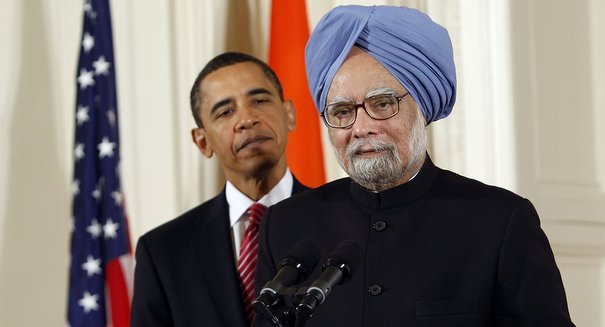
Although many in India have claimed that their prime minister’s November trip to Washington was a disappointment, the summit was successful in demonstrating U.S. interest in strengthening its strategic partnership with India, and it built a foundation for further conversations.
Source: Indian Express

Consider the context surrounding the November summit. After eight years of an unprecedented deepening in bilateral ties, President Barack Obama got off to a rather wobbly start in sustaining the US partnership with India. Although Democratic cheerleaders were emphatic during the presidential campaign that Obama would be just as invested as Bush was in preserving India’s priority in US foreign policy, Obama’s early positions made those claims suspect. Beginning with his unenthusiastic support for the nuclear deal when still a US senator and continuing with his ruminations about mediating in Kashmir when still president-elect, Obama intimated changes in US policy that would have adversely affected India. Since becoming president, his evident hesitation about committing the resources necessary to secure victory in Afghanistan and the fear that he might seek to appease Pakistan at India’s expense combined to produce a deep anxiety about Obama’s strategic vision in New Delhi. Finally, his angst-inducing faux pas of failing to integrate India into his vision of Asian stability, even as he seemingly endorsed a Chinese oversight role in South Asia just on the eve of Singh’s visit to Washington, intensified the growing suspicion that Obama would likely end up undermining core Indian strategic interests.
The prime minister’s visit to Washington, therefore, must be assessed against this inauspicious backdrop and against the widespread fear that the bilateral partnership, which had enjoyed unparalleled success under George W. Bush, was at serious risk because of Obama’s neglect and missteps involving India. Given these realities, the correct measure of accomplishment during this visit could not be whether Obama and Singh would produce a breakthrough akin to July 2005, but whether they would fundamentally protect the inherited achievement.
In particular, the success of this summit had to be measured by whether the two leaders could achieve three specific objectives. First, could they prove to the international community that the US-Indian bilateral relationship transcends the preferences of any single leader on either side and actually represents the national strategy of both countries? Second, could they assure each other that their fundamental strategic goals are in fact convergent, if not aligned? Third, could they exploit the complementarities in their evolving partnership, while simultaneously managing their differences effectively?
By these criteria, the recent Obama-Singh summit was more successful than is currently realised. Through both the symbol of being the first invited state visitor to Washington and, more importantly, through the public affirmations that India’s rise was helpful to preserving stability in Asia, President Obama sought to signal continuity with Bush policy. In other words, strengthening the strategic partnership with India does represent the national strategy of the United States — even if Obama has yet to emulate the critical decision made by his predecessor to deliberately aid the growth of Indian power for strategic reasons.
Further, the warm private conversations between Obama and Singh provided proof of their personal rapport and strengthened the convergence towards common goals. Their utterly frank tête-à-tête not only traversed the range of issues that deeply affect critical American and Indian geopolitical interests, but it also produced a new and consequential appreciation of India’s concerns at the highest levels of the US government. Given that this was the first meeting between Obama and Singh where the bilateral relationship was the centrepiece of discussion, there could have been no better ending — and the prime minister’s later declaration that he was “very satisfied with the outcome of [his] discussion with President Obama” said it all.
Finally, the joint statement and fact sheets published by the two sides confirmed the reality that the two countries share many complementarities that can yield fruit which will make a real difference to the lives of millions of ordinary Americans and Indians. Equally significant, they proved that even when both sides disagree on matters of significance — climate change being a good example — Washington and New Delhi can manage their differences creatively and with an eye to reaching solutions, rather than merely engaging in grandstanding as both might have done in the past.
When the evidence is weighed, therefore, the prime minister’s trip to Washington was emphatically not the disappointment that many in India have claimed. To be sure, work still remains to be done: lasting success will require that the assurances expressed during the bilateral discussions find reflection in future policy decisions in both countries. That will undoubtedly be the ultimate proof of achievement. But while the two governments move towards that end, Singh’s visit has already had important ameliorative benefits: it has rectified the American missteps that had cast a shadow over the bilateral relationship; it has refocused the United States on issues of high politics that are critical to both nations’ security, while providing a fillip to further cooperation in low politics; it has cemented presidential attention on critical strategic issues involving India; it has provided opportunities for India to demonstrate tangibly its desire to partner with the United States on issues of global security; and, it has further deepened the personal ties between Obama and Singh, which are indispensable for any sustained transformation of the relationship. All in all, a worthwhile harvest for a summit that was supposedly only about symbols.
Former Senior Fellow
Ashley J. Tellis was a senior fellow at the Carnegie Endowment for International Peace.
Recent Work
Ashley J. Tellis
Ashley J. Tellis
Carnegie does not take institutional positions on public policy issues; the views represented herein are those of the author(s) and do not necessarily reflect the views of Carnegie, its staff, or its trustees.

But their "principal to principal" model will only be as effective as the political strength of each leader back home.

Damien Ma

U.S. unpredictability has allowed China to capitalize on its positioning as the “responsible great power”. Paradoxically, the more China wins the perception game, the more likely expectations will rise for Beijing to deliver not just words but to demonstrate with its deeds.

Chong Ja Ian

Hanoi and Beijing have long treated each other as distant cousins rather than comrades in arms. That might be changing as both sides draw closer to hedge against uncertainty and America’s erratic behavior.

Nguyễn Khắc Giang

Across Asia, China is better positioned to withstand energy shocks from the fallout of the Iran war. Its abundant coal capacity can ensure stability in the near term. Yet at the same time, the country’s energy transition away from coal will make it even less vulnerable during the next shock.
Damien Ma

Malaysia’s chairmanship sought to fend off short-term challenges while laying the groundwork for minimizing ASEAN’s longer-term exposure to external stresses.

Elina Noor