

Paper
Paul Salem
{
  "authors": [
    "Paul Salem"
  ],
  "type": "legacyinthemedia",
  "centerAffiliationAll": "",
  "centers": [
    "Carnegie Endowment for International Peace",
    "Malcolm H. Kerr Carnegie Middle East Center"
  ],
  "collections": [],
  "englishNewsletterAll": "",
  "nonEnglishNewsletterAll": "",
  "primaryCenter": "Malcolm H. Kerr Carnegie Middle East Center",
  "programAffiliation": "",
  "programs": [],
  "projects": [],
  "regions": [
    "Levant"
  ],
  "topics": [
    "Security"
  ]
}
Source: Getty
While officials are quietly suggesting that indirect peace talks between Syria and Israel may resume, escalating tensions between Israel, Syria, and Lebanon are sparking concerns about the possibility of a regional war.
Source: Al-Hayat

The tensions mounted in the wake of Israeli military exercises in northern Israel in late January. This spurred Syria to activate reservists and Hezbollah to put its forces and officials on high alert. Israel’s foreign minister Avigdor Lieberman warned Syria’s Assad that he would “fall from power” if Syria provoked Israel; Syria’s foreign minister Walid Muallem told Israelis that “you know that war at this time will reach your cities”; and Hezbollah leader Nasrallah warned that he would crush Israel and the war would “change the face of the region”.
Israeli military officials have insisted that the exercises were routine, but this has not allayed fears in Beirut and other capitals.
The tension might also be linked to reports, published first in the Kuwaiti newspaper al-Rai, that Syria was allowing Hezbollah fighters to train on SA-2 anti-aircraft missile systems in Syria and might be considering allowing such missiles into Lebanon. Such missiles are a ‘red line’ for Israel. The introduction of similar missiles to Lebanon almost led to war in 1981 and required direct intervention by US special envoy Philip Habib to avoid a full scale war.
The missile issue might partly explain the intensified and low altitude sorties of Israeli air planes over Lebanese airspace—to test whether such systems have been brought in. It would also explain why Israel has issued strong warnings to Syria, in order to make clear that such missile transfers would cross a red line.
Among Lebanese government officials there are serious fears that the risk of another war—by Israel on Hezbollah and Lebanon—is real. A war could be sparked by Israeli attacks on possible anti-aircraft batteries; or it could be a large-scale air and land operation reminiscent of the 1982 war.
The 1982 war was the second round of a first war that was launched in 1978 and in which Israel failed to reach its objectives of defeating the PLO in Lebanon. The 1982 war effectively ended the PLO’s dominant presence in Lebanon and was a large-scale operation that reached all the way up to Beirut. The fear is that four years after the 2006 war, Israel might seek a second and knockout round against Hezbollah at a time when the US administration is adrift and Syria is tied up with rapprochements with Saudi Arabia, Europe and the US. The speculation is that Israel would aim to cripple Hezbollah as a real threat on Israel’s northern border and also to reduce Iran’s retaliation options in any upcoming confrontation over the nuclear issue. The scenario of a large-scale 1982-type war has been aired in a number of Arab newspapers that claimed that such warnings have been relayed by various western intelligence sources.
Lebanese residents of the South have expressed deep concern about such a new war and the Lebanese government is worried that a new war would target Lebanese government and army infrastructure and would devastate the population, the country and the state even more than the war of 2006.
While many observers still think the probability of imminent war is small, there is serious concern among officials and the diplomatic community regarding the escalation of tension. The Gaza war in December 2008 caught the region and the world unawares; it is important, even if the risk of actual war seems small, for regional and international capitals to take the risk of this recent escalation seriously, and to make sure that whatever causes might be behind it are defused.
Read from a different perspective, this recent war of words could be part of the positioning of Israel and Syria before the resumption of indirect talks. The US administration has named an ambassador to Syria after a gap of five years, and US special envoy George Mitchell has indicated that resuming Israeli-Syrian peace talks is an important priority. Turkish foreign minister Ahmet Davutoglu indicated Turkey’s willingness to restart such talks, and both Assad and Netanyahu have made statements favourable to such talks, although they disagree on conditions.
An early resumption of Israeli-Syrian talks, under Turkish or American auspices, would be important. It would help allay gathering tensions and would be a valuable step forward in the otherwise stalled peace process. Let us hope that this is the direction events on the Israel-Syria-Lebanon triangle are taking, and that we are not drifting again toward war.

Senior Fellow at the Middle East Institute
Paul Salem is a senior fellow at the Middle East Institute.
Recent Work
Paul Salem
Paul Salem

The Thai-Cambodian conflict highlights the limits to China's peacemaker ambition and the significance of this role on Southeast Asia’s balance of power.

Pongphisoot (Paul) Busbarat

Beijing believes that Washington is overestimating its own leverage and its ability to handle the trade war’s impacts.


Rick Waters, Sheena Chestnut Greitens

Tapping our network of China experts in the region, Carnegie China offers this latest “China Through a Southeast Asian Lens” report to offer preliminary assessments of whether the U.S. effort to reshape the global trading order will lead countries in the region to tilt toward Beijing.



Selina Ho, Khin Khin Kyaw Kyee, Joseph Ching Velasco, …
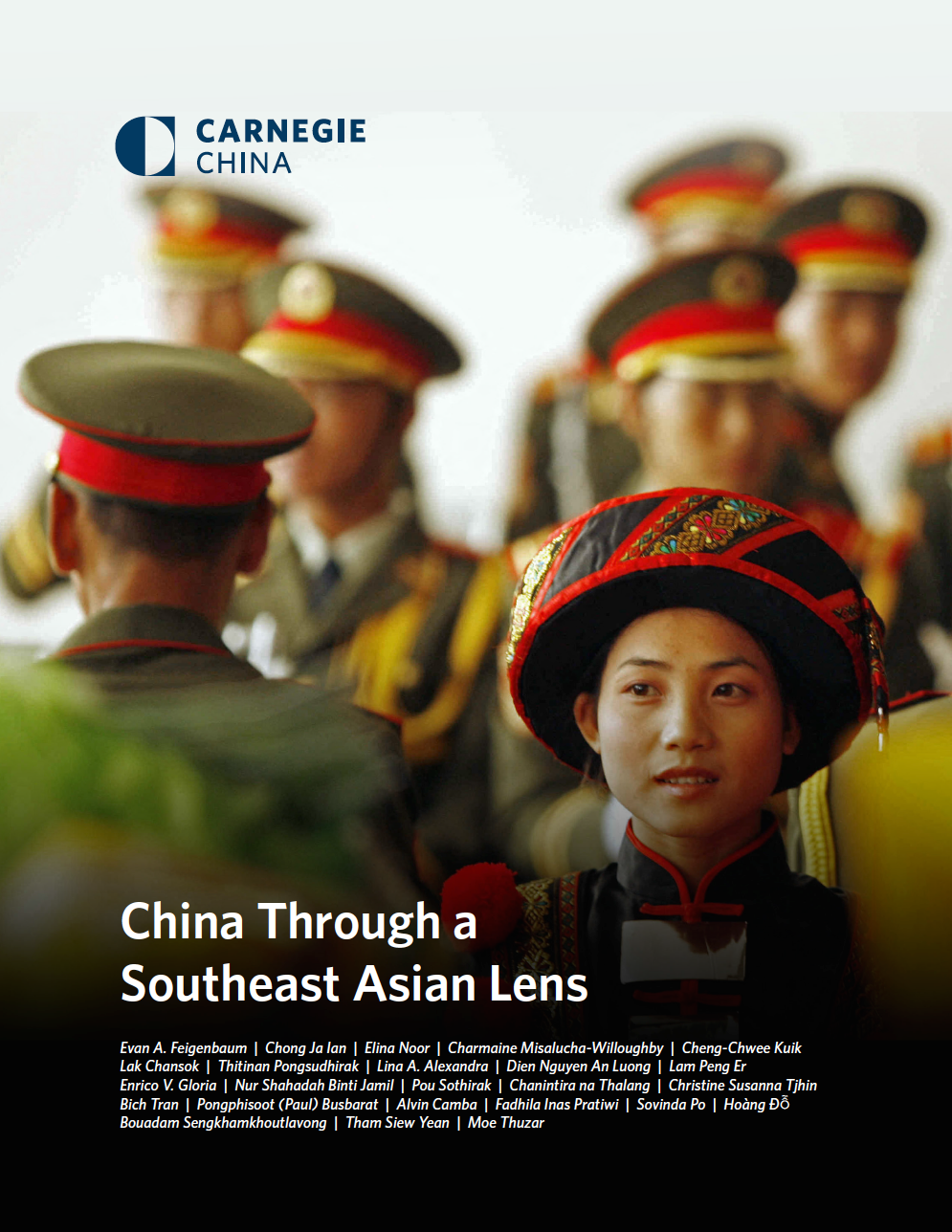
Because strategic, economic, and ideological perceptions of China contain multiple, sometimes contradictory facets in Southeast Asia, receptions of and responses to Beijing diverge across and within state lines.



Evan A. Feigenbaum, Chong Ja Ian, Elina Noor

Most Southeast Asian states behave as if the actions of their Northeast Asian neighbors and the Philippines will be sufficient to maintain a regional status quo from which they can benefit.
Chong Ja Ian