

Q&A
Raluca Csernatoni, Sinan Ülgen
{
  "authors": [
    "Sinan Ülgen"
  ],
  "type": "legacyinthemedia",
  "centerAffiliationAll": "",
  "centers": [
    "Carnegie Endowment for International Peace",
    "Carnegie Europe",
    "Malcolm H. Kerr Carnegie Middle East Center"
  ],
  "collections": [
    "Brexit and UK Politics"
  ],
  "englishNewsletterAll": "",
  "nonEnglishNewsletterAll": "",
  "primaryCenter": "Carnegie Europe",
  "programAffiliation": "",
  "programs": [],
  "projects": [],
  "regions": [
    "Middle East",
    "Europe",
    "Maghreb"
  ],
  "topics": [
    "Foreign Policy",
    "Economy"
  ]
}
Source: Getty
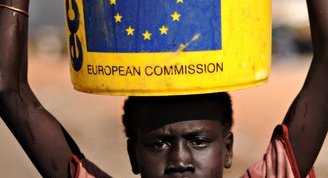
The EU's approach to economic development in North Africa has been handicapped by a failure to focus on private-sector development and a refusal to open its markets to agricultural exports from the region.
Source: EurActiv

The Jasmine Revolution has made it clear that, despite European efforts to encourage political and economic development, many fundamental challenges remain unaddressed in the Arab world, even in countries previously considered to be the region's most advanced. Much of the work required must be done by the North African countries themselves, but the EU can help to make a difference.
North Africa has always been a special region for the EU not only because of colonial ties, but also because of concerns that people from the region would migrate to Europe. The official relationship that began in 1995 with the Barcelona Process therefore sought to establish a space of stability and security, economic prosperity and a joint culture in the Euro-Mediterranean region.
Over the past fifteen years this relationship has evolved significantly, from the arrival in 2004 of the European Neighbourhood Policy (ENP) to its relaunch as the Union for the Mediterranean (UfM) in 2007.
Today, the EU aspires to anchor the political and economic evolution of North Africa. To that end, it has allocated approximately $3.4 billion to implementing the ENP Action Plans of the nine North African economies over the next three years.
However, while not insignificant, this assistance is significantly inferior in per-capita terms to the amount the EU earmarked for its Eastern Euromed partners. Perhaps more importantly, however, the EU's sustained engagement has not significantly improved growth in North Africa, nor has it moved the region closer to EU income levels.
Since the Barcelona process was launched, the income gap between each North African economy and the EU 15 has barely narrowed.
Two major shortcomings have handicapped the EU's approach to economic development in North Africa: a failure to focus on private-sector development and a refusal to open its markets to agricultural exports from the region.
World Bank economists have highlighted the prevalence of two obstacles to private-sector development in the region – patronage networks and connected lending, which limits access to capital to regime- friendly enterprise owners. EU policy has failed to address these issues, continuing instead to rely on the North African states as the agents for change. The most recent EU initiative – the UfM – represents an even starker failure than the earlier Barcelona Process in this regard, excluding the latter's focus on economic restructuring and grassroots economic activity.
The weakness of the private sector in North Africa is clearly illustrated by the low growth of new export capacity, particularly when compared to that of other emerging markets. In the period from 1996 to 2009, North African countries were outperformed by every emerging market economy.
Egypt, the region's top performer, created 514 new export categories over that period, compared to 865 new categories in China, 714 categories in Turkey, and 619 categories in Thailand. New exports accounted for only 0.4% (Algeria) to 15% (Tunisia) of total exports in North Africa, compared to approximately 20% in the benchmark emerging countries, again highlighting their more dynamic performance.
Given the reliance of some North African countries on exports of agricultural and processed goods – they account for more than one-fifth of Egypt, Morocco and Syria's non-energy exports to the EU 15 – the protectionism embedded in the EU's agricultural policy also significantly impedes its efforts to assist the region.
Despite rhetoric about the importance of helping development – which, incidentally, is now enshrined in the Lisbon Treaty – the EU has maintained the inherent protectionism of its agricultural policies. While presenting the European Commission's new 'Trade, Growth and World Affairs' policy in Brussels last November, Trade Commissioner Karel de Gucht failed to even mention agricultural liberalisation.
The EU has conditioned its agricultural trade liberalisation with North Africa on progress made at the Doha Round of World Trade Organisation (WTO) negotiations. Given Doha's visible lack of progress, however, the EU needs to revisit this policy and should instead introduce a new initiative for dismantling its agricultural trade barriers, including the lowering of tariffs, the elimination of export subsidies, and the gradual elimination of tariff quotas.
North Africa obviously suffers from many governance problems that will need to be tackled before the region can experience a more sustainable and inclusive growth pattern. Nonetheless, the EU can start to make concrete progress on the ground by refocusing its reform agenda on private-sector development and by delinking the dismantling of its own agricultural protectionism from the fate of the Doha Round.

Senior Fellow, Carnegie Europe
Sinan Ülgen is a senior fellow at Carnegie Europe in Brussels, where his research focuses on Turkish foreign policy, transatlantic relations, international trade, economic security, and digital policy.
Recent Work

Raluca Csernatoni, Sinan Ülgen

Catherine Hoeffler, Sinan Ülgen
Carnegie does not take institutional positions on public policy issues; the views represented herein are those of the author(s) and do not necessarily reflect the views of Carnegie, its staff, or its trustees.

Across Asia, China is better positioned to withstand energy shocks from the fallout of the Iran war. Its abundant coal capacity can ensure stability in the near term. Yet at the same time, the country’s energy transition away from coal will make it even less vulnerable during the next shock.

Damien Ma

In the latest Five-Year Plan, the Chinese president cements the shift to an innovation-driven economy over a consumption-driven one.
Damien Ma

Malaysia’s chairmanship sought to fend off short-term challenges while laying the groundwork for minimizing ASEAN’s longer-term exposure to external stresses.

Elina Noor

For Malaysia, the conjunction that works is “and” not “or” when it comes to the United States and China.
Elina Noor
In July 2025, Vietnam and China held their first joint army drill, a modest but symbolic move reflecting Hanoi’s strategic hedging amid U.S.–China rivalry.

Nguyễn Khắc Giang