

Research
- +10
Rosa Balfour, Frances Z. Brown, Yasmine Farouk, …
{
  "authors": [
    "Moisés Naím"
  ],
  "type": "legacyinthemedia",
  "centerAffiliationAll": "",
  "centers": [
    "Carnegie Endowment for International Peace"
  ],
  "collections": [
    "Arab Awakening"
  ],
  "englishNewsletterAll": "",
  "nonEnglishNewsletterAll": "",
  "primaryCenter": "Carnegie Endowment for International Peace",
  "programAffiliation": "",
  "programs": [],
  "projects": [],
  "regions": [
    "North Africa",
    "Libya",
    "North America"
  ],
  "topics": [
    "Foreign Policy"
  ]
}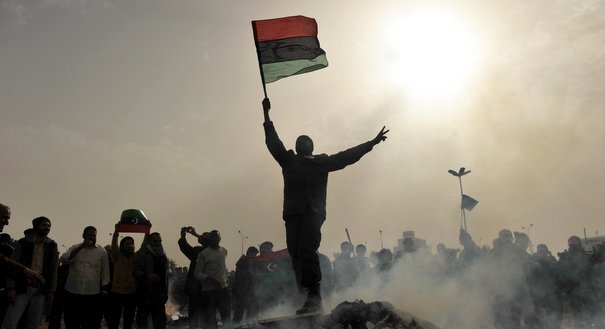
Source: Getty
While economic, military, and geopolitical interests are always going to come first in determining U.S. foreign policy, the defense of fundamental humanitarian principles can play a role in calculating the country’s national interest.
Source: Huffington Post

Sure, the numbers and circumstances are very different. 700,000 people live in Benghazi and if troops loyal to Muammar Gaddafi had entered the city and followed his orders to take out "the greasy rats", they probably wouldn't have killed the entire population. But still, a large massacre was in the offing.
And that is the dilemma. Should countries intervene militarily in other nations to prevent the extermination of thousands of innocent people? They didn't in 1994, when 800,000 civilians were massacred in Rwanda, or in 1995 when Serb forces killed 8,000 Bosnians in Srebrenica.
Remembering these events is relevant when we discuss what could have happened in Benghazi and to the larger debate about foreign intervention in Libya. Barack Obama is being fiercely criticized for having decided to intervene in the Libyan conflict and for having done so too late and too hesitantly. For having joined an international coalition instead of acting unilaterally and for having allowed American planes and missiles to play a greater role than others in the coalition at the start of the bombing campaign.
He is also attacked for entangling the U.S. in Libya without knowing who the rebels are or what they want, or whether they have links to anti-American players (Iran, Al Qaeda, etc.) who may consequently gain a foothold in Libya. For the lack of thought-out plans for a post-Gaddafi Libya and for the hypocrisy of intervening in Libya and not Bahrain (where the U.S. has a major naval base).
But the most fundamental criticism of Obama is that the situation in Libya does not affect the vital interests of the United States and, therefore, it is unjustifiable to risk American lives or spend taxpayers' dollars in this conflict. Even oil does not justify it, Obama's critics say. Libya supplies only 2 percent of the world's oil and, anyway, Gaddafi had excellent relationships with foreign oil companies.
And how will it end? Will the United States now be obliged to act as a global policeman intervening militarily whenever a dictator decides to massacre his people? Would Washington intervene in China if the government puts down an uprising in the same way as Gaddafi did? What about in Russia, or indeed Venezuela?
Behind these criticisms there are three basic assumptions: The first is that a head of state should only act when he has complete and reliable information. The second is that consistency is achievable (and desirable) in international relations. And the third is that in the brutal world of international realpolitik, moral standards cannot be given too much weight.
These three assumptions are wrong. Major decisions based on complete and fully reliable information are the exception. In reality, heads of state must nearly always make decisions based on insufficient and uncertain evidence, since the costs of waiting for the complete picture are often too high. Moreover, complete consistency of action is not possible or even desirable. For example, the U.S. harasses the military junta of Myanmar for its human rights violations, but welcomes China's leaders at the White House with full honors. The inconsistency and double standards of these two policies are obvious. Do we prefer to avoid these contradictions? Should Washington stop pressuring the butchers of Burma? Or should it escalate a conflict with China?
All countries that interact with the rest of the world face dilemmas that cannot be resolved by trying to be completely consistent. Inconsistency, and incomplete information, are part of international politics. Finally, there is the weight given to decency in the definition of national interest. It's naive to assume that morality is the only consideration behind the way states conduct their foreign affairs. Economic, military and geopolitical interests are always going to come first. But to forget about what defines us as human beings is unacceptable.
The defense of fundamental humanitarian principles should be part of the national interest of any decent country. Fortunately for the Libyan rebels in this case decency prevailed. And even if what comes after Gaddafi is distinctly lacking in decency, it's still a risk worth taking.

Distinguished Fellow
Moisés Naím is a distinguished fellow at the Carnegie Endowment for International Peace, a best-selling author, and an internationally syndicated columnist.
Recent Work



Rosa Balfour, Frances Z. Brown, Yasmine Farouk, …
Moisés Naím
Carnegie does not take institutional positions on public policy issues; the views represented herein are those of the author(s) and do not necessarily reflect the views of Carnegie, its staff, or its trustees.

But their "principal to principal" model will only be as effective as the political strength of each leader back home.

Damien Ma

U.S. unpredictability has allowed China to capitalize on its positioning as the “responsible great power”. Paradoxically, the more China wins the perception game, the more likely expectations will rise for Beijing to deliver not just words but to demonstrate with its deeds.

Chong Ja Ian

Hanoi and Beijing have long treated each other as distant cousins rather than comrades in arms. That might be changing as both sides draw closer to hedge against uncertainty and America’s erratic behavior.

Nguyễn Khắc Giang

Across Asia, China is better positioned to withstand energy shocks from the fallout of the Iran war. Its abundant coal capacity can ensure stability in the near term. Yet at the same time, the country’s energy transition away from coal will make it even less vulnerable during the next shock.
Damien Ma

Malaysia’s chairmanship sought to fend off short-term challenges while laying the groundwork for minimizing ASEAN’s longer-term exposure to external stresses.

Elina Noor