• Commentary
  • Research
  • Experts
  • Events
Carnegie China logoCarnegie lettermark logo
{
  "authors": [
    "Ashley J. Tellis"
  ],
  "type": "other",
  "centerAffiliationAll": "dc",
  "centers": [
    "Carnegie Endowment for International Peace"
  ],
  "collections": [],
  "englishNewsletterAll": "ctw",
  "nonEnglishNewsletterAll": "",
  "primaryCenter": "Carnegie Endowment for International Peace",
  "programAffiliation": "SAP",
  "programs": [
    "South Asia"
  ],
  "projects": [],
  "regions": [
    "South Asia",
    "India",
    "Afghanistan",
    "Pakistan"
  ],
  "topics": [
    "Security",
    "Military",
    "Foreign Policy"
  ]
}
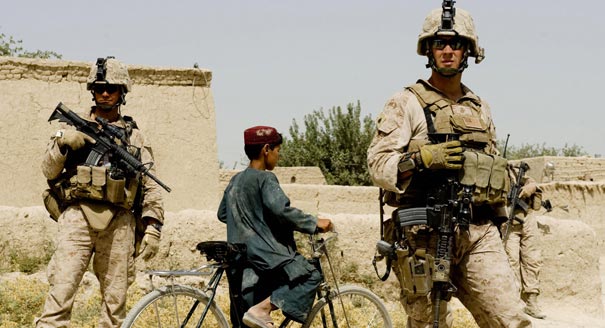
Source: Getty

Other

Creating New Facts on the Ground

Continued military pressure will allow the United States to alter the realities on the ground in Afghanistan, convince the Taliban to consider reconciliation, and enable effective regional diplomacy to find a successful solution for the country.

Link Copied
By Ashley J. Tellis
Published on May 4, 2011

  • Although meaningful cooperation in the region surrounding Afghanistan is of vital importance, it has been elusive because Afghanistan’s key neighbors have significantly divergent aims. Engineering a successful regional solution would require the United States to fundamentally transform either these actors’ objectives or their dominant strategies. Achieving the latter may prove more feasible, most crucially vis-à-vis Pakistan.

  • The region’s history of discord is mainly rooted in the troubled relationship between Afghanistan and Pakistan. Although Pakistan’s involvement in Afghanistan is colored by its rivalry with India, its relations with Afghanistan are a geopolitical challenge independent of India because of its fears of disorder along its western borders, the unwelcome idea of “Pashtunistan,” and a related long-standing border dispute.

  • Pakistan’s reaction to these problems has only exacerbated them. As Islamabad, by supporting the Taliban insurgency, has sought to exercise preponderant, if not overweening, influence over Kabul’s strategic choices, it has earned Kabul’s distrust, deepened the Kabul–New Delhi partnership, and increased the risk to its relations with Washington—not to mention threatening the lives of U.S. and other coalition forces operating in Afghanistan.

  • Despite widespread support in Afghanistan for ending the war through a negotiated settlement if possible, the Afghan Taliban leadership is unlikely to consider reconciliation unless it is faced with the prospect of continued losses of the kind sustained as a result of coalition military operations in 2010. A regional solution is similarly unlikely as long as Afghanistan and its neighbors, including India, perceive Islamabad as bent on holding Kabul in a choking embrace.

  • Solving these problems lies beyond the capability of American diplomacy, and right now even of the promised diplomatic surge. The best hope for progress lies in continuing military action to alter the realities on the ground—thereby inducing the Taliban to consider reconciliation, while simultaneously neutralizing the Pakistani strategy that is currently preventing a regional solution.

  • To increase the probability of military success, however, President Obama will need to forgo the politically calculated drawdown of combat troops this summer and instead accept the advice of his field commanders to maintain the largest possible contingent necessary for the coming campaign in eastern Afghanistan. Hard and unpalatable as it might be for the president, this course alone offers a solution that will protect the recent gains in Afghanistan and advance American interests over the long term.

About the Author

Ashley J. Tellis

Former Senior Fellow

Ashley J. Tellis was a senior fellow at the Carnegie Endowment for International Peace.

    Recent Work

  • Paper
    Multipolar Dreams, Bipolar Realities: India’s Great Power Future

      Ashley J. Tellis

  • Commentary
    India Sees Opportunity in Trump’s Global Turbulence. That Could Backfire.

      Ashley J. Tellis

Ashley J. Tellis
Former Senior Fellow
SecurityMilitaryForeign PolicySouth AsiaIndiaAfghanistanPakistan

Carnegie does not take institutional positions on public policy issues; the views represented herein are those of the author(s) and do not necessarily reflect the views of Carnegie, its staff, or its trustees.

More Work from Carnegie China

  • Commentary
    China’s Energy Security Doesn’t Run Through Hormuz but Through the Electrification of Everything

    Across Asia, China is better positioned to withstand energy shocks from the fallout of the Iran war. Its abundant coal capacity can ensure stability in the near term. Yet at the same time, the country’s energy transition away from coal will make it even less vulnerable during the next shock.


      • Damien Ma

      Damien Ma

  • Commentary
    Malaysia’s Year as ASEAN Chair: Managing Disorder

    Malaysia’s chairmanship sought to fend off short-term challenges while laying the groundwork for minimizing ASEAN’s longer-term exposure to external stresses.

      Elina Noor

  • Commentary
    When It Comes to Superpower Geopolitics, Malaysia Is Staunchly Nonpartisan

    For Malaysia, the conjunction that works is “and” not “or” when it comes to the United States and China.

      Elina Noor

  • Commentary
    Neither Comrade nor Ally: Decoding Vietnam’s First Army Drill with China

    In July 2025, Vietnam and China held their first joint army drill, a modest but symbolic move reflecting Hanoi’s strategic hedging amid U.S.–China rivalry.

      • Nguyen-khac-giang

      Nguyễn Khắc Giang

  • Commentary
    China’s Mediation Offer in the Thailand-Cambodia Border Dispute Sheds Light on Beijing’s Security Role in Southeast Asia

    The Thai-Cambodian conflict highlights the limits to China's peacemaker ambition and the significance of this role on Southeast Asia’s balance of power.

      Pongphisoot (Paul) Busbarat

Get more news and analysis from
Carnegie China
Carnegie China logo, white
Keck Seng Tower133 Cecil Street #10-01ASingapore, 069535Phone: +65 9650 7648
  • Research
  • About
  • Experts
  • Events
  • Contact
  • Careers
  • Privacy
  • For Media
Get more news and analysis from
Carnegie China
© 2026 Carnegie Endowment for International Peace. All rights reserved.






