

Article
Bernd von Muenchow-Pohl
{
  "authors": [
    "Bernd von Muenchow-Pohl"
  ],
  "type": "legacyinthemedia",
  "centerAffiliationAll": "dc",
  "centers": [
    "Carnegie Endowment for International Peace",
    "Carnegie Europe"
  ],
  "collections": [],
  "englishNewsletterAll": "ctw",
  "nonEnglishNewsletterAll": "",
  "primaryCenter": "Carnegie Endowment for International Peace",
  "programAffiliation": "SAP",
  "programs": [
    "South Asia"
  ],
  "projects": [],
  "regions": [
    "South Asia",
    "India",
    "Western Europe",
    "Asia",
    "Europe"
  ],
  "topics": [
    "Economy",
    "Trade",
    "Foreign Policy"
  ]
}
Source: Getty
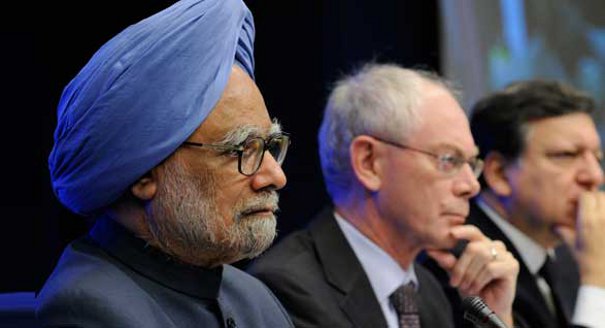
Despite initially high expectations, the enhanced relationship between India and the European Union has so far made relatively little impact and has fallen short of its own objectives.
Source: Great Indian Dream

From a historic perspective, the match seemed as if it would have a solid foundation. Adding a new dimension to its relationship with Europe, which was still overshadowed by the colonial past, New Delhi established diplomatic relations with the European Economic Community (EEC) as early as 1963. Ten years later, when Britain — India’s most important trading partner at the time — joined the original six EEC members, India’s loss of imperial trade preferences led to its first commercial cooperation agreement with the community. It took both sides another 20 years to sign their first political declaration after the EEC had morphed into an enlarged European Union of then twelve member states. In 2000, India’s raised economic and political profile and the EU’s desire to extend its newly defined political mission beyond the confines of the European continent after the end of the Cold War, brought about the first summit meeting in Lisbon. Successive annual summits heralded the EU-India Strategic Partnership (2004) and a voluminous Joint Action Plan for its implementation (2005).
Former Nonresident Scholar, South Asia Program
Von Muenchow-Pohl was a nonresident scholar in Carnegie’s South Asia Program, where his work focuses on Indian domestic, foreign, and economic policy.
Recent Work
Bernd von Muenchow-Pohl
Bernd von Muenchow-Pohl
Carnegie does not take institutional positions on public policy issues; the views represented herein are those of the author(s) and do not necessarily reflect the views of Carnegie, its staff, or its trustees.

China’s banking crisis in the 2000s was resolved by transferring the costs to households through financial repression—a decision that recapitalized the banks while exacerbating the structural imbalances that continue to shape the Chinese economy today.

Michael Pettis

Chinese biotech companies have been on the receiving end of U.S. economic coercion. Yet their responses have differed significantly because firm and state interests are not uniformly aligned. For Washington, treating all Chinese tech firms the same, irrespective of their actual interests, risks pushing them farther into Beijing’s corner.

Xue Gong

But their "principal to principal" model will only be as effective as the political strength of each leader back home.

Damien Ma

U.S. unpredictability has allowed China to capitalize on its positioning as the “responsible great power”. Paradoxically, the more China wins the perception game, the more likely expectations will rise for Beijing to deliver not just words but to demonstrate with its deeds.

Chong Ja Ian

Hanoi and Beijing have long treated each other as distant cousins rather than comrades in arms. That might be changing as both sides draw closer to hedge against uncertainty and America’s erratic behavior.

Nguyễn Khắc Giang