

Research
- +10
Rosa Balfour, Frances Z. Brown, Yasmine Farouk, …
{
  "authors": [
    "Moisés Naím"
  ],
  "type": "legacyinthemedia",
  "centerAffiliationAll": "",
  "centers": [
    "Carnegie Endowment for International Peace"
  ],
  "collections": [],
  "englishNewsletterAll": "",
  "nonEnglishNewsletterAll": "",
  "primaryCenter": "Carnegie Endowment for International Peace",
  "programAffiliation": "",
  "programs": [],
  "projects": [],
  "regions": [
    "North America",
    "United States"
  ],
  "topics": [
    "Political Reform",
    "Economy"
  ]
}
Source: Getty
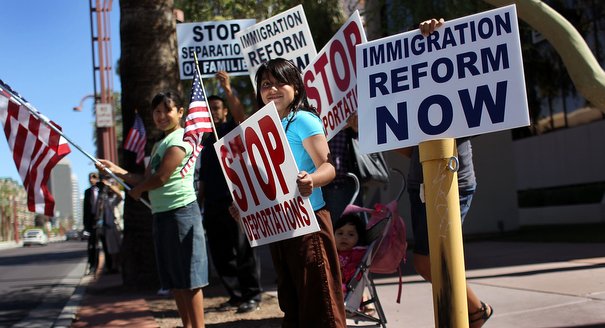
Alabama’s new immigration law, which has led to inadvertent arrests of foreign business executives, risks becoming the next example of a bad government decision bred by a period of economic trouble.
Source: Daily Beast

Mr. Hager, who was visiting the Mercedes Benz plant from headquarters, was driving a rented Kia, which was missing a license plate. This caught the attention of a policeman who stopped him and, as usual, asked for his driver’s license. The only document that Hager was carrying was his identification as a German citizen. It landed him in jail. That’s what the law (Alabama HB 56), as of October 1, 2011 commands. The new law mandates that anyone who does not carry identification proving their legal status in the country should be immediately jailed. Fortunately for Hager, colleagues went to his hotel and collected his passport with the appropriate visa as well as his German driver’s license, and eventually he was able to regain his freedom. Felyicia Jerald, spokeswoman for Mercedes Benz, reported that the company will “take steps to educate our visiting business guests and employees stationed in the U.S. of the documentation requirements for the State of Alabama.”
The idea behind the new legislation is to make daily life so difficult for illegal immigrants that they choose to go elsewhere without the need for costly and cumbersome police roundups. While the illegal immigrants understand the new law’s message loud and clear and many are already moving elsewhere, foreign car company executives have been slower to grasp the implications for them. Following Hager’s arrest, a Honda executive was similarly caught by police without carrying the proper documents and paid the consequences.
It has also become clear that, inadvertently, American citizens who are perfectly legal residents are being affected. Since the new law’s entry into force, 66 American citizens have been imprisoned for not having with them the papers that show that they are legal residents of their own country. Of these, half are black.
A major irony in all of this is that foreign companies harassed by the new law came to Alabama because of huge financial incentives offered by the State. For example, Alabama awarded a $253 million package of incentives to lure Mercedes Benz into setting up a plant there. Similar packages attracted Hyundai and Honda.
The anti-immigrant law is in direct conflict with the pro-foreign investment posture of the State. The incentives to attract foreigners who run industrial plants collides with the desire to expel foreign workers who immigrate illegally. The law’s drafters did not anticipate that it would make life less pleasant not just for illegal immigrants, but for the likes of Herr Hager.
Nothing threatens civility as much as scarcity. Generosity, altruism and tolerance become scarce when there is a shortage of jobs and money. In times of economic crisis, xenophobia blooms along with political conflict, protectionism and, in some places, racism. And we know the dangers engendered by these reactions to economic downturns. In the past, wars or the ascent of political movements that espouse repugnant ideas or bad government decisions that outlast the period of economic troubles have all been examples of these dangers. Hopefully, the current economic crisis will not cause reactions that will deserve to be included in the blackest chapters of our history.
Fortunately, competition in the United States sometimes works to limit the impact of bad ideas. States as well as businesses compete. Missouri, which is much more tolerant of immigrants and is also looking to attract new investors, is being actively promoted as a place where foreigners can work without being harassed. “In Missouri we have many advantages over Alabama,” says an editorial in the St. Louis Post-Dispatch. “We are the Show-Me State, not the ‘Show me your papers’ state.” Unless Alabama changes its law and the conditions that led to its enactment, in the long run Missouri will beat it in the competition for talent, good workers and foreign investment.

Distinguished Fellow
Moisés Naím is a distinguished fellow at the Carnegie Endowment for International Peace, a best-selling author, and an internationally syndicated columnist.
Recent Work



Rosa Balfour, Frances Z. Brown, Yasmine Farouk, …
Moisés Naím
Carnegie does not take institutional positions on public policy issues; the views represented herein are those of the author(s) and do not necessarily reflect the views of Carnegie, its staff, or its trustees.

China’s banking crisis in the 2000s was resolved by transferring the costs to households through financial repression—a decision that recapitalized the banks while exacerbating the structural imbalances that continue to shape the Chinese economy today.

Michael Pettis

But their "principal to principal" model will only be as effective as the political strength of each leader back home.

Damien Ma

U.S. unpredictability has allowed China to capitalize on its positioning as the “responsible great power”. Paradoxically, the more China wins the perception game, the more likely expectations will rise for Beijing to deliver not just words but to demonstrate with its deeds.

Chong Ja Ian

In the latest Five-Year Plan, the Chinese president cements the shift to an innovation-driven economy over a consumption-driven one.
Damien Ma

For Malaysia, the conjunction that works is “and” not “or” when it comes to the United States and China.

Elina Noor