• Commentary
  • Research
  • Experts
  • Events
Carnegie China logoCarnegie lettermark logo
{
  "authors": [
    "Douglas H. Paal"
  ],
  "type": "legacyinthemedia",
  "centerAffiliationAll": "dc",
  "centers": [
    "Carnegie Endowment for International Peace"
  ],
  "collections": [],
  "englishNewsletterAll": "asia",
  "nonEnglishNewsletterAll": "",
  "primaryCenter": "Carnegie Endowment for International Peace",
  "programAffiliation": "AP",
  "programs": [
    "Asia"
  ],
  "projects": [],
  "regions": [
    "North America",
    "United States",
    "East Asia",
    "China"
  ],
  "topics": [
    "Security",
    "Military",
    "Foreign Policy"
  ]
}
Source: Getty

In The Media

China Threats Walk a Fine Line in Run-up to U.S. Election

Portrayals of the Obama administration's return to Asia as an effort to contain China exaggerate competition between Washington and Beijing. As the 2012 presidential election draws near, U.S. officials must adopt a prudent approach to China in the face of mounting anti-China rhetoric.

Link Copied
By Douglas H. Paal
Published on Dec 19, 2011

Source: China Daily

China and the U.S.If you review this year's coverage of the Asia-Pacific region by the media, you might conclude that the United States has successfully tightened the noose of containment around China. News reports repeatedly returned to the theme of checking China's rise in power, such as in the South China Sea.

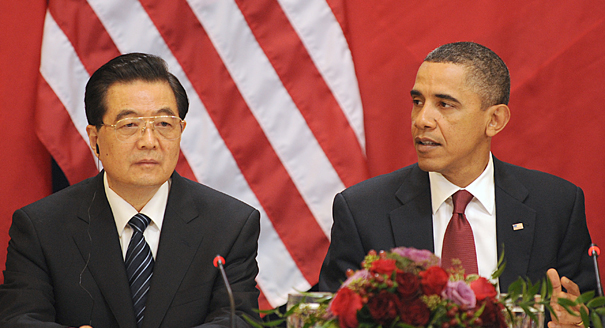
US President Barack Obama was considered to have come back "winner" from his 10-day visit to the region in November. Obama himself struck a stern note about trade and currency after meeting with China's President Hu Jintao at the APEC meeting. Some commentators in China detected an anti-China flavor in the Trans-Pacific Partnership's emphasis on "high quality" trade agreements, and the initial exclusion of China as a party to the talks. They did not note that China has, in fact, been signing its own deals of varying quality and scope without attempting to include the US.

The new American access to a training facility in Australia was portrayed as adding to Washington's string of bases in the region and placing the US in a better position to contend with China over the South China Sea issue and to be out of range of China's conventional missiles. The fact that this will be a training ground and not a base, with an initial detachment of 250 troops envisioned to grow only to 2,500, was less remarked upon.
 
Moreover, the remote distance of Australia from China and the unlikelihood of scenarios where the US Marines will play a role in any future conflict with China make the "anti-China base" story line a fiction.
 
In the run-up to the East Asian Summit (EAS), the US contended that the EAS should become the regional forum for political and security issues, in contrast with APEC's economic focus. And the US proposed an agenda, including maritime security and non-proliferation.
 
China sought to exclude discussion on maritime security from the agenda, arguing that maritime territorial disputes should be dealt with bilaterally and not in a multilateral setting. However, the South China Sea issue was finally presented on the table. This led to another round of stories about China being confronted by a region being led effectively by the US.
 
Finally, Obama's decision to dispatch Secretary of State Hillary Clinton to Myanmar was portrayed as essentially a play to pry away from China's grip one of its closest allies. Little effort was made to illustrate that the Myanmar story line is essentially a domestically driven one, not really the result of a new great game of strategic rivalry between the US and China. However, that real reform in Myanmar will have indirect implications for its relations with the two powers.
 
In general, the media coverage, perhaps inevitably, was too stark about the competition between Washington and Beijing. In fact, the US is just re-engaging in the region after more than a decade of reduced attention. That inattention started with the Asian financial crisis of 1997, when the Bill Clinton administration opted more out than in, and former Chinese president Jiang Zemin successfully stepped up China's diplomatic game.
 
But none of the lingering territorial, proliferation, military, economic, or other issues that beset the region, can be settled ultimately without China's cooperation or acquiescence, and Obama and the other leaders realize that.
 
Cold War rhetoric is not appropriate because the circumstances in the region are not of a Cold War nature. There is vigorous trade and investment across the region, and tourists and students are exchanged in huge numbers. China does not yet pose an existential or ideological threat.
 
But then there is politics. With an election year looming in the US, and a generational transition pending on the Chinese mainland and election in Taiwan, plus elections in Malaysia, Russia and Republic of Korea, 2012 will be a sensitive year politically.
 
Already, the Republican candidates for US president are lining up to take rhetorical shots at China. Obama's tough talk on trade in Hawaii suggests he is not going to allow himself to be outflanked and put on the defensive over China. He has already suffered from the media spin on his visit to China in 2009, which said he had been too weak.
 
The trick for American foreign policy officials will be to persuade China's officials and leaders that the US remains serious about cooperation with China, despite the rising rhetoric, and the need to occasionally to push China back.

About the Author

Douglas H. Paal

Distinguished Fellow, Asia Program

Paal previously served as vice chairman of JPMorgan Chase International and as unofficial U.S. representative to Taiwan as director of the American Institute in Taiwan.

    Recent Work

  • Paper
    America’s Future in a Dynamic Asia

      Douglas H. Paal

  • Q&A
    U.S.-China Relations at the Forty-Year Mark
      • +1

      Douglas H. Paal, Tong Zhao, Chen Qi, …

Douglas H. Paal
Distinguished Fellow, Asia Program
Douglas H. Paal
SecurityMilitaryForeign PolicyNorth AmericaUnited StatesEast AsiaChina

Carnegie does not take institutional positions on public policy issues; the views represented herein are those of the author(s) and do not necessarily reflect the views of Carnegie, its staff, or its trustees.

More Work from Carnegie China

  • Commentary
    Malaysia’s Year as ASEAN Chair: Managing Disorder

    Malaysia’s chairmanship sought to fend off short-term challenges while laying the groundwork for minimizing ASEAN’s longer-term exposure to external stresses.

      Elina Noor

  • Commentary
    When It Comes to Superpower Geopolitics, Malaysia Is Staunchly Nonpartisan

    For Malaysia, the conjunction that works is “and” not “or” when it comes to the United States and China.

      Elina Noor

  • Commentary
    ASEAN-China Digital Cooperation: Deeper but Clear-Eyed Engagement

    ASEAN needs to determine how to balance perpetuating the benefits of technology cooperation with China while mitigating the risks of getting caught in the crosshairs of U.S.-China gamesmanship.

      Elina Noor

  • Commentary
    Neither Comrade nor Ally: Decoding Vietnam’s First Army Drill with China

    In July 2025, Vietnam and China held their first joint army drill, a modest but symbolic move reflecting Hanoi’s strategic hedging amid U.S.–China rivalry.

      • Nguyen-khac-giang

      Nguyễn Khắc Giang

  • Commentary
    Today’s Rare Earths Conflict Echoes the 1973 Oil Crisis — But It’s Not the Same

    Regulation, not embargo, allows Beijing to shape how other countries and firms adapt to its terms.

      Alvin Camba

Get more news and analysis from
Carnegie China
Carnegie China logo, white
Keck Seng Tower133 Cecil Street #10-01ASingapore, 069535Phone: +65 9650 7648
  • Research
  • About
  • Experts
  • Events
  • Contact
  • Careers
  • Privacy
  • For Media
Get more news and analysis from
Carnegie China
© 2026 Carnegie Endowment for International Peace. All rights reserved.









