

• Commentary
  • Research
  • Experts
  • Events
Carnegie China logoCarnegie lettermark logo
{
  "authors": [
    "Uri Dadush",
    "Kati Suominen"
  ],
  "type": "legacyinthemedia",
  "centerAffiliationAll": "",
  "centers": [
    "Carnegie Endowment for International Peace"
  ],
  "collections": [],
  "englishNewsletterAll": "",
  "nonEnglishNewsletterAll": "",
  "primaryCenter": "Carnegie Endowment for International Peace",
  "programAffiliation": "",
  "programs": [],
  "projects": [],
  "regions": [
    "United States",
    "China",
    "North America"
  ],
  "topics": [
    "Economy",
    "Trade"
  ]
}

Source: Getty

In The Media

Is There Life for the G20 Beyond the Global Financial Crisis?

In 2008, the G20 proved to be an effective forum for coordinating action to stem the global financial crisis. But now that the storm has passed, it remains to be seen if the G20 is capable of assuming leadership on key economic governance issues.

Link Copied
By Uri Dadush and Kati Suominen
Published on Jan 31, 2012

Source: Journal of Globalization and Development

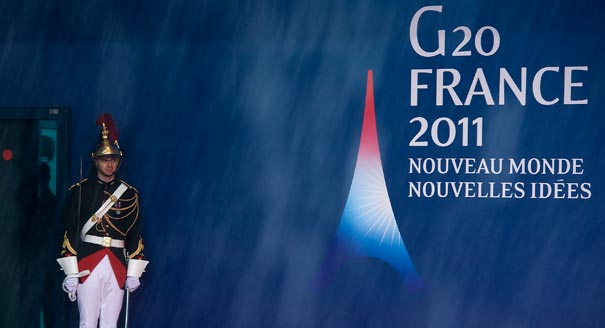
The G20 summit of heads of state, a creature born of the financial crisis, has appointed itself as the preeminent forum for global economic policymaking. Notwithstanding its original design to curb food price volatility, reform the global monetary system, and improve the working of the G20 itself, the group’s latest summit in Cannes, France in November 2011 was hijacked by the prolonged Eurozone financial crisis. An enormous source of turbulence in the world economy, Europe’s problems are the world’s problems and should be on the G20 agenda. But the Euro crisis also diverted the G20’s focus from its long-term imperative: ensuring sustained global economic growth. Instead, the outcome of the summit was inconclusive, vague, and thus modest: the group agreed in principle to increase the resources of the International Monetary Fund to respond to Europe’s woes; China modestly strengthened its pledge to move towards exchange flexibility to assuage critics of its currency manipulation; and the leaders yet again expressed their commitment to the Doha trade round.

The French summit epitomizes the difficulties in making sweeping yet specific decisions in a large, diverse group of nations with divergent interests. Comprising ten emerging markets, nine advanced economies, and the EU, the G20 reflects the reality of a world economy where developing and advanced countries are starting to have roughly equal economic weight. By including the largest emerging markets, it has the potential to fill a large gap in global economic governance that its predecessors – the G4 launched by US Treasury Secretary George Schultz in 1973, and the subsequent permutations, G5, G7 club of rich countries, and the G8, which also included Russia – were not built to bridge. The G7 helped the liberal democracies prevail in the Cold War and worked to enhance global macroeconomic stability, while the G8 sought to engage Russia after the collapse of the Soviet bloc. But with the onslaught of economic globalization and the rise of emerging economies, both groups are outdated as venues for global policy coordination. The G20, on the other hand, looks and feels like a 21st century forum.

About the Authors

Uri Dadush

Former Senior Associate, International Economics Program

Dadush was a senior associate at the Carnegie Endowment for International Peace. He focuses on trends in the global economy and is currently tracking developments in the eurozone crisis.

Kati Suominen

German Marshall Fund

Authors

Uri Dadush
Former Senior Associate, International Economics Program
Uri Dadush
Kati Suominen
German Marshall Fund
EconomyTradeUnited StatesChinaNorth America

Carnegie does not take institutional positions on public policy issues; the views represented herein are those of the author(s) and do not necessarily reflect the views of Carnegie, its staff, or its trustees.

More Work from Carnegie China

  • Commentary
    China Financial Markets
    Who Paid for China’s Last Debt Cleanup, and Who Will Pay for the Next?

    China’s banking crisis in the 2000s was resolved by transferring the costs to households through financial repression—a decision that recapitalized the banks while exacerbating the structural imbalances that continue to shape the Chinese economy today.

      Michael Pettis

  • Robot arm with disposable test tube virus sampling in laboratory
    Commentary
    Caught in the Middle: Chinese Biotech Firms’ Divergent Responses to U.S. Sanctions

    Chinese biotech companies have been on the receiving end of U.S. economic coercion. Yet their responses have differed significantly because firm and state interests are not uniformly aligned. For Washington, treating all Chinese tech firms the same, irrespective of their actual interests, risks pushing them farther into Beijing’s corner.

      Xue Gong

  • An aerial drone photo taken on June 4, 2026 shows a wind-photovoltaic power storage station of Huadian Inner Mongolia New Energy Co., Ltd. as part of the Horinger data center cluster green energy supply demonstration project, in Hohhot, north China's Inner Mongolia Autonomous Region.
    Commentary
    Are Data Centers the Solution to China’s Renewables Excess Capacity?

    China’s latest energy plan explicitly calls for integrating data centers into the electricity system, particularly connecting them to green energy. It appears Beijing wants to use compute as a source of domestic demand to absorb renewables excess capacity.

      • Damien Ma

      Damien Ma

  • Commentary
    Emissary
    Trump and Xi Are Angling for Three Years of Stability

    But their "principal to principal" model will only be as effective as the political strength of each leader back home.

      • Damien Ma

      Damien Ma

  • Commentary
    China Sells Stability Amid American Volatility

    U.S. unpredictability has allowed China to capitalize on its positioning as the “responsible great power”. Paradoxically, the more China wins the perception game, the more likely expectations will rise for Beijing to deliver not just words but to demonstrate with its deeds.

      Chong Ja Ian

Get more news and analysis from
Carnegie China
Carnegie China logo, white
Keck Seng Tower133 Cecil Street #10-01ASingapore, 069535Phone: +65 9650 7648
  • Research
  • About
  • Experts
  • Events
  • Contact
  • Careers
  • Privacy
  • For Media
Get more news and analysis from
Carnegie China
© 2026 Carnegie Endowment for International Peace. All rights reserved.






