

Commentary
Dmitri Trenin
{
  "authors": [
    "Dmitri Trenin"
  ],
  "type": "legacyinthemedia",
  "centerAffiliationAll": "",
  "centers": [
    "Carnegie Endowment for International Peace",
    "Carnegie China",
    "Carnegie Russia Eurasia Center"
  ],
  "collections": [
    "China’s Foreign Relations",
    "U.S.-China Relations"
  ],
  "englishNewsletterAll": "",
  "nonEnglishNewsletterAll": "",
  "primaryCenter": "Carnegie Endowment for International Peace",
  "programAffiliation": "",
  "programs": [],
  "projects": [
    "Eurasia in Transition"
  ],
  "regions": [
    "East Asia",
    "China",
    "Caucasus",
    "Russia",
    "North America",
    "United States"
  ],
  "topics": [
    "Foreign Policy"
  ]
}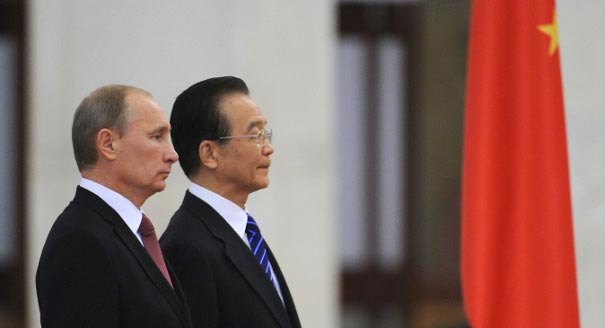
Source: Getty
As China's power continues to grow, Russians need to rediscover themselves as a Euro-Pacific nation and strengthen ties to East Asia in order to avoid becoming Beijing's junior partner.
Source: Public Service Europe

The remarkable thing is that, given the enormity of the change and its swiftness, Moscow and Beijing managed to end their 30-year-long Cold War in 1989 and moved toward a generally peaceful and collaborative arrangement. The thorny border issue, a fulcrum of tension in the past, has been resolved. And the border itself has been largely demilitarised. China has become Russia's biggest foreign trade partner, ahead of Germany. Russian arms sales over the past 20 years have helped the PLA to narrow the gap with the world's top militaries. With a number of smaller Central Asian states, China and Russia have formed the Shanghai Cooperation Organisation, which helps mitigate their regional rivalry and functions as a platform for dialogue involving much of continental Asia. Finally, on the global arena, Moscow and Beijing speak the language of multilateralism and insist on the sanctity of national sovereignty - and the principle of non-interference in domestic affairs. ...
Full text of the article in Public Service Europe
Former Director, Carnegie Moscow Center
Trenin was director of the Carnegie Moscow Center from 2008 to early 2022.
Recent Work
Dmitri Trenin
Dmitri Trenin
Carnegie does not take institutional positions on public policy issues; the views represented herein are those of the author(s) and do not necessarily reflect the views of Carnegie, its staff, or its trustees.

The Plaza Accord was not an externally imposed punishment of Japan but part of a broader restructuring that Japanese economists and policymakers themselves recognized was necessary. Its effects were undermined, however, when Tokyo responded to the resulting slowdown with policies that exacerbated investment, credit expansion, and the very imbalances the adjustment was intended to resolve.

Michael Pettis

The nuclear relationship between China and the United States is increasingly shaped by widening perception gaps rather than deliberate strategic design.

Tong Zhao
China’s banking crisis in the 2000s was resolved by transferring the costs to households through financial repression—a decision that recapitalized the banks while exacerbating the structural imbalances that continue to shape the Chinese economy today.
Michael Pettis

Chinese biotech companies have been on the receiving end of U.S. economic coercion. Yet their responses have differed significantly because firm and state interests are not uniformly aligned. For Washington, treating all Chinese tech firms the same, irrespective of their actual interests, risks pushing them farther into Beijing’s corner.

Xue Gong

China’s latest energy plan explicitly calls for integrating data centers into the electricity system, particularly connecting them to green energy. It appears Beijing wants to use compute as a source of domestic demand to absorb renewables excess capacity.

Damien Ma