

Article
Frederic Wehrey, Charles H. Johnson
{
  "authors": [
    "Frederic Wehrey"
  ],
  "type": "legacyinthemedia",
  "centerAffiliationAll": "dc",
  "centers": [
    "Carnegie Endowment for International Peace",
    "Malcolm H. Kerr Carnegie Middle East Center"
  ],
  "collections": [],
  "englishNewsletterAll": "menaTransitions",
  "nonEnglishNewsletterAll": "",
  "primaryCenter": "Carnegie Endowment for International Peace",
  "programAffiliation": "MEP",
  "programs": [
    "Middle East"
  ],
  "projects": [],
  "regions": [
    "Middle East",
    "Yemen",
    "Gulf"
  ],
  "topics": [
    "Political Reform",
    "Security",
    "Foreign Policy"
  ]
}
Source: Getty
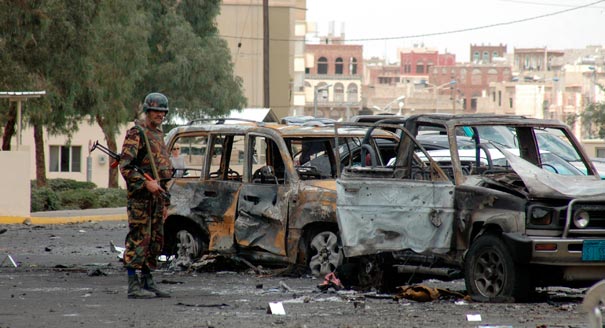
The struggle to root out al-Qaeda in the Arabian Peninsula will require extensive Yemeni and U.S. cooperation, but it is ultimately a problem that the Yemenis must solve.
Source: Fox News
In the continued fight against Al Qaeda in the Arabian Peninsula (AQAP), the Obama administration has relied on a two-track strategy of conducting drone strikes and working to build the capacity of the Yemeni government. Speaking with Fox News, Carnegie's Frederic Wehrey explained that this dual track approach “is the best option given the circumstances and the lessons we’ve learned from Iraq and Afghanistan." Wehrey discussed how AQAP, like other branches of al Qaeda, feeds off the local grievances in a country.
In response to a question regarding whether or not the administration should utilize a larger military campaign, Wehrey noted, “This is ultimately a Yemeni problem that will have to be addressed and solved by the Yemenis.” Indeed, there is mounting evidence that the drone strikes are exacerbating radicalization, he added. Ultimately, the struggle to root out AQAP is destined to be a long battle that will require extensive Yemeni and U.S. cooperation, Wehrey concluded.

Senior Fellow, Middle East Program
Frederic Wehrey is a senior fellow in the Middle East Program at the Carnegie Endowment for International Peace, where his research focuses on governance, conflict, and security in Libya, North Africa, and the Persian Gulf.
Recent Work
Frederic Wehrey, Charles H. Johnson
Frederic Wehrey, Charles H. Johnson
Carnegie does not take institutional positions on public policy issues; the views represented herein are those of the author(s) and do not necessarily reflect the views of Carnegie, its staff, or its trustees.

China’s political future will be shaped between now and next October. As the Communist Party enters its intense “campaign season” to prepare for a major political transition in 2027, reading Beijing's actions and responses may become more difficult as domestic politics weigh on its behavior more than usual.

Damien Ma

But their "principal to principal" model will only be as effective as the political strength of each leader back home.
Damien Ma

U.S. unpredictability has allowed China to capitalize on its positioning as the “responsible great power”. Paradoxically, the more China wins the perception game, the more likely expectations will rise for Beijing to deliver not just words but to demonstrate with its deeds.

Chong Ja Ian

Hanoi and Beijing have long treated each other as distant cousins rather than comrades in arms. That might be changing as both sides draw closer to hedge against uncertainty and America’s erratic behavior.

Nguyễn Khắc Giang

Across Asia, China is better positioned to withstand energy shocks from the fallout of the Iran war. Its abundant coal capacity can ensure stability in the near term. Yet at the same time, the country’s energy transition away from coal will make it even less vulnerable during the next shock.
Damien Ma