

Commentary
Nathan J. Brown
{
  "authors": [
    "Nathan J. Brown"
  ],
  "type": "legacyinthemedia",
  "centerAffiliationAll": "dc",
  "centers": [
    "Carnegie Endowment for International Peace"
  ],
  "collections": [
    "Arab Awakening"
  ],
  "englishNewsletterAll": "menaTransitions",
  "nonEnglishNewsletterAll": "",
  "primaryCenter": "Carnegie Endowment for International Peace",
  "programAffiliation": "MEP",
  "programs": [
    "Middle East"
  ],
  "projects": [],
  "regions": [
    "North Africa",
    "Egypt"
  ],
  "topics": [
    "Political Reform"
  ]
}
Source: Getty
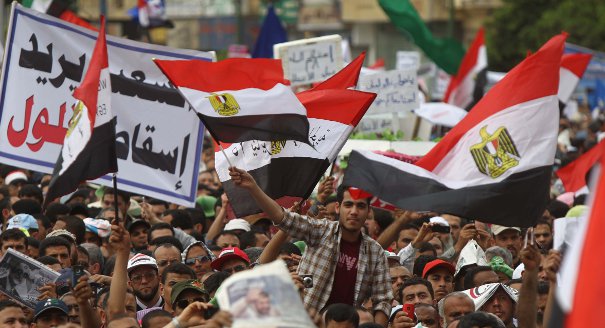
The democratic spirit that seems to have struck deep roots in Egyptian society may still ensure that when everything that could go wrong does go wrong, the country can still recover.
Source: National Interest

Both candidates immediately attempted to shake the Etch A Sketch. Shafik, who had run in the first round as the strongman who would face down the Islamists, suddenly explained that he would be quite willing to work with the Islamist majority already elected to parliament. And Morsi immediately reached out to the candidates he had defeated narrowly and posed as the rainbow candidate of the broad coalition of revolutionary forces.
But Egyptians are still in for an unpleasant campaign. On the surface, narrowing down the field to two opponents is likely to set off the sort of negative campaigning and character assassination that had been mercifully muted in the multicandidate first round.And more deeply, a very nasty kind of sectarianism has already emerged. You will not hear it from the candidates themselves, who will speak sweetly of national unity. (In his final campaign rally before the first round of voting, I heard Mohamed Morsi use symbolic language of "Muslim and Copt," "mosque and church," and even the martyrs of "Tahrir and Maspiro," the latter referring to the largely Christian victims killed last year while demonstrating at the state-television complex.) But Egyptian Christians, understandably nervous about the Islamist rise, lurched heavily toward Shafik in the the days before the election and away from more consensual or prorevolution candidates. That seems to have been enough to help Shafik place second; in the June balloting, it is difficult to imagine many Christians voting for Morsi. Some will hold them responsible for visiting upon them a security-minded former general, promising "deeds, not words" and delivering prerevolutionary rhetoric, thus reopening wounds and divisions that seemed to have healed a year ago.
And if a Shafik candidacy is divisive, his victory would likely be worse: his sudden rise in the polls; the refusal of the Presidential Election Commission to enforce legislation designed to bar him; the manner in which state-owned media seemed to revert to habit by boosting his candidacy; and his position as Mubarak's last prime minister have all have led many revolutionary groups to insist that any election resulting in a Shafik victory is by definition fraudulent. Rather than concentrate on the looming economic crisis, Egypt might easily plunge into a dangerous mix of paralysis and disorder.
If Shafik would lead to gridlock, Morsi offers just the opposite. Islamists dominate the parliament but have been able to do little with their majority because executive authority lies with an unaccountable cabinet and the Supreme Council of the Armed Forces (SCAF), the interim military leadership. Their few accomplishments have sometimes been blocked by the courts. But if the presidency and parliament were both in their hands, the cabinet would follow. In Mubarak's Egypt, the president served as chairman of the SCAF. Under the country's interim constitution, the president also chairs the National Defense Council. Of course, nobody expects real civilian oversight of the military and security forces to operate immediately, but those who wonder if the military will surrender power have often overlooked the degree to which key Egyptian institutions are currently hardwired to place authority on the president's desk.
A Morsi victory would test whether the Brotherhood's strong constitutional position would allow it to overcome resistance by what is called in some other nominally democratic systems the "deep state"—the shadowy web of security, military and elite leaders who seem able to call all the shots. There may indeed be something of a deep state in Egypt, but robbed of the presidency, it may lack coherence (and, if the past year is any indication, competence). What might be more likely than a soft or hard coup is grinding guerilla warfare in which the deep state gradually retreats.
Should that happen, Egypt's political fate likely would be determined by three things. First, can the Brotherhood deliver on its ambitious "Renaissance Project" and its promise to deliver clean government, jobs, education, health care—and even an end to traffic tie ups? Second, can the Brotherhood coexist with the less shadowy parts of the Egyptian state (the courts, the bureaucracy, the various ministries, councils and state bodies that are not used to dealing with either Islamist leaders or democratic oversight)? And third, can clear constitutional rules be written that protect minority rights, make lines of accountability clear and facilitate the development of democratic habits?
There is no doubt that in foreign-policy terms, a Morsi victory would be a severe headache. But for Egyptians focusing on domestic concerns, the real question is whether they have traded the tyranny of an autocratic ruler for the tyranny of the majority. For all the mistakes made over the past year, I am not pessimistic. The democratic spirit that seems to have struck deep roots in the society may still ensure that when everything that could go wrong does go wrong, the country can still recover.
This article originally appeared in the National Interest.

Nonresident Senior Fellow, Middle East Program
Nathan J. Brown, a professor of political science and international affairs at George Washington University, is a distinguished scholar and author of nine books on Arab politics and governance, as well as editor of five books.
Recent Work
Nathan J. Brown
Nathan J. Brown
Carnegie does not take institutional positions on public policy issues; the views represented herein are those of the author(s) and do not necessarily reflect the views of Carnegie, its staff, or its trustees.
Transactional relationships are stable but can be shallow.



Paul Haenle, Maha Yahya, Benjamin Ho, …
It’s about managing oil prices, bread prices, and strategic partnerships.



Amr Hamzawy, Karim Sadjadpour, Aaron David Miller, …
The murder of George Floyd has underscored the deep inequities that have long plagued American society. In a note to the Carnegie community, Bill Burns reflects on Carnegie’s commitment to build a more just future here at home and around the world, without which peace will remain beyond our grasp.

William J. Burns

While the world hoped this pandemic might lead to more cooperation between these two great powers, American and Chinese leaders instead fell into a blame game and allowed their increasing suspicions to guide their decision-making.
Lyu Jinghua

Biological viruses and computer malware differ in important respects. They have considerable potential to spread widely, invading, disrupting and destroying their targets.

Ariel (Eli) Levite, Lyu Jinghua