

Commentary
But their "principal to principal" model will only be as effective as the political strength of each leader back home.
Damien Ma
{
  "authors": [
    "Seyed Hossein Mousavian"
  ],
  "type": "questionAnswer",
  "centerAffiliationAll": "",
  "centers": [
    "Carnegie Endowment for International Peace"
  ],
  "collections": [],
  "englishNewsletterAll": "",
  "nonEnglishNewsletterAll": "",
  "primaryCenter": "Carnegie Endowment for International Peace",
  "programAffiliation": "",
  "programs": [],
  "projects": [],
  "regions": [
    "Middle East",
    "Iran"
  ],
  "topics": [
    "Foreign Policy",
    "Nuclear Policy"
  ]
}
Source: Getty
Iran’s nuclear program continues to be a source of tension between Iran and the West, but there appears to be an increasingly positive atmosphere in Iran for reaching a nuclear deal.
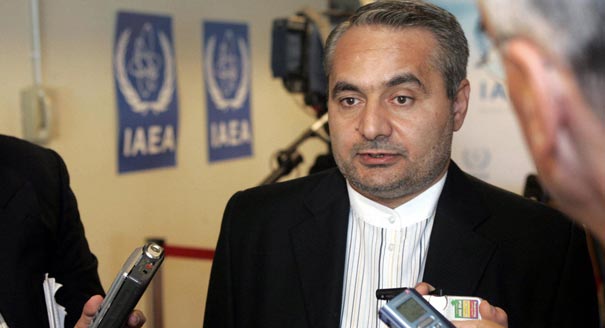
Iran’s nuclear program continues to be a source of tension between Iran and the West. Hossein Mousavian, the former spokesmen for Iran’s nuclear negotiating team and author of the forthcoming book, The Iranian Nuclear Crisis: A Memoir, speaks with Tom Carver about what the negotiations with the West over Iran’s nuclear activities are like from inside Iran. Mousavian sees an increasingly positive atmosphere in Iran for reaching a nuclear deal and believes that a military strike on Iran, while highly unlikely, would be catastrophic for the entire region.
MOUSAVIAN: On the nuclear negotiations, the ultimate decisionmaker is the Supreme Leader. This is not only on nuclear issues. By the Iranian constitution, the main issues on foreign policy are all decided ultimately by the religious leader.
It doesn’t matter who rules Iran—monarchy or clerics. If clerics, it is an Islamic Republic. If the president is moderate like Rafsanjani or reformist like Khatami or radical or conservative like Ahmadinejad, it doesn’t matter. This is the red line: no nuclear bomb but nuclear technology.
CARVER: You were arrested in 2007 for criticizing the President. What was that about?
MOUSAVIAN: The president was publically, without naming me, was raising espionage charges. Because of these accusations, three courts and three judges during 2007 and 2008 investigated my files and I was cleared of the charges.
CARVER: So this was politically motivated?
MOUSAVIAN: I’m sure.
CARVER: It seems that in the last few weeks, the whole tone of the negotiations with the West have become more positive. Is that right, do you think?
MOUSAVIAN: Definitely there is a much more positive atmosphere. It is not only in the West. It is also within Iranian public opinion and Iranian politicians are much more optimistic today. And the reason is because of the recent meeting in Istanbul.
The P5+1 accepted to find a solution within the Non-Proliferation Treaty. Before, they were always asking for requirements from Iran beyond the NPT, like zero enrichment.
They have admitted the principle of reciprocity. This was something that since 2003 we were telling them. That if you are going to find a face-saving solution, we need reciprocity. If we take one step, you should take one step and go forward.
They were not ready. They were always telling us, “You should take steps.” And in the end, they agreed to a step-by-step plan. In my book, I have explained that all proposals we made since 2003 were step-by-step plans. But the P5+1 and EU3 were looking at a piecemeal approach. Iran has always been looking for a broad package to be implemented step by step because Iranians always want to see the end state, the end game.
CARVER: Do you think that military action against Iran is likely?
MOUSAVIAN: I think this is not very likely because the United States has learned a lot about the military strikes they conducted against Afghanistan and Iraq. As far as I understand, neither the United States nor the Europeans are ready for a third war in the Middle East. And I cannot imagine Israel would go for a unilateral military strike against Iran without U.S. engagement or U.S. backing.
CARVER: And if it were to happen, the effect on the regime would be what?
MOUSAVIAN: If there is a military strike, from either Israelis unilaterally or with Americans, it would be a disaster. On the nuclear issue, I’m convinced Iran would withdraw from the NPT and no one can guarantee then that Iranians would not divert to a nuclear weapon because this would be an existential threat for Iran. And the consequences would engulf the whole region and beyond. This would be catastrophic.
Seyed Hossein Mousavian
Princeton University
Carnegie does not take institutional positions on public policy issues; the views represented herein are those of the author(s) and do not necessarily reflect the views of Carnegie, its staff, or its trustees.

But their "principal to principal" model will only be as effective as the political strength of each leader back home.

Damien Ma

U.S. unpredictability has allowed China to capitalize on its positioning as the “responsible great power”. Paradoxically, the more China wins the perception game, the more likely expectations will rise for Beijing to deliver not just words but to demonstrate with its deeds.

Chong Ja Ian

Hanoi and Beijing have long treated each other as distant cousins rather than comrades in arms. That might be changing as both sides draw closer to hedge against uncertainty and America’s erratic behavior.

Nguyễn Khắc Giang

Across Asia, China is better positioned to withstand energy shocks from the fallout of the Iran war. Its abundant coal capacity can ensure stability in the near term. Yet at the same time, the country’s energy transition away from coal will make it even less vulnerable during the next shock.
Damien Ma

Malaysia’s chairmanship sought to fend off short-term challenges while laying the groundwork for minimizing ASEAN’s longer-term exposure to external stresses.

Elina Noor