

Commentary
Sarah Chayes
{
  "authors": [
    "Sarah Chayes"
  ],
  "type": "legacyinthemedia",
  "centerAffiliationAll": "dc",
  "centers": [
    "Carnegie Endowment for International Peace"
  ],
  "collections": [
    "Arab Awakening"
  ],
  "englishNewsletterAll": "democracy",
  "nonEnglishNewsletterAll": "",
  "primaryCenter": "Carnegie Endowment for International Peace",
  "programAffiliation": "DCG",
  "programs": [
    "Democracy, Conflict, and Governance"
  ],
  "projects": [],
  "regions": [
    "North Africa",
    "Egypt"
  ],
  "topics": [
    "Political Reform",
    "Democracy",
    "Foreign Policy"
  ]
}
Source: Getty
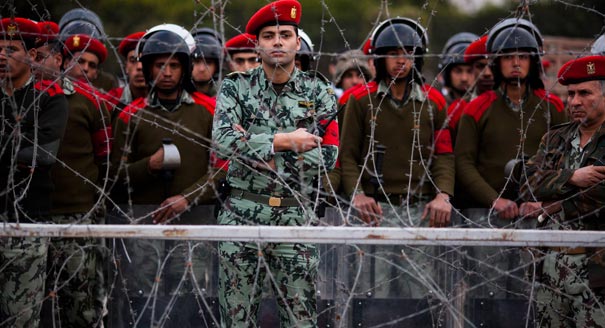
In the face of a power grab by its armed forces, the United States should consider suspending some or all of its military aid to Cairo.
Source: Los Angeles Times

Two weeks ago, the Supreme Constitutional Court dissolved the parliament, saying electoral rules had been broken. Then the Supreme Council of the Armed Forces exempted itself from civilian oversight and claimed a decisive role in lawmaking and in the drafting of Egypt's constitution. It also assigned a general to "advise" Egypt's new president.
In the face of this power grab, for the sake of U.S. credibility as well as our long-term interests, the U.S. should suspend some or all of its military aid to Egypt.The 2012 Appropriations Act stipulates that the U.S. can provide such aid only if the secretary of State certifies to Congress that the Egyptian leadership "is supporting the transition to civilian government, including holding free and fair elections, and implementing ... due process of law." But Congress also left an escape clause. The secretary of State can waive this democratization requirement "in the national security interest of the United States."
That is precisely what happened in March. After intense interagency debate, the requirement was waived, and military assistance is now flowing to Egypt at a rate of $170 million a month.
As painful as a cutoff might be to an outsized military in cash-strapped Egypt, damming the flow won't necessarily curb the ruling generals' actions in the short run. Sheer self-preservation might be a weightier consideration. Since Hosni Mubarak came to power, the military has played a preponderant role in Egypt, enjoying a secretive insulation from the public, little or no governmental oversight and huge economic interests and privileges, including palatial homes on the Mediterranean, free vehicles, vacations, food produced on military farms and high-paid positions in military-owned businesses upon retirement.
Along with toppling Mubarak, the Tahrir Square revolution was aimed at ending such excesses and at laying bare the military's shady workings and inbred structures, and holding perpetrators accountable. Democracy, in other words, personally threatens many Egyptian generals.
These men seem to be gambling that the U.S. will put what it sees as immediate national security objectives ahead of its commitment to fundamental values. There is plenty of evidence to support such a notion. Our equivocal response to the democracy movements in Yemen, where the structures of the old regime remain largely in place, and in Bahrain, where Saudi tanks crushed a peaceful protest movement that mobilized a third of the citizenry, are just the most recent cases in point.
According to media reports of the March interagency deliberations, U.S. domestic economic considerations also influenced the decision to waive the democratization conditions on military aid. "A delay or a cut in ... military aid to Egypt risked breaking existing contracts with American arms manufacturers that could have shut down production lines," the New York Times said on March 23.
Finally, the election as president of the Muslim Brotherhood's Mohammed Morsi, together with its victory in parliamentary elections, may be cooling the democratic ardor of some in Egypt and the U.S. Some may be breathing a private sigh of relief that the Supreme Council has "saved" Egypt from Islamist rule.
Such an attitude would be shortsighted. A growing body of evidence, from such disparate countries as Afghanistan and Nigeria, suggests a correlation between abusively corrupt regimes and the rise of radical Islam. As demonstrated by Algeria, where a canceled election led to a decade of violence in the 1990s, shutting off legitimate avenues to political and economic inclusiveness is not a good recipe for keeping violent Islamist extremism in check.
The degree to which the U.S. is seen as enabling such abuses of power will determine whether populations around the world see us as hostile to their interests. For these reasons, and because it is time to shift the weight of our aid from military to civilian purposes, continuing to finance the Egyptian generals now would not serve long-term U.S. national interests.
This article was originally published in the Los Angeles Times.
Former Senior Fellow, Democracy, Conflict, and Governance Program
Sarah Chayes is internationally recognized for her innovative thinking on corruption and its implications. Her work explores how severe corruption can help prompt such crises as terrorism, revolutions and their violent aftermaths, and environmental degradation.
Recent Work
Sarah Chayes
Carnegie does not take institutional positions on public policy issues; the views represented herein are those of the author(s) and do not necessarily reflect the views of Carnegie, its staff, or its trustees.

U.S. unpredictability has allowed China to capitalize on its positioning as the “responsible great power”. Paradoxically, the more China wins the perception game, the more likely expectations will rise for Beijing to deliver not just words but to demonstrate with its deeds.

Chong Ja Ian

Hanoi and Beijing have long treated each other as distant cousins rather than comrades in arms. That might be changing as both sides draw closer to hedge against uncertainty and America’s erratic behavior.

Nguyễn Khắc Giang

Across Asia, China is better positioned to withstand energy shocks from the fallout of the Iran war. Its abundant coal capacity can ensure stability in the near term. Yet at the same time, the country’s energy transition away from coal will make it even less vulnerable during the next shock.

Damien Ma

Malaysia’s chairmanship sought to fend off short-term challenges while laying the groundwork for minimizing ASEAN’s longer-term exposure to external stresses.

Elina Noor

For Malaysia, the conjunction that works is “and” not “or” when it comes to the United States and China.
Elina Noor