

Commentary
Judy Dempsey
{
  "authors": [
    "Judy Dempsey"
  ],
  "type": "legacyinthemedia",
  "centerAffiliationAll": "",
  "centers": [
    "Carnegie Endowment for International Peace",
    "Carnegie Europe"
  ],
  "collections": [
    "Transatlantic Cooperation"
  ],
  "englishNewsletterAll": "",
  "nonEnglishNewsletterAll": "",
  "primaryCenter": "Carnegie Europe",
  "programAffiliation": "",
  "programs": [],
  "projects": [],
  "regions": [
    "Europe",
    "North America",
    "Southern, Eastern, and Western Africa"
  ],
  "topics": [
    "Foreign Policy"
  ]
}
Source: Getty
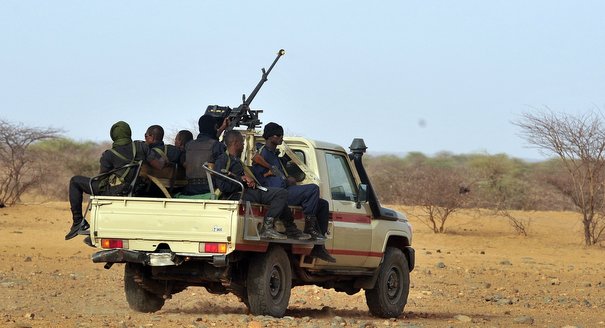
Europeans and Americans need to pay attention to the dangerous terrorist threat that is developing in sub-Saharan Africa.
Source: Munich Calling

So great is the fear of this happening, that neighboring countries are asking France, the former colonial power in the region, and the European Union to step in. Niger’s Prime Minister, Brigi Rafini lobbied Brussels earlier this month to raise the alarm. He told Jose Manuel Barroso, the EU’s Commission president, just how dangerous the situation had become. Al-Qaeda was in a position to use Mali as a launching pad for the entire region.
In Mali, the rise of Ansar al-Din, Islamic fundamentalists who are very close to al-Qaeda in the Islamic Maghreb, or AQIM, began when al-Qaeda militants who were driven out of Afghanistan, strengthened their bases in Yemen, Sudan, Somalia and further west.Mali, which had been considered one of Africa’s more peaceful, stable and democratic countries, provided an ideal breeding ground for Ansar al-Din. The organization was able to exploit both divisions inside the country and the fall out from the Arab Spring.
Since the fall of the Qaddafi regime, Tuareg mercenaries from northern Mali, Niger and Algeria, who had been in the pay of the late Muammar Qaddafi, returned home. This influx of well-armed fighters into northern Mali gave the Tuareg separatist movement there such a boost that it managed to drive out the Mali military and proclaim an independent state called Azawad.
To gain access to guns and money, the Tuareg nationalists, in spite of being a secular movement, then teamed up with the Islamic fundamentalist movement of Ansar al-Din, the “defenders of the faith”. It is far from clear if this accord will hold. The Tuareg tribe is divided over the deal especially when Ansar al-Din announced its intentions to impose Shari’ah law and expel all non-Muslim non-governmental organizations.
Still, France is extremely worried. In March, the French foreign minister Alain Juppe was warned by Mali’s neighbors that the region risked becoming a “west African Afghanistan” if Ansar al-Din gained control of the north. In the meantime, the south of Mali also got embroiled in conflict. In March, the army staged a coup in the capital, Bamako, because it was frustrated that it had not been given sufficient resources to defeat the rebellion in the north.
While military officers agreed to support an interim civilian government, the junta is still very much in control. The public does not support the junta but has some sympathy for its cause. The former government led by President Amadolu Toumani Toure neglected to provide basic services, denying young people a proper education and thus a perspective in life.
With such turmoil in the south of the country, it is difficult to see how the junta or the interim civilian government can contain the influence of Ansar al-Din and deal with the prospect of a divided country. Clearly, this is not the time for the United States and Europe to sit around and wait for things to get worse in this part of western Africa. The fear of contagion is all too great.
Even before Francois Hollande was elected President of France, his foreign policy advisors discussed in Washington how the U.S. and France could work together in Africa. "There is a risk that it could be the same in (other) parts of the Sahel, and we know that the instability in Mali could also spread to neighboring countries,” Anders Piebalgs, the EU Development Commissioner said recently.
Yet so far, the EU, has only reacted by suspending its development aid projects in Mali. That is not a strategy. What other options are there? Clearly, both Europe and the U.S. need to work intensely with the civilian government in Bamako as well as with the secular Tuaregs to find ways to counter the Islamist influence.
Western countries will probably also have to assist with food distribution and help retrain Mali’s army. Can anyone imagine how much more dangerous the world could become if Mali was ruled by al-Qaeda and then al-Qaeda set its sights on its northern neighbors, Algeria, Libya and Egypt, not to mention Mauritania to the west and Niger to the east?
Making Mali safe again, is an enormous task – and one that Europe and America will ignore at their peril.
This article was originally published in the Munich Security Conference's Munich Calling.

Nonresident Senior Fellow, Carnegie Europe
Judy Dempsey is a nonresident senior fellow at Carnegie Europe
Recent Work
Judy Dempsey
Judy Dempsey
Carnegie does not take institutional positions on public policy issues; the views represented herein are those of the author(s) and do not necessarily reflect the views of Carnegie, its staff, or its trustees.

But their "principal to principal" model will only be as effective as the political strength of each leader back home.

Damien Ma

U.S. unpredictability has allowed China to capitalize on its positioning as the “responsible great power”. Paradoxically, the more China wins the perception game, the more likely expectations will rise for Beijing to deliver not just words but to demonstrate with its deeds.

Chong Ja Ian

Hanoi and Beijing have long treated each other as distant cousins rather than comrades in arms. That might be changing as both sides draw closer to hedge against uncertainty and America’s erratic behavior.

Nguyễn Khắc Giang

Across Asia, China is better positioned to withstand energy shocks from the fallout of the Iran war. Its abundant coal capacity can ensure stability in the near term. Yet at the same time, the country’s energy transition away from coal will make it even less vulnerable during the next shock.
Damien Ma

Malaysia’s chairmanship sought to fend off short-term challenges while laying the groundwork for minimizing ASEAN’s longer-term exposure to external stresses.

Elina Noor