

Commentary
Judy Dempsey
{
  "authors": [
    "Judy Dempsey"
  ],
  "type": "legacyinthemedia",
  "centerAffiliationAll": "",
  "centers": [
    "Carnegie Endowment for International Peace",
    "Carnegie Europe"
  ],
  "collections": [],
  "englishNewsletterAll": "",
  "nonEnglishNewsletterAll": "",
  "primaryCenter": "Carnegie Europe",
  "programAffiliation": "",
  "programs": [],
  "projects": [],
  "regions": [
    "Europe"
  ],
  "topics": [
    "Foreign Policy"
  ]
}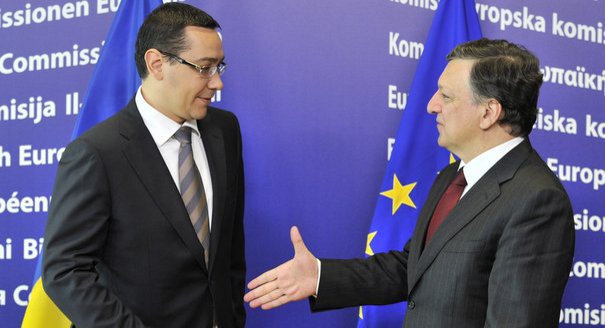
Source: Getty
What can realistically be done to persuade the governments of Romania and Bulgaria to embrace long-term commitments to establishing the rule of law and fighting corruption?
Source: New York Times

But what can realistically be done to persuade the two governments to embrace long-term commitments to establishing the rule of law and fighting corruption?
As I explain in my latest Page Two column, Bulgaria and Romania were allowed to join the Union in 2007, though these problems were evident then — and reported by the E.U. — because of the belief that joining the Union would encourage the reformers while exclusion would hurt efforts to modernize the countries.But now the European Commission has a responsibility to act. It can do several things. It might withhold the special structural and development funds that amount to several hundred million euros. It has already delayed both countries’ access to the Schengen accord that would allow their citizens to cross most European Union borders without passports.
The ultimate sanction would be to suspend the voting rights of Bulgaria and Romania. In practice it would mean that neither country would be able to vote along with the other E.U. member states on issues that affect them.
It would, however, be extremely difficult for the member states to reach agreement on suspending voting rights.
But if the E.U. is true to its word about upholding democracy, the rule of law and human rights, then the option to suspend voting rights should be taken seriously.
Doing so would also send a signal to countries applying to join the bloc, such as Serbia, that the E.U. is not going to allow its strategy of enlargement to be tainted by corruption.
Indeed, if anything, say analysts, the unfinished transitions in Bulgaria and Romania point to the difficulties the E.U. will encounter when dealing with other Balkan candidate countries.

Nonresident Senior Fellow, Carnegie Europe
Judy Dempsey is a nonresident senior fellow at Carnegie Europe
Recent Work
Judy Dempsey
Judy Dempsey
Carnegie does not take institutional positions on public policy issues; the views represented herein are those of the author(s) and do not necessarily reflect the views of Carnegie, its staff, or its trustees.

But their "principal to principal" model will only be as effective as the political strength of each leader back home.

Damien Ma

U.S. unpredictability has allowed China to capitalize on its positioning as the “responsible great power”. Paradoxically, the more China wins the perception game, the more likely expectations will rise for Beijing to deliver not just words but to demonstrate with its deeds.

Chong Ja Ian

Hanoi and Beijing have long treated each other as distant cousins rather than comrades in arms. That might be changing as both sides draw closer to hedge against uncertainty and America’s erratic behavior.

Nguyễn Khắc Giang

Across Asia, China is better positioned to withstand energy shocks from the fallout of the Iran war. Its abundant coal capacity can ensure stability in the near term. Yet at the same time, the country’s energy transition away from coal will make it even less vulnerable during the next shock.
Damien Ma

Malaysia’s chairmanship sought to fend off short-term challenges while laying the groundwork for minimizing ASEAN’s longer-term exposure to external stresses.

Elina Noor