

Commentary
Judy Dempsey
{
  "authors": [
    "Judy Dempsey"
  ],
  "type": "legacyinthemedia",
  "centerAffiliationAll": "",
  "centers": [
    "Carnegie Endowment for International Peace",
    "Carnegie Europe"
  ],
  "collections": [],
  "englishNewsletterAll": "",
  "nonEnglishNewsletterAll": "",
  "primaryCenter": "Carnegie Europe",
  "programAffiliation": "",
  "programs": [],
  "projects": [],
  "regions": [
    "Europe"
  ],
  "topics": [
    "Foreign Policy"
  ]
}
Source: Getty
Both Bulgaria and Romania have, haphazardly, tried to deal with corruption since joining the European Union. But the overall picture is still miserable, according to a recent report from the European Commission.
Source: New York Times

E.U. member states knew that neither country was ready to join. They just had to look up the European Commission reports describing the endemic corruption, the powerful criminal networks engaging in human and drug trafficking, and the weakness of the judiciary and the rule of law. Still, there was the sentiment that it was better to allow Bulgaria and Romania to join to encourage the reformers rather than keep them out, which would delay modernization.
Since joining, both countries have, haphazardly, tried to deal with corruption. But as the European Commission made clear in detailed reports on the two countries published last week, the overall picture still is miserable.“Transitions to a market economy and the rule of law are immensely complex,” said Antoinette Primatarova, a European expert at the independent Center for Liberal Strategies research organization in Sofia. “The European Commission underestimated the systemic deficiencies that we inherited from the communist era and before.”
Still, over 20 years since the collapse of the communist system in Bulgaria and Romania, one might have expected a younger generation in both countries to adopt a political culture that would represent a break with the past.
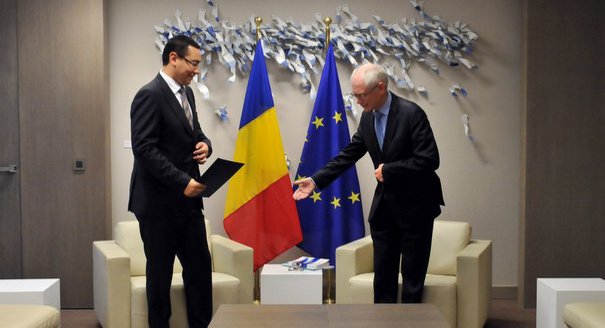
Yet the European Commission has accused Prime Minister Victor Ponta or Romania of running roughshod over the rule of law in order to oust President Traian Basescu from office.
Mr. Ponta, 39, leader of the formerly communist Socialist Party, has fired two ombudsmen from the opposition, dismissed directors of institutes responsible for looking into Romania’s communist past and tightened his grip on state television. Mr. Ponta also seems determined to protect former and indicted communists from the courts.
“Ponta has set back any improvements we tried to make over the past few years,” said Monica Macovei, a conservative lawmaker in the European Parliament.
As justice minister in Romania from 2004 to 2007, Ms. Macovei had started to overhaul the judiciary to make the courts independent and fight corruption. “The public and the politicians have to understand that the transition means accountability,” Ms. Macovei said. “That means checks and balances.”
In its report on Bulgaria, the Commission singled out the role of organized crime groups. According to Europol, Bulgarian criminal networks were active in 15 E.U. member states, specializing in human trafficking and credit card fraud.
Inside Bulgaria, the Commission said that these organized crime groups played a unique role. They were exercising their influence over the economy in a way that restricted competition and deters foreign investment. “It also gives these groups a platform from which to influence the political process and state institutions,” the Commission said.
So what went wrong with Bulgaria and Romania?
Ms. Primatarova believes that changing a political culture shaped over many decades takes more than the adoption of a host of essentially technical E.U. laws.
For years, the European Commission and the E.U. member states have stuck to a formula that stipulates that candidate countries should adapt their economic, trade, environmental and health legislation to E.U. legislation. But adapting is one thing. Implementing it — and changing a political culture — is another. The Commission, Ms. Primatarova said, failed to appreciate how long transitions take to replace deeply entrenched structures.
Yet several other former communist countries have done better with transition. In their cases, two elements seem to have helped: if they had strong dissident movements during the communist era, and later, if they decided to open the secret police files.
Poland, which joined the Union in 2004, had a strong anti-communist opposition that served it well in entrenching democracy during the 1990s. Poland, too, at an early stage started dealing with the communist past.
The former Czechoslovakia, which had a small dissident movement, introduced in the early 1990s one of the most radical “lustration” or “cleansing laws” of the communist secret services in the region. Czechoslovakia’s first post-communist president, the late Vaclav Havel, had no sympathy for collaborators.
Hungary also introduced a cleansing law in 1994. But it has been slow to make the secret police files accessible to the public, despite the intense anti-communist rhetoric of the government.
Both Bulgaria and Romania have only recently begun to deal with their communist past — and tentatively at that.
Ms. Macovei believes that opening the secret files earlier could have made a difference to tackling corruption or dismantling the entrenched communist networks.
Despite failing to do that, being inside the Union is making a difference, said Daniel Smilov, a political science professor at the University of Sofia. “It has given civil society the chance to fight for change and accountability,” he argued. “We would be far, far worse off outside the E.U. The transition would even take longer.”

Nonresident Senior Fellow, Carnegie Europe
Judy Dempsey is a nonresident senior fellow at Carnegie Europe
Recent Work
Judy Dempsey
Judy Dempsey
Carnegie does not take institutional positions on public policy issues; the views represented herein are those of the author(s) and do not necessarily reflect the views of Carnegie, its staff, or its trustees.

But their "principal to principal" model will only be as effective as the political strength of each leader back home.

Damien Ma

U.S. unpredictability has allowed China to capitalize on its positioning as the “responsible great power”. Paradoxically, the more China wins the perception game, the more likely expectations will rise for Beijing to deliver not just words but to demonstrate with its deeds.

Chong Ja Ian

Hanoi and Beijing have long treated each other as distant cousins rather than comrades in arms. That might be changing as both sides draw closer to hedge against uncertainty and America’s erratic behavior.

Nguyễn Khắc Giang

Across Asia, China is better positioned to withstand energy shocks from the fallout of the Iran war. Its abundant coal capacity can ensure stability in the near term. Yet at the same time, the country’s energy transition away from coal will make it even less vulnerable during the next shock.
Damien Ma

Malaysia’s chairmanship sought to fend off short-term challenges while laying the groundwork for minimizing ASEAN’s longer-term exposure to external stresses.

Elina Noor