

Commentary
Thomas de Waal
{
  "authors": [
    "Thomas de Waal"
  ],
  "type": "legacyinthemedia",
  "centerAffiliationAll": "dc",
  "centers": [
    "Carnegie Endowment for International Peace",
    "Carnegie Europe"
  ],
  "collections": [],
  "englishNewsletterAll": "ctw",
  "nonEnglishNewsletterAll": "",
  "primaryCenter": "Carnegie Europe",
  "programAffiliation": "russia",
  "programs": [
    "Russia and Eurasia"
  ],
  "projects": [],
  "regions": [
    "Caucasus"
  ],
  "topics": [
    "Political Reform"
  ]
}
Source: Getty
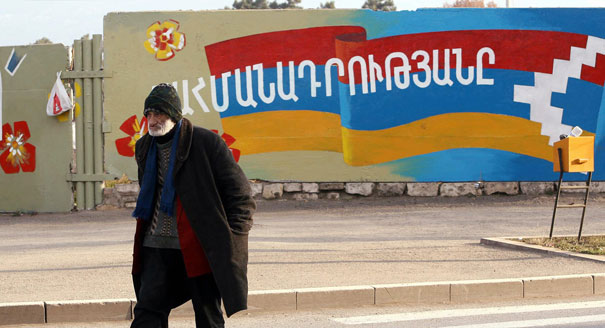
A surprisingly strong electoral showing for the opposition presidential candidate in Nagorny Karabakh reflects the emergence of politics from below in former Soviet Union territories.
Source: National Interest

With no support from any political party and in a place with a strong tradition of government control, Vitaly Balasanian collected 32 percent of the vote against the incumbent Bako Saakian, who was reelected president. According to local statistics, about seventy thousand people voted. Balasanian’s was an impressive performance by any standards. In most of the former Soviet Union, opposition candidates do not get a third of the vote. The result was even more striking in the limited conditions of Nagorny Karabakh. In Armenia’s last—disputed—presidential election, former president and head of the opposition Levon Ter-Petrosian was awarded 21 percent of the vote. The Armenian opposition may now take heart ahead of the next presidential election there, due in February 2013.
This was not an election fought primarily over foreign or security policy. There was consensus on the issue of Nagorny Karabakh’s status, with both main candidates maintaining that the territory should be an independent state, separate from Azerbaijan. Having been a leading military commander in the conflict of 1991–1994, Balasanian’s patriotic credentials were unimpeachable, and he actually took a harder-line position than his rival: he said that Karabakh should insist on being represented at the negotiating table and unequivocally rejected the return of the occupied territories around Karabakh to Azerbaijan (a central part of the peace deal currently on the table, accepted by Yerevan).The differences were over domestic policy, with the discontent of voters perhaps more directed against the controversial prime minister, Arayik Harutyunyan, than against the president. The opposition candidate picked up his strongest support in three rural regions, Askeran, Martakert and Martuni, where socio-economic problems are greatest.
The Karabakh election conforms to a curious trend whereby some of the most competitive elections in the post-Soviet space are in unrecognized or partially recognized territories.
Separatist Transnistria recently chose as its new leader a young parliamentarian Yevgeny Shevchuk, who defeated the candidates more favored by the old guard and by Moscow. Abkhazia has had two fiercely competitive elections in 2004 and 2011, in which the candidate positioning himself as the outsider prevailed both times. Even South Ossetia, whose current population is estimated at no more than forty thousand and whose budget is 99 percent supported by Russia, managed to hold a dramatic semifarcical election last year in which the opposition candidate, Alla Jiyoeva, won. The results of that ballot were then annulled, but the eventual winner, Leonid Tibilov, was by local standards a fairly independent candidate who has appointed Jiyoeva to his cabinet.
What is going on here? If I have an explanation it is that, paradoxically, because statehood is weaker in these territories, ordinary members of society are more self-reliant and less susceptible to pressure. There is more politics from below. But I would use the word “competitive” advisedly. These are not regular elections. There is a democratic deficit in part because these territories are not recognized sovereign states (although this should not disqualify them from having democratic aspirations.)
More problematic is the issue of the “missing populations,” Azerbaijani and Georgian, that cannot take part in the vote because they were displaced by war. In the last Soviet census of 1988, 23 percent of the population of Nagorny Karabakh was Azerbaijani. All of those people are now refugees inside their own country.
What is a proper international verdict on a poll like such as one? International observers continue to tie themselves in knots, satisfying neither the Armenian side (“Why do you ignore us if we hold a good democratic election?”) nor the Azerbaijanis (“Don‘t give any credence to a territory that no one, not even Armenia, has recognized as sovereign.”) Freedom House has begun to give democracy ratings to the breakaway territories but has almost no direct presence on the ground to make its judgment.
At the very least, there is a political judgment that the citizens of these lands have a crucial stake in the eventual peace settlements of the conflicts and that it is desirable for them to have legitimate leaders who can speak on their behalf.
In March 1992, making plans for a peace conference on the Karabakh conflict (that has still not been held twenty years on), the then Conference on Security and Cooperation in Europe, now the OSCE, first tried to square this circle by stating that “elected and other representatives of Nagorno-Karabakh (i.e. Armenians and Azerbaijanis respectively) will be invited to the Conference.”
The current OSCE mediators did their best to continue this line in their latest statement, saying “The Co-Chairs acknowledge the need for the de facto authorities in NK to try to organize democratically the public life of their population with such a procedure. However, the Co-Chairs note that none of their three countries, nor any other country, recognizes Nagorno-Karabakh as an independent and sovereign state.”
Along the same lines, the EU foreign policy chief Baroness Ashton issued a statement, criticizing the basis for the election but not the election itself: “I would like to reiterate that the European Union does not recognise the constitutional and legal framework in which they will be held. These 'elections' should not prejudice the determination of the future status of Nagorno-Karabakh in the negotiated general framework of the peaceful settlement of the conflict.”
The rather tortured language of these statements reflects an underlying discomfort. The longer these protracted post-Soviet conflicts remain unresolved, these elections pose an international challenge which is growing, not diminishing.
This article was originally published in the National Interest.

Senior Fellow, Carnegie Europe
Thomas de Waal is a senior fellow at Carnegie Europe, specializing in Eastern Europe and the Caucasus.
Recent Work
Thomas de Waal
Thomas de Waal
Carnegie does not take institutional positions on public policy issues; the views represented herein are those of the author(s) and do not necessarily reflect the views of Carnegie, its staff, or its trustees.
Transactional relationships are stable but can be shallow.


Paul Haenle, Maha Yahya, Benjamin Ho, …
It’s about managing oil prices, bread prices, and strategic partnerships.



Amr Hamzawy, Karim Sadjadpour, Aaron David Miller, …
The murder of George Floyd has underscored the deep inequities that have long plagued American society. In a note to the Carnegie community, Bill Burns reflects on Carnegie’s commitment to build a more just future here at home and around the world, without which peace will remain beyond our grasp.
William J. Burns
While the world hoped this pandemic might lead to more cooperation between these two great powers, American and Chinese leaders instead fell into a blame game and allowed their increasing suspicions to guide their decision-making.
Lyu Jinghua
Biological viruses and computer malware differ in important respects. They have considerable potential to spread widely, invading, disrupting and destroying their targets.

Ariel (Eli) Levite, Lyu Jinghua