

Commentary
It’s about managing oil prices, bread prices, and strategic partnerships.
- +8
Amr Hamzawy, Karim Sadjadpour, Aaron David Miller, …
Source: Getty
The U.S.-sponsored TRIPP deal is driving the Armenia-Azerbaijan peace process forward. But foreign and domestic hurdles remain before connectivity and economic interdependence can open up the South Caucasus.
For more than three decades, the Armenia-Azerbaijan conflict has exerted human, economic, and political tolls on both countries. In 2026, thanks to direct dialogue between Baku and Yerevan and agreements brokered in Washington, both a peace accord and the reopening of the region look to be in sight. Connectivity and regional economic cooperation are driving the process forward.
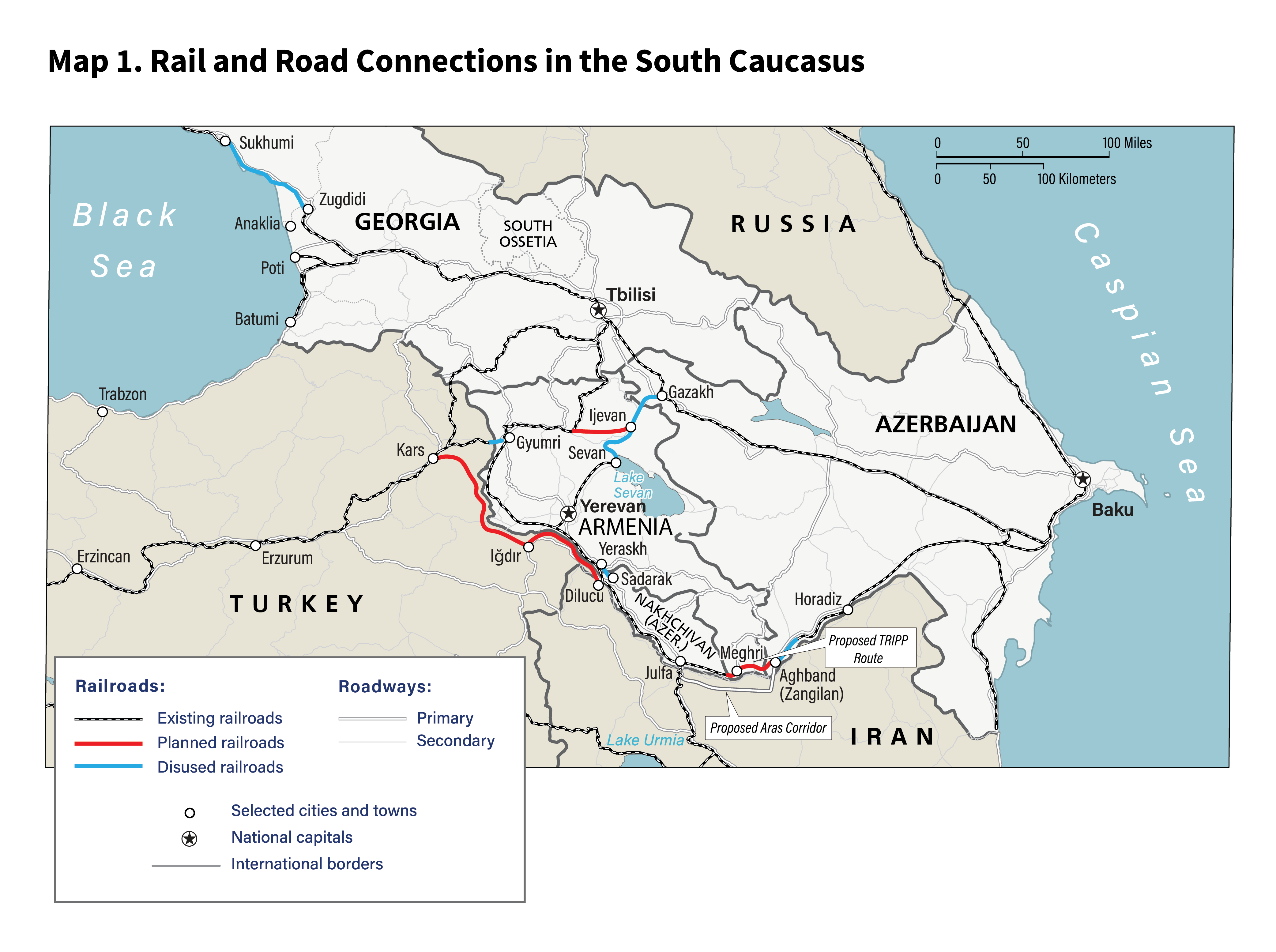
The key breakthrough came in a meeting at the White House on August 8, 2025, hosted by U.S. President Donald Trump with Armenian Prime Minister Nikol Pashinyan and Azerbaijani President Ilham Aliyev. The Armenian and Azerbaijani leaders initialed but did not sign the text of a peace agreement. Crucially, they also committed to an important U.S.-designed connectivity deal. The summit declaration announced a resolution of the vexed issue of how to connect the main part of Azerbaijan with its exclave of Nakhchivan across southern Armenia. The proposed route, which comprises a 43-kilometer (27-mile) section through the town of Meghri and along the Arax River and the Armenia-Iran border, was named the Trump Route for International Peace and Prosperity (TRIPP).
TRIPP is designed to create a new dynamic of Armenia-Azerbaijan economic cooperation, replacing one of antagonism and closed borders. For international actors, TRIPP is also potentially a new east–west transit route linking Central Asia to Europe, which would reduce dependence on Russian and Chinese infrastructure.
Baku, Yerevan, and Washington share the ambition that the rail link envisaged under TRIPP can be completed by 2028 and the end of Trump’s presidency. However, the peace process is still at an early stage, and the region’s societies are far less engaged in it than the leaders are. Many differences in outlook remain. Both domestic risks and regional developments could still shape, derail, or delay the peace and connectivity processes. One immediate threat, as of this writing, is that a continuation of the war in Iran could make it too dangerous for the U.S.-led company entrusted with implementing the project on the Armenia-Iran border to begin its work.
The TRIPP agreement addresses a century-old geographic and political issue. In 1921, the Treaties of Moscow and Kars defined Nakhchivan as an autonomous territory under Soviet Azerbaijan, an exclave that was geographically separate from mainland Azerbaijan and that bordered Soviet Armenia, Iran, and Turkey—a status that was later formalized. In Soviet times, this was a source of only minor problems. But when the dispute between Armenia and Azerbaijan escalated into full-scale war in 1991 as the Soviet Union collapsed, transportation connections were shut down and Nakhchivan lost its primary link to the western part of mainland Azerbaijan via Armenia. Restoring that connection has been a major goal of Azerbaijani policy for the past thirty-five years.
After the six-week war between the two countries in 2020, the issue became a major source of tension. The Azerbaijani leadership called for a reopening of the route to Nakhchivan across Armenia, referring to it as the “Zangezur corridor.” This traditional name for the region is no longer used by Armenians, and Yerevan regarded Baku’s language as threatening annexation of Armenian territory. Azerbaijan said it had no territorial claim to the region and expressed frustration at slow progress on reopening the route.
TRIPP aims to unlock this puzzle by restoring the link to Nakhchivan while respecting Armenian sovereignty and jurisdiction. The prime objective is to restore the old rail line that runs along the Armenia-Iran border (see map 1). Fiber-optic and electricity transmission lines and a natural-gas pipeline crossing Armenia into Nakhchivan will also be constructed. In January 2026, the United States and Armenia published an implementation framework for these plans. U.S. Vice President JD Vance’s February trip to the region gave an extra impetus to the deal and boosted U.S. bilateral economic engagement with both countries.
The first positive repercussions of the TRIPP agreement and the peace process are already visible. For the first time in more than three decades, Armenian and Azerbaijani officials talk of a shared peaceful regional vision in the South Caucasus. Fears in Armenia of renewed military action have receded. In Baku, official language toward Armenia has softened. Aliyev has declared that “peace has already been achieved” with his country’s neighbor and that the two sides are “just learning to live in peace.”
The two governments are taking practical steps to support this change in outlook. Aliyev has lifted a long-standing ban on transit to and from Armenia via third countries. Between December 2025 and March 2026, Azerbaijan sent several fuel shipments, including consignments of gasoline and diesel, to Armenia by rail via Georgia. The two sides also exchanged lists of goods as part of efforts to normalize economic relations and advance bilateral trade.
The promise of peace and subsequent economic benefits for both countries has contributed to a positive repricing of sovereign risk. In 2025, Armenian Eurobonds rallied strongly as investors anticipated that the peace process could bolster fiscal stability, attract foreign investment, and reduce the costs of external borrowing. Azerbaijani bonds strengthened more moderately, reflecting the country’s already strong fiscal and external position.
Some details of TRIPP are still being negotiated. Under the January 2026 framework, Yerevan secured recognition that all infrastructure on its territory would remain under Armenian sovereignty and jurisdiction, allaying concerns that the new route would be extraterritorial and outside Armenia’s control. At the same time, the concept of “unimpeded access” for Azerbaijani traffic, as set out in the declaration of the August 2025 meeting in Washington, remains politically sensitive.
According to the January document, this challenge will be resolved by a “front office–back office operating model.” This puts third-party private operators on the ground to provide “customer-facing services” for users of the route, while overall management, decisionmaking, and sovereign control remain with Armenia. Azerbaijani officials stress that the choice and mandate of the third-party operators are of vital importance to them.
Security is a sensitive issue. While all security and border functions will remain under Armenian authority, the implementation agreement also stipulates that “private operational security personnel may be employed subject to Armenian licensing.” As any security incidents can easily become politicized, questions about how to handle incident responses and information sharing between Baku and Yerevan still need to be addressed.
Full financing has yet to be secured. According to U.S. officials interviewed, the U.S. government had sourced around $400 million in financing by the end of 2025, but this represented only an initial tranche.1 A larger mix of public and private funds, including a planned multibillion‑dollar TRIPP fund, is still being structured. Transportation experts interviewed estimate that the TRIPP rail segment, at around 43 kilometers (27 miles), would likely cost in the range of $250–400 million, based on comparable interurban rail projects in Europe and Asia.2
Plans for a new road across Armenia to Nakhchivan lag behind the rail project and are as yet unfunded. Azerbaijan wants to see a new highway built in parallel to the railroad, continuing a multilane highway that has already been constructed on its side up to the Armenian border. Armenia says that the difficult mountainous terrain of the Meghri region would make a highway extremely expensive and require digging long new tunnels. Yerevan has proposed two alternative routes farther north; the most direct route also runs through highland terrain, however.
The TRIPP agreement promises both to break the decades-old isolation of Armenia and Nakhchivan and to reconfigure the region’s broader economic and political relationships. By the logic of the agreement, Azerbaijan now accepts that Armenia will be de-isolated and integrated into regional infrastructure projects. This stance reflects a new convergence of interests between Baku and Yerevan, which now both welcome U.S. intervention in the region as a way to reduce Russian influence.
The TRIPP agreement erased the connectivity provisions set out in a November 2020 trilateral declaration signed by Aliyev, Pashinyan, and Russian President Vladimir Putin. That deal gave Russia a pivotal role in connectivity routes, stating in particular that border guards of the Russian Federal Security Service (FSB) would “oversee” the route to Nakhchivan. Armenia later challenged Moscow over this setup, rejecting what it viewed as extraterritorial control of a vital route. Azerbaijan initially supported Russian involvement, seeing Moscow as the only actor capable of enforcing the connectivity arrangements, but changed its position in 2025 as relations with Russia deteriorated sharply and the U.S.-brokered solution emerged.
Still, Armenia and Azerbaijan—as well as neighboring Turkey—have different ambitions about the TRIPP agreement and what they hope to achieve from it.
For Baku, the agreement reestablishes the shortest transportation route with Nakhchivan, which now has the potential to change its status from remote backwater to regional hub. Since the end of the Soviet Union, Nakhchivanis have had access to the rest of their country only by traveling 677 kilometers (421 miles) through Iran or more than 1,200 kilometers (746 miles) via Georgia and Turkey. Air links with Baku are limited and expensive. In addition to TRIPP, a new natural-gas pipeline to Nakhchivan from Iğdır in Turkey, inaugurated in 2024, will replace Iranian supply.
TRIPP also reinforces Azerbaijan’s bid to be an important east–west transit country. The Azerbaijani view, expressed by senior officials in interviews, is that TRIPP will be a west-facing link between Central Asia and Europe, complementary to and distinct from the existing Middle Corridor, which runs via Azerbaijan, Georgia, and Turkey to Europe.3
For Yerevan, the TRIPP framework affirms its conception of a de-isolated Armenia as a “Crossroads of Peace”—the name of an official project, launched in 2023, that foresees Armenia as a regional transportation hub. The closure for more than thirty years of the country’s two longest borders has left Armenia isolated and economically reliant on Russia and narrow trade corridors through Georgia and Iran. For the Armenian leadership, open borders are essential to its project of economic diversification, political balance, looser dependence on Russia, and stronger ties with Europe and the United States.
The biggest gain for Armenia may come less from an increase in exports and more from becoming a reliable transit partner. At the same time, a normalization with Azerbaijan would significantly enhance Armenia’s connectivity to Europe through Turkey, integrating Armenia more directly into European transportation and trade corridors.
Turkey, meanwhile, approaches TRIPP with a more expansive strategic horizon and without the same political constraints as Azerbaijan. Ankara sees TRIPP as part of the broader Middle Corridor and is now more open to regional cooperation projects with Armenia that will bring commercial benefits, especially to the economies of Turkey’s underdeveloped eastern provinces of Kars and Iğdır. What is more, TRIPP can reinvigorate Turkey-EU cooperation on transportation and infrastructure financing, areas where the relationship has stagnated.
TRIPP also challenges Georgia’s current status as the region’s default transit hub, just as the governing Georgian Dream party is turning away from Europe. For now, Georgia’s seaports and overland links with Turkey handle a large share of regional freight. In four to six years from now, if TRIPP proceeds smoothly, Tbilisi’s effective monopoly will face competition, as new connections through Armenia could offer shorter routes and diversified options for cargoes.
The growing friction between Georgia and its neighbors was highlighted in December 2025, when Georgian officials demanded extremely high transit fees for the first fuel shipment from Azerbaijan to Armenia, triggering pushback in both Baku and Yerevan. The issue was resolved after Azerbaijan said it could open the border with Armenia directly, and Georgia lowered its demands. The episode highlighted how Tbilisi’s actions may strengthen incentives for Baku and Yerevan to accelerate alternative arrangements.
TRIPP’s successful implementation through Meghri into Nakhchivan rests on a logic of mutual benefits for Armenia and Azerbaijan through economic interdependence between them. However, that logic is not guaranteed when it comes to the opening of other routes to the west of Nakhchivan into Turkey.
The case for TRIPP as a commercial project is as yet unproven in a region that already has connectivity routes through Georgia. The TRIPP rail route will compete with the Baku–Tbilisi–Kars (BTK) railroad, which was opened in 2017 but is underused despite an upgrade in 2024. A 2026 connectivity study by the European Commission estimated that the new Armenia route would cut travel time by up to 25 percent compared with BTK. TRIPP rail traffic will also compete with road traffic by truck through Georgia, which currently constitutes most freight that passes through the region.
The 158-kilometer (98-mile) rail line across Nakhchivan to the Turkish and Armenian borders needs major investment and an agreement on practicalities to operate again. The TRIPP implementation framework states that the agreement “is expected to generate reciprocal benefits for international and intrastate connectivity for the Republic of Armenia.” However, the two sides interpret the concept of “reciprocal benefits” differently. Yerevan argues that the ease of passage granted to Azerbaijani traffic in Armenia should be matched by comparable access for Armenian exporters across Azerbaijani territory. Baku, by contrast, frames reciprocity in terms of overall mutual benefit rather than identical arrangements.
Yet more contentious is the issue of which route international train traffic should take in the future from Nakhchivan to the Turkish city of Kars. Turkey and Azerbaijan plan a new 224-kilometer (139-mile) double-track railroad connecting Kars to Dilucu in Nakhchivan at an estimated cost of €2.4 billion ($2.8 billion). The line was inaugurated in August 2025 by Turkish President Recep Tayyip Erdoğan, with construction scheduled to start later in 2026 and a projected completion date of 2030. Azerbaijan and Turkey say that the planned new railroad is a strategic investment that minimizes risks by connecting their two countries directly.
Critics in Armenia and elsewhere, while respecting Azerbaijan and Turkey’s sovereign choice to build a new railroad, argue that the Kars–Dilucu line is a not a viable commercial project and say it damages the cause of regional integration because it bypasses Armenia. Instead, the Armenians argue for reopening the previous 238-kilometer (148-mile) railroad link, which goes from Nakhchivan into central Armenia and then across the (currently closed) Armenia-Turkey border to Kars. The Armenians maintain that this route can be reopened for international freight more quickly and cost-effectively, as it requires only the restoration of two short rail segments on the Armenia-Nakhchivan and Armenia-Turkey borders.
From Baku’s standpoint, relying solely on the Armenian route is problematic, because it would require trains to make a second crossing back into Armenian territory, complicating customs and border management. What is more, the Armenian rail network is currently under concession to Russian Railways, a Russian state-owned company under Western sanctions.
To address this difficulty, Pashinyan has asked the Russian firm to invest in new infrastructure. This move is widely seen as a challenge that, if not met, would lead Armenia to take the first steps toward renationalizing its railroads. Russian Railways is in a severe financial crisis, suffering heavy losses and roughly $51 billion in debt. The Armenian government has also suggested to Moscow that it could sell the concession rights to a country that is friendly to both Armenia and Russia, most probably a reference to Kazakhstan, Qatar, or the United Arab Emirates.
As international interest in TRIPP as a wider east–west route grows, questions arise for the three states concerned. Western partners want reassurances from Azerbaijan and Turkey that their intention is not to isolate Armenia from international commercial projects. Visible progress on reopening the Kars–Gyumri line would reinforce confidence in an inclusive regional approach that reduces Armenia’s reliance on Russia and underpins the peace process.
For its part, Yerevan needs to prove that it can find the financing to upgrade the old single-track Soviet-era rail line through Armenia and that traffic will not be slowed down by a double crossing of the Armenian border. Western partners also hope for a clear strategy from the Armenian authorities to address the Russian Railways problem.
The two routes are not necessarily mutually exclusive and can operate in parallel. The main issue is how much capacity there will be for international freight traffic in general in the region.
In the shorter term, one measure could promote trust and cooperation. Rebuilding the short Yeraskh–Sadarak section of railroad between Armenia and Nakhchivan can be done fairly fast, perhaps in a matter of weeks. This would allow for restored rail access to the exclave from the north via Georgia and Armenia, opening a rail route to Nakhchivan for the first time in thirty-five years—and perhaps several years before the TRIPP route is completed. This stretch could be used for construction equipment to access Nakhchivan and to accelerate the building of the TRIPP railroad and the lines in the exclave itself. This short-term measure would not fully de-isolate Nakhchivan but could build confidence between the two sides—with the proviso, Baku insists, that it contributes to TRIPP and is not seen as an alternative to it.
TRIPP potentially faces geopolitical resistance. Both Russia and Iran view the project as Western-backed intrusion into what they regard as their traditional sphere of influence. Neither can block the route outright, yet both have the means to slow or complicate it.
For the moment, Moscow is cautious not to antagonize a U.S. administration led by Trump, whose name is tied to the project. For decades, Russia used the Nagorny Karabakh conflict as a lever over both Armenia and Azerbaijan. However, after conflicts in 2020 and 2023 and now TRIPP, Moscow’s influence in the South Caucasus has sharply diminished.
Russia has no direct rail link to Iran. A Russian-supervised route via Meghri would have given Moscow control over a cheap and secure connection to the Julfa railroad junction and the Iranian rail network. That would have established the missing link in a north–south corridor connecting Russia to the Persian Gulf, a long-standing ambition of Putin’s. Russian commentators have invoked the memory of the so-called Persian Corridor, a road-and-rail route running north from Iran through Armenia and Azerbaijan to Russia that carried almost half of U.S. Lend-Lease aid to the Soviet Union during the Second World War.
The Kremlin has so far reacted to TRIPP with restrained skepticism rather than open opposition. Speaking in an interview, a Moscow-based analyst close to official circles said the initiative was “politically premature” and would falter without Russian coordination. That position has become harder to sustain since concrete progress was made in 2026. As a result, some in Moscow appear to be recalibrating their approach, according to interviews with EU diplomats and Moscow-based foreign policy analysts.4 Russia seems to recognize that outright obstruction could prove counterproductive and that, for the time being at least, the country retains leverage through its concession over Armenia’s rail infrastructure.
Armenian and U.S. officials, for their part, have stopped short of explicitly excluding Russia or Iran from using the new route. They have sought to minimize their potential spoiler role by structuring TRIPP in a way that leaves the door open for their benefit in the future.
Armenia’s next parliamentary election, due in June 2026, will be a key milestone. The vote will provide Moscow with an opportunity to challenge and, potentially, halt Pashinyan’s pro-Western trajectory and outreach to Ankara and Baku. As a result, the Armenian government will be cautious about antagonizing Moscow with threats to take over any Russian-managed assets in the country.
The stance taken by Iran depends on the current U.S.-Israeli military campaign against the country. Many different outcomes are possible. Before this war, Iran’s position on connectivity between Armenia and Azerbaijan was deliberately ambiguous. Tehran sought to preserve the status quo and avoid losing its role as a major transit route both for international traffic and for Azerbaijanis traveling between Nakhchivan and the rest of Azerbaijan—a role that provided Tehran with revenue and strategic leverage. After TRIPP was announced, Iran’s politicians became increasingly divided. Tehran’s security establishment opposed the project outright and made open threats. Earlier they had called plans to build a railroad a “Turkic” route or a “NATO” line, shorthand for unease over Ankara’s growing footprint in the South Caucasus and the perceived encroachment of Western influence.
Other factions, particularly in the economic affairs and transportation ministries under Iranian President Masoud Pezeshkian, saw potential for dialogue with Washington over TRIPP. They suggested that Iran could tolerate plans for a railroad under Armenian jurisdiction—especially if it reconnected Iran’s rail network to the South Caucasus via Julfa. However, they were more openly opposed to a highway through Armenia that could undermine a proposed joint Azerbaijani-Iranian highway along the Arax Valley in northern Iran.
Significant U.S. investment and construction near Iran’s border is difficult to imagine while the military escalation continues; for TRIPP’s implementation to be feasible, the escalation will need to subside as soon as possible.
TRIPP is a technical project with major geopolitical repercussions. It aims to underpin a normalization between Armenia and Azerbaijan and create a new pattern of economic interdependence between them, putting the conflict firmly in the past.
Developments in the wider region reinforce the urgency of making progress. The ongoing war in Iran highlights the vulnerability of existing transit routes and the isolation of Nakhchivan, which in turn strengthens the case for alternative and more resilient connections in the region. The conflict’s uncertain trajectory may also delay or disrupt the practical implementation of the project by the U.S.-led TRIPP Development Company in charge of the initiative. Even before TRIPP becomes fully operational, Armenia and Azerbaijan could pursue a limited reopening of transportation links as a confidence-building measure, allowing incremental cooperation before the broader transit framework is completed.
TRIPP’s status as a commercially attractive international transit route is not guaranteed in a region that has established connectivity routes via Georgia. As of now, it is first and foremost a regional project to provide the shortest overland link between mainland Azerbaijan and Nakhchivan, with a promise of economic benefits for the exclave, southern Armenia, and eastern Turkey. How local communities along the route will reap benefits from the connections has yet to be clearly articulated; without visible local gains, the project risks being seen by people along the route as a mainly geopolitical venture with little bearing on everyday livelihoods.
Azerbaijan’s economic rationale for investing in TRIPP stems in large part from growing uncertainty about existing transit corridors through Georgia and Iran. Baku sees reliance on a single route in a geopolitically sensitive region as carrying structural risks. That means TRIPP represents not redundancy but resilience, reducing overdependence on any one corridor.
For Yerevan, by contrast, the principal benefit is not so much TRIPP itself but the opening of east–west links to Azerbaijan, Turkey, and beyond. Armenia seeks the reopening of multiple transportation arteries, including Gyumri–Kars, Yeraskh–Sadarak, and Ijevan–Gazakh, to overcome its long-standing isolation and re-anchor itself economically in the region.
The main risk to the project, now that its core principles have been agreed on, is not active obstruction but delay. Successful execution will require sustained, practical coordination not only between Yerevan and Washington and between Yerevan and Baku but among all stakeholders. Implementing TRIPP is a big test for Armenia, which faces administrative constraints and has yet to institutionalize its Crossroads for Peace concept.
The strong commitment of the United States remains central to the success of the TRIPP process. The EU, with its strong political and financial involvement in the region, can also play an important role, as long as there is a firm strategic commitment at the highest level. Turkey has a special part to play as a regional neighbor committed to east–west connectivity. In the end, however, the success of any transit framework will hinge on Baku and Yerevan’s ability to manage their differences and forge a new relationship built on mutual confidence.

Senior Fellow, Carnegie Europe
Thomas de Waal is a senior fellow at Carnegie Europe, specializing in Eastern Europe and the Caucasus.

Areg Kochinyan
President, Armenian Council
Areg Kochinyan is the president of the Armenian Council analytical center.

Nonresident Scholar, Carnegie Russia Eurasia Center
Zaur Shiriyev is a nonresident scholar at the Carnegie Russia Eurasia Center.
Carnegie does not take institutional positions on public policy issues; the views represented herein are those of the author(s) and do not necessarily reflect the views of Carnegie, its staff, or its trustees.

It’s about managing oil prices, bread prices, and strategic partnerships.



Amr Hamzawy, Karim Sadjadpour, Aaron David Miller, …

As North Korea continues to stall talks with the United States and South Korea, there is a greater need for China to play a more assertive role to help break the impasse.

Tong Zhao
Pitched as a new Silk Road sweeping from Asia to Europe, China’s enormous Belt and Road Initiative is an ambitious, multinational infrastructure project. Experts from four Carnegie global centers explain other countries’ perspectives.


Paul Haenle, Dmitri Trenin, Alexander Gabuev, …
Despite the BRI’s prevalence in discussions of China’s global engagement, many experts are divided on how to interpret it. Is it a global strategy or just an interregional initiative? How can countries and international companies participate in its growth and development?
Feng Yujun, Alexander Gabuev, Paul Haenle, …
With the threat of nuclear war growing, China, Russia, and the United States should not wait until political relations improve before making efforts to manage new technologies.


James M. Acton, Tong Zhao, Li Bin