

Commentary
Judy Dempsey
{
  "authors": [
    "Judy Dempsey"
  ],
  "type": "legacyinthemedia",
  "centerAffiliationAll": "",
  "centers": [
    "Carnegie Endowment for International Peace",
    "Carnegie Europe"
  ],
  "collections": [],
  "englishNewsletterAll": "",
  "nonEnglishNewsletterAll": "",
  "primaryCenter": "Carnegie Europe",
  "programAffiliation": "",
  "programs": [],
  "projects": [],
  "regions": [
    "Europe"
  ],
  "topics": [
    "Foreign Policy"
  ]
}
Source: Getty
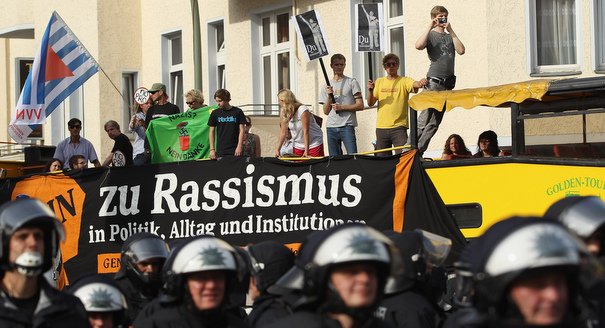
After another scandal damaged the creditability of Germany’s police force, more people are beginning to question whether the force is racist.
Source: New York Times

The latest scandal concerns two police officers serving in the southern state of Baden-Württemberg. They were members of the European White Knights, or E.W.K., which is linked to the extreme right-wing racist group, the Ku Klux Klan.
One of the police officers belongs to the regular police force, the other is a squad commander for a riot-control police unit.They are still in their jobs because they told their superior officers that when they joined the E.W.K. several years ago, they had been unaware of the intentions of the movement. They left after a few months.
Sebastian Edathy, a federal lawmaker and chairman of a parliamentary committee who is investigating a series of murders of Turks and a policewoman by the extreme right-wing National Socialist Underground, said the two officers should have been dismissed.
“Civil servants who are or were members of a decidedly anti-democratic, extremist organization must be removed from the police force,” he said.
Coincidentally, the two policemen were colleagues of Michele Kiesewetter, the policewoman murdered by the National Socialist Underground.
In another racist incident made public last March, the police union in Bavaria had distributed a calendar depicting caricatures of black people with comments in offensive language.
The police union said it could not understand what the fuss was about.
“People are acting as if there is no such thing as police jargon,” said Hermann Benker who was responsible for distributing the calendar. He said the union had, until now, been producing the calendar for six years. Had anyone complained before? No.

Nonresident Senior Fellow, Carnegie Europe
Judy Dempsey is a nonresident senior fellow at Carnegie Europe
Recent Work
Judy Dempsey
Judy Dempsey
Carnegie does not take institutional positions on public policy issues; the views represented herein are those of the author(s) and do not necessarily reflect the views of Carnegie, its staff, or its trustees.

US unpredictability has allowed China to capitalize on its positioning as the “responsible great power”. Paradoxically, the more China wins the perception game, the more likely expectations will rise for Beijing to deliver not just words but to demonstrate with its deeds.

Chong Ja Ian

Hanoi and Beijing have long treated each other as distant cousins rather than comrades in arms. That might be changing as both sides draw closer to hedge against uncertainty and America’s erratic behavior.

Nguyễn Khắc Giang

Across Asia, China is better positioned to withstand energy shocks from the fallout of the Iran war. Its abundant coal capacity can ensure stability in the near term. Yet at the same time, the country’s energy transition away from coal will make it even less vulnerable during the next shock.

Damien Ma

Malaysia’s chairmanship sought to fend off short-term challenges while laying the groundwork for minimizing ASEAN’s longer-term exposure to external stresses.

Elina Noor

For Malaysia, the conjunction that works is “and” not “or” when it comes to the United States and China.
Elina Noor