

Commentary
Judy Dempsey
{
  "authors": [
    "Judy Dempsey"
  ],
  "type": "legacyinthemedia",
  "centerAffiliationAll": "",
  "centers": [
    "Carnegie Endowment for International Peace",
    "Carnegie Europe"
  ],
  "collections": [],
  "englishNewsletterAll": "",
  "nonEnglishNewsletterAll": "",
  "primaryCenter": "Carnegie Europe",
  "programAffiliation": "",
  "programs": [],
  "projects": [],
  "regions": [
    "Russia",
    "Europe"
  ],
  "topics": [
    "Foreign Policy"
  ]
}
Source: Getty
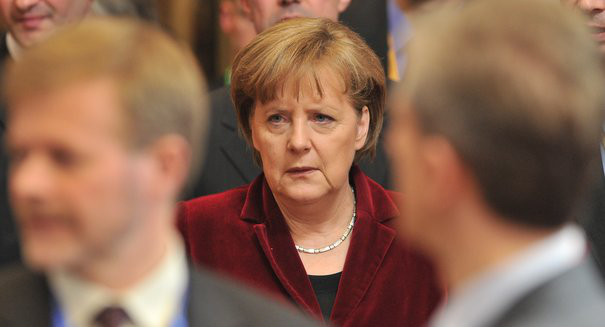
Chancellor Angela Merkel of Germany has her hands full this week, with issues concerning Moldova, France, and Greece.
Source: New York Times

Little, if anything.
Take Moldova. Ms. Merkel on Wednesday is off to this poor, corrupt and divided country on the fringe of the European Union and the Caucasus. It borders the E.U. member-state Romania.
Ms. Merkel wants to end this longtime “frozen conflict,” but without the cooperation of Vladimir Putin, the Russian president with whom Ms. Merkel does not have good relations, it is difficult to see what she can achieve — unless the lure of German investment and the European Union can shift the balance of power in Moldova.Back in Berlin, on Thursday, Ms. Merkel will have to deal with requests by President François Hollande of France to soften the conditions for Greece.
Ms. Merkel is in no position to say yes or no. Her Christian Democrats, and the public, are in no mood to give Greece more time or more money. And in any case, Ms. Merkel cannot do anything right now, as she will explain to Prime Minister Antonis Samaras of Greece, whom she will host in Berlin on Aug. 24.
As I write in my latest column, Ms. Merkel can say with full conviction that she has to wait until Sept. 12, when the country’s Constitutional Court will give its ruling on whether Germany can both ratify the fiscal pact that she negotiated with her E.U. partners and contribute to the bailout mechanism of the European Stability Mechanism.
If the court says no, then the only way Germany can forge ahead on Europe is a referendum on a new constitution. If the judges give a qualified yes, Ms. Merkel will still have a difficult job convincing her skeptical party — and the German public — that Germany must pay more.

Nonresident Senior Fellow, Carnegie Europe
Judy Dempsey is a nonresident senior fellow at Carnegie Europe
Recent Work
Judy Dempsey
Judy Dempsey
Carnegie does not take institutional positions on public policy issues; the views represented herein are those of the author(s) and do not necessarily reflect the views of Carnegie, its staff, or its trustees.

But their "principal to principal" model will only be as effective as the political strength of each leader back home.

Damien Ma

U.S. unpredictability has allowed China to capitalize on its positioning as the “responsible great power”. Paradoxically, the more China wins the perception game, the more likely expectations will rise for Beijing to deliver not just words but to demonstrate with its deeds.

Chong Ja Ian

Hanoi and Beijing have long treated each other as distant cousins rather than comrades in arms. That might be changing as both sides draw closer to hedge against uncertainty and America’s erratic behavior.

Nguyễn Khắc Giang

Across Asia, China is better positioned to withstand energy shocks from the fallout of the Iran war. Its abundant coal capacity can ensure stability in the near term. Yet at the same time, the country’s energy transition away from coal will make it even less vulnerable during the next shock.
Damien Ma

Malaysia’s chairmanship sought to fend off short-term challenges while laying the groundwork for minimizing ASEAN’s longer-term exposure to external stresses.

Elina Noor