

Commentary
Judy Dempsey
{
  "authors": [
    "Judy Dempsey"
  ],
  "type": "legacyinthemedia",
  "centerAffiliationAll": "",
  "centers": [
    "Carnegie Endowment for International Peace",
    "Carnegie Europe"
  ],
  "collections": [],
  "englishNewsletterAll": "",
  "nonEnglishNewsletterAll": "",
  "primaryCenter": "Carnegie Europe",
  "programAffiliation": "",
  "programs": [],
  "projects": [],
  "regions": [
    "Europe"
  ],
  "topics": []
}
Source: Getty
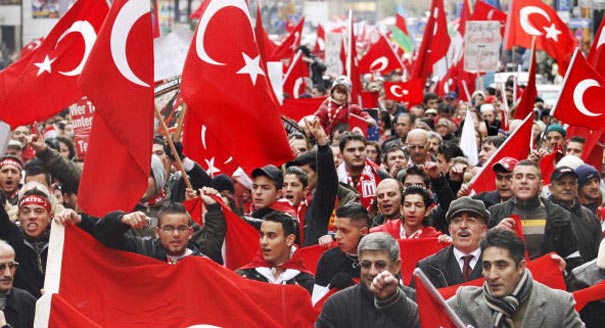
A series of killings of small-business people of Turkish origin has rocked the German security and intelligence services and shocked the public.
Source: New York Times

As chairman of a special parliamentary investigations committee, Mr. Edathy is trying to unravel a series of killings of small-business people of Turkish origin that has rocked the German security and intelligence services and shocked the public.
Furthermore, the killings have led to a deep crisis of trust between the large Turkish community — as well as other immigrants — and the police to such an extent that efforts at greater integration could be seriously undermined.“There is no doubt that it is going to take some time to rebuild that trust,” Mr. Edathy said.
The killing of eight people of Turkish descent, a Greek man and one female police officer took place between September 2000 and April 2007.
The police and intelligence services had failed to connect the cases and find any suspects, until last November. Finally, after a botched bank robbery in the southeastern city of Eisenach, they identified as the main suspects three neo-Nazis who had been living underground since 1999.
One of them, Uwe Mundlos, shot and killed his accomplice, Uwe Böhnhardt, and then himself. The third, Beate Zschäpe, went on the run but later gave herself up to the police. The three had belonged to the radical organization the National Socialist Underground. They were known as the Zwickau cell, named for the eastern city where they lived.
As the work of the investigations committee continues, members say they have discovered stunning incompetence, a failure to exchange information among the police and the criminal-investigation authorities, and a reluctance by senior intelligence officers to hand over relevant files.
Nowhere has the shock been felt more keenly than in the 3.5-million-strong Turkish community, whose members feel betrayed by the institutions of their host country.
“The police did not pursue the cases because they have this idea that when it comes to Germans with a foreign background, the reasons for the killings are linked, for instance, to criminal gangs,” said Kenan Kolat, chairman of the Turkish Community in Germany.
He believes there is institutionalized racism among the police forces.
“The police have this prejudice that if a German of Russian descent is killed it’s because of a drugs dispute, or if a Turk is killed its because of some inner-cultural or family honor dispute,” Mr. Kolat said. “What does that mean for integration when people who become German citizens expect the state to protect them but then they discover that it doesn’t?”
Police officials have denied that there is systemic racism among their ranks.
Still, the investigations committee is trying to discover how the police failed to connect the dots between the neo-Nazi group and the killings. The Zwickau cell and other groups had, after all, been under constant observation by the intelligence services.
“This certainly was a failure for what the domestic intelligence service and all the other security service are accountable for,” Interior Minister Hans-Peter Friedrich said recently.
The police, too, had recruited informers but somehow failed to discover that the N.S.U. cells had weapons and that the three neo-Nazis from the Zwickau cell had been planning the killings for some time.
An even more disturbing aspect is that on Nov. 12, 2011, a day after it became public that the N.S.U. was suspected in the killing of the Turks, the Greek and the policewoman, the office for the Protection of the Constitution, Germany’s domestic intelligence agency, destroyed files relating to the case. Those files included details about recruiting far-right informants.
Interior Ministry officials said the files had already been due to be shredded as a matter of data-protection policy. Still, even committee members say it seems more than a coincidence that those files should be destroyed just at the investigations began.
“Informants do not have clean information,” said Petra Pau, who is also on the parliamentary committee. “That recruitment system should be scrapped.”
That is of little solace to the families of the victims. They are demanding a complete overhaul of the police and intelligence services.
Mr. Friedrich has already dismissed Heinz Fromm, chief of the domestic intelligence service, and other top officials have been forced to resign.
Mr. Edathy, however, says the changes have to go much deeper.
He wants an overhaul of the way information is exchanged between the police and the criminal-investigation authorities on the state and national level. And he wants a more professional police force.
“That’s all very well,” said Mr. Kolat, the Turkish community leader. But what he wants most of all is for the police to acknowledge the existence of racism among its ranks and do something about it.
“If the police remain in self-denial, this racism will not end,” he said. “Germany’s immigrant communities will not feel safe here. What does that say for integration?”

Nonresident Senior Fellow, Carnegie Europe
Judy Dempsey is a nonresident senior fellow at Carnegie Europe
Recent Work
Judy Dempsey
Judy Dempsey
Carnegie does not take institutional positions on public policy issues; the views represented herein are those of the author(s) and do not necessarily reflect the views of Carnegie, its staff, or its trustees.
As the United States confronts China more directly, Merkel is exploring deeper cooperation with Xi. Economic upheaval from the coronavirus could reinforce the temptation in Berlin to keep Beijing close.
Noah Barkin
The 2017 G20 summit exposed the United States' isolation on the key issues of climate and trade.

Marc Pierini
A selection of experts answer a new question from Judy Dempsey on the foreign and security policy challenges shaping Europe’s role in the world.
Judy Dempsey
Europe may need to start planning for defense of the continent without the United States, but first it should do its utmost to prevent Trump from turning his back on NATO.
Tomáš Valášek
Citizens across Europe are taking to the streets and the Internet to counter the Euroskeptic and anti-immigrant messages of far-right populists and nationalists.
Caroline de Gruyter