

In The Media
David Rothkopf
{
  "authors": [
    "David Rothkopf"
  ],
  "type": "legacyinthemedia",
  "centerAffiliationAll": "",
  "centers": [
    "Carnegie Endowment for International Peace"
  ],
  "collections": [],
  "englishNewsletterAll": "",
  "nonEnglishNewsletterAll": "",
  "primaryCenter": "Carnegie Endowment for International Peace",
  "programAffiliation": "",
  "programs": [],
  "projects": [],
  "regions": [
    "North America",
    "United States"
  ],
  "topics": [
    "Political Reform"
  ]
}
Source: Getty
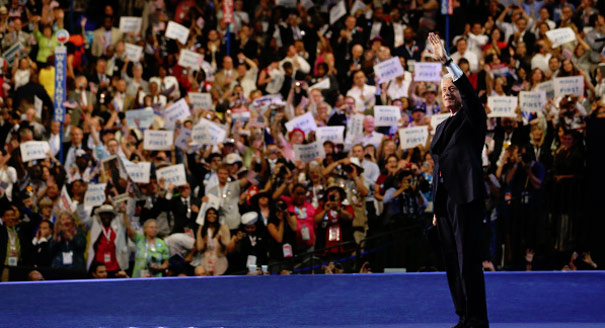
In his convention speech, Bill Clinton demonstrated why he has earned consideration as the most dominant American political figure of the past two decades.
Source: CNN

It was in that moment easy to imagine that on some level, off-stage, watching, Barack Obama was wondering whether he too would suffer a similar fate.
To be sure, as he strode out to congratulate Clinton after the speech, Obama and his team and his fervent supporters filling the arena in Charlotte were likely thrilled by the job the 42nd president had done in supporting the cause of the 44th.
But, as David Gergen said on CNN shortly after the speech, "Clinton told the Obama story better than Obama has." That is saying something, of course: Obama is a gifted speaker. Sometimes, he even soars. But as he himself noted recently when asked about his weaknesses during his first term, he has failed to effectively communicate why people should support his policies at critical moments.
Recognizing this is no doubt why Obama, who was disinclined to consult with Clinton early in his presidency as much as the former president would have liked, turned to Clinton to play such a central role in this convention and in his re-election campaign. But there was a risk. He would pay a price. He would violate one of the first rules of show business: The closer on stage you stand to a taller actor, the shorter you look.
With his speech last night, as with his post-presidency, his successes at the Clinton Global Initiative, the ascendancy of his wife as a senator and then as an exceptionally effective secretary of state, and the position he holds with her today, high atop the polls as the most popular leading politicians in the Democratic Party, Clinton has earned consideration as the most dominant American political figure of the past two decades. Warts and all, he is to his generation as Franklin Roosevelt was to his.
For a man as proud as Obama, this must be galling. Sure, the president is no doubt grateful for the brilliance with which Clinton defended his policies, the deftness with which he sliced up Mitt Romney with a razor made of finely honed, carefully forged praise for his Republican predecessors. Obama, like everyone else watching, must have been particularly struck by how Clinton could speak of the same issues that divide average pols and make them ennobling. "We're all in this together is a far better philosophy than you're on your own," was effective. But in the current era, his "Democracy does not have to be a blood sport. It can be an honorable enterprise that advances the public interest" was both timely and transcendent. Part rhetoric. Part prayer.
On some level, Barack Obama must have wondered, "have I unleashed the reverse Clint Eastwood? A guy who will upstage me not with ill-conceived clownishness but with genius?" But eventually, after running on for even longer than his 1988 convention address, one almost universally panned for its verbosity, Clinton's speech came to a close. And when Obama walked out to embrace him and then usher him off into the wings, the younger man set the stage for perhaps his last chance to change the Clinton-centric narrative that has been Democratic politics since 1992.
Tonight in his address to the delegates in Charlotte and to viewers across America, Obama will have a chance to step up and truly become Bill Clinton's successor, rather than a supporting player living in his era, in his shadow. Clinton's speech was superb even served as it was without portion control. But it did not do what only Obama can do. It did not offer the current president's vision for the future. It did not offer new solutions to the new problems we face as a country. Clinton may have forcefully said we're better off now than we were four years ago, but Obama can and must say how we will be better off four years hence and how that will better position America for future growth beyond that.
Clinton didn't do that and as an ex-president, he couldn't. (And mimicking Clinton-era policies won't work because many of them are outdated and frankly some, like financial deregulation, proved wrongheaded.) Romney has not done it either, his convention speech offering few ideas, no new ones and no specifics.
The country is at a watershed moment. It has only one president at a time and that man right now is Barack Obama. Starting with tonight's speech and continuing through this campaign and into a next term if he has one, by dint of creativity and vision or lack thereof, Obama will demonstrate whether he is a new force, not a secondary player, in modern history.
Bill Clinton's speech reminded us of his place in history. Barack Obama's will help determine his.
Former Visiting Scholar
David Rothkopf was a visiting scholar at the Carnegie Endowment as well as the former CEO and editor in chief of the FP Group.
Recent Work
David Rothkopf
David Rothkopf
Carnegie does not take institutional positions on public policy issues; the views represented herein are those of the author(s) and do not necessarily reflect the views of Carnegie, its staff, or its trustees.

But their "principal to principal" model will only be as effective as the political strength of each leader back home.

Damien Ma

U.S. unpredictability has allowed China to capitalize on its positioning as the “responsible great power”. Paradoxically, the more China wins the perception game, the more likely expectations will rise for Beijing to deliver not just words but to demonstrate with its deeds.

Chong Ja Ian

For Malaysia, the conjunction that works is “and” not “or” when it comes to the United States and China.

Elina Noor

Regulation, not embargo, allows Beijing to shape how other countries and firms adapt to its terms.
Alvin Camba
Beijing believes that Washington is overestimating its own leverage and its ability to handle the trade war’s impacts.


Rick Waters, Sheena Chestnut Greitens