

Commentary
Judy Dempsey
{
  "authors": [
    "Judy Dempsey"
  ],
  "type": "legacyinthemedia",
  "centerAffiliationAll": "",
  "centers": [
    "Carnegie Endowment for International Peace",
    "Carnegie Europe"
  ],
  "collections": [],
  "englishNewsletterAll": "",
  "nonEnglishNewsletterAll": "",
  "primaryCenter": "Carnegie Europe",
  "programAffiliation": "",
  "programs": [],
  "projects": [],
  "regions": [
    "Europe"
  ],
  "topics": [
    "EU"
  ]
}
Source: Getty
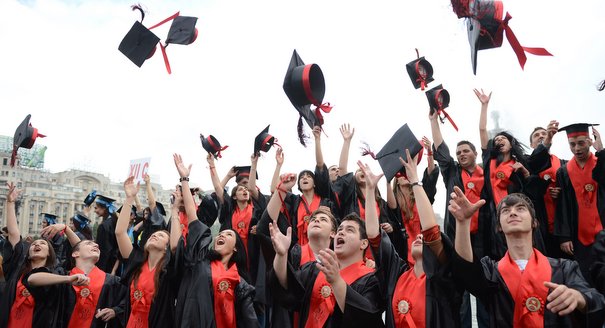
The global financial crisis has brought budget trims for higher education across Europe. But not in Poland and Lithuania.
Source: New York Times

When the East and Central European countries joined the European Union in 2004, foreign direct investment increased and trade with E.U. partners flourished. For the young, membership opened the door to participation in E.U educational programs like Erasmus and student exchanges between European universities. The opportunities were huge.
Then came the global financial meltdown and its aftermath, a systemic banking and debt crisis and economic stagnation across most of Europe.
Among the newest E.U. entrants, Latvia and Hungary needed help from the International Monetary Fund to save their banking sectors from collapse, and amid ongoing pressure for budgetary rigor, several governments in the region moved to cut planned spending — including expenditures on education.According to the European University Association, based in Brussels, public funding for higher education has fallen at least 10 percent over the past two years in the Czech Republic, Hungary and Latvia.
Teachers, too, have felt the pinch, according to a recent report by the European Commission’s directorate for Education. In Bulgaria, Latvia and Romania secondary school teachers earn about €6,000, or $7,765, in their first year, which the report says gives few incentives for graduates to enter the profession.
Poland and Lithuania have many of the same problems, including aging teachers and poor salaries. Still, “we weathered the global financial crisis and we are more than coping with the euro crisis,” Michal Federowicz, director of Poland’s Educational Research Institute in Warsaw, said during an interview.
Poland started major education overhauls in 1989, restructured its school system in 1999 and introduced a new curriculum in 2009, he noted.
The Polish government’s education budget is now about 5.7 percent of gross domestic product, in line with the European average and it is rising, not falling. Of that amount, nearly a fifth, more than 1.1 percent of G.D.P, is earmarked for higher education. With rising university student numbers, per capita spending on them has dipped. But total spending is only one part of the picture, Mr. Federowicz said. The other is how it is allocated.
Across Europe, there is a shortage of mathematicians, scientists and engineers, and Poland is not an exception. “In the E.U. and Poland alike, as far as the needs of the economy are concerned, there are still too few graduates in scientific and technical subjects,” said a new report by Mr. Federowicz’s research institute.
Responding to this shortage, Poland’s Ministry of Science and Higher Education recently introduced a special contract system under which it will provide more funding to certain science and engineering faculties in return for having more students studying these disciplines. The government has also reintroduced mathematics as a compulsory subject for the “matura,” the high school final exam that students must pass to qualify for university entrance.
Math was part of the matura curriculum for more than 220 years until 1983, when in an extraordinary decision soon after the introduction of martial law, Poland’s Communist government removed it as a compulsory subject.
Polish educationalists said the result was catastrophic. Because math was no longer a compulsory subject for entering university, pupils dropped it early. “It left a huge gap in the intellectual development of the pupils,” Mr. Federowicz said.
Catching up has not been easy. The research institute study highlights the key role of good teaching in repairing the damage done and encouraging pupils to develop a problem-solving mind-set.
In neighboring Lithuania, the government has also protected education from the budgetary pressures brought on by the Union’s economic crisis.
“Education is a top priority for the Lithuanian government,” an official at the Ministry of Education and Science said in reply to an e-mail. “Education was not affected as much by the impact of the global economic crisis, as other areas. On the whole, the amount of funding allocated to education in Lithuania was more affected by demographic reasons (diminishing student numbers) than financial pressure.”
As pre-university student numbers have dropped, the total national education budget has followed suit, falling 7.2 percent in 2011 and another 3.4 percent this year. Still, funding for higher education has been maintained, rising to 13.1 percent of all national education spending last year and 17.5 percent this year.
Poland and Lithuania share the demographic challenges of their West European counterparts — aging populations and falling birthrates. Both have consequences for education.
According to a new report by the Organization for Economic Cooperation and Development, in Paris, more than 40 percent of secondary school teachers in five E.U. countries — Austria, the Czech Republic, Estonia, the Netherlands and Sweden — are 50 or older. In Germany and Italy it is more than 50 percent.
At the other end of the spectrum is the declining birth rate — the reason, according to the Lithuanian government, for reduced funding for secondary schools.
“Funding per pupil (per capita) has not been cut,” the Lithuanian Education Ministry said. “During the last couple of years, the decline in pupil numbers entering schools has been around 20,000 each year, due to the birthrates.
“Even as the pupil numbers decline, the Ministry of Education and Science has been making every possible effort to keep the funding for education at the same level.”
Poland is trying to do the same. Both countries see that their economies need a well-educated younger generation that is equipped to prosper in the globalized economy.
That means having universities focus on mathematics and engineering, science and medicine. Wroclaw University, in Poland, for example, has carved out a niche for itself in scientific research and entrepreneurship. That, after all, is what the “smart economy” is about.

Nonresident Senior Fellow, Carnegie Europe
Judy Dempsey is a nonresident senior fellow at Carnegie Europe
Recent Work
Judy Dempsey
Judy Dempsey
As the United States confronts China more directly, Merkel is exploring deeper cooperation with Xi. Economic upheaval from the coronavirus could reinforce the temptation in Berlin to keep Beijing close.
Noah Barkin
The 2017 G20 summit exposed the United States' isolation on the key issues of climate and trade.

Marc Pierini
A selection of experts answer a new question from Judy Dempsey on the foreign and security policy challenges shaping Europe’s role in the world.
Judy Dempsey
Europe may need to start planning for defense of the continent without the United States, but first it should do its utmost to prevent Trump from turning his back on NATO.
Tomáš Valášek
Amid the threats of an inward-looking United States and rising European populism, cooperation between the EU and China is more necessary than ever.
Shi Zhiqin, Lai Suetyi