

Commentary
Nathan J. Brown
{
  "authors": [
    "Nathan J. Brown"
  ],
  "type": "legacyinthemedia",
  "centerAffiliationAll": "dc",
  "centers": [
    "Carnegie Endowment for International Peace",
    "Malcolm H. Kerr Carnegie Middle East Center",
    "Carnegie Russia Eurasia Center"
  ],
  "collections": [],
  "englishNewsletterAll": "menaTransitions",
  "nonEnglishNewsletterAll": "",
  "primaryCenter": "Carnegie Endowment for International Peace",
  "programAffiliation": "MEP",
  "programs": [
    "Middle East"
  ],
  "projects": [
    "Eurasia in Transition"
  ],
  "regions": [
    "Middle East",
    "Israel",
    "Palestine",
    "Levant"
  ],
  "topics": [
    "Political Reform",
    "Security"
  ]
}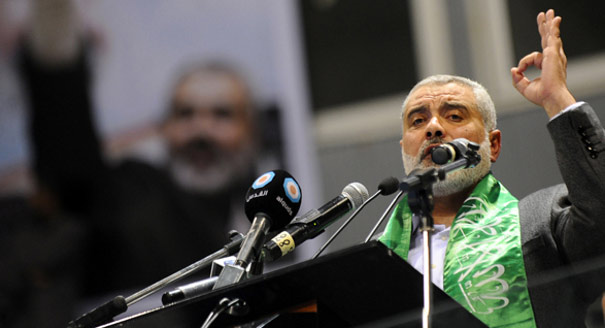
Source: Getty
However damaging the violence and shrill the rhetoric, the current round of fighting between Gaza and Israel is likely to be anything but decisive. The most likely outcome is a return to something like the status quo ante.
Source: New Republic

But is there room for hope beyond that kind of stalemate? Is there any chance that after the smoke clears and a tenuous cease fire returns, there can be some hope that Hamas can be gradually transformed by its assumption of political responsibility for the Gaza statelet into a normal political actor and a negotiating partner in an internationally-sponsored effort to resolve the underlying conflict?
The answer is clear: Yes, but.
Yes, it is possible that Hamas can change and evolve. In some ways, it already has. But further evolution, if possible, is hardly inevitable, and the process is likely to be extremely slow and uncertain.In order to understand what change is possible, it is important to note two clear but generally unspoken developments in the Israeli-Hamas relationship since Hamas's 2006 electoral triumph and 2007 seizure of Gaza.
First, Israel and Hamas have agreed to negotiate. Israel continues to insist that it will not speak to Hamas, but that fiction is maintained largely to discourage other international actors from treating Hamas as a legitimate interlocutor. (The Israelis themselves have dropped any pretense about indirect negotiations. “The Egyptians have been a pipeline for passing messages,” Israel's vice prime minister recently announced. “We are in contact with the Egyptian defence ministry. And it could be a channel in which a ceasefire is reached.”) Similarly, Hamas also insists that it will never negotiate with Israel—but when the Egyptian prime minister showed up in the midst of the current fighting not only to demonstrate support but also to underscore Egyptian mediation efforts, he was warmly welcomed.
Second, neither Hamas nor the Israeli leadership has anything like a viable long-term plan for dealing with the other side. Israeli leaders offers only glum, limted, and even cynical cooperation with the cadaverous “peace process.” Hamas offers its people outright intransigence coupled with hope that its boat will rise together with a regional Islamist tide. Israel and Hamas are capable of negotiating about almost anything short-term (exchnage of prisoners; cease fire), but absolutely nothing long-term. In this sense, Hamas is a victor: It has always insisted that it was open to the idea of a long-term truce but closed to a permanent settlement. Plenty of truces have been achieved between the two sides, though they have been unwritten, shaky, and frequently violated.
Clearly, Hamas can not be expected to change overnight. But there is still reason to hope that Hamas can change incrementally. However odd it may seem, Hamas has always boasted of its pragmatism. It continues to claim to be a “wasati” movement—the term means “centrist” and is used by Islamists who want to communicate their responsiveness to the interests of the public rather than their devotion to the strictest version of religious teachings. And it is clear that in the first few years after winning elections in Gaza in 2006, some Hamas leaders, confronted with intense regional pressure and a fiscal crisis, and the knowledge that they would have to face the Palestinian voters again in 2010, took initial steps in a more moderate direction.
Unfortunately, the elections they were anticipating were never held (and the primary culprits in that regard were President Mahmud Abbas who threatened constantly to use an utterly imaginary authority to dissolve the parliament and Western actors who supported him in those threats). When a Palestinian civil war erupted in June 2007, the governments in the West Bank and Gaza became more explicitly autocratic, to the detriment of Palestinians in both territories. Hardly anyone harbors expectations any longer of free elections: On those rare occasions when Hamas and the leaders of the West Bank have had half-hearted conversations about reuniting, elections haven't been a meaningful part of the negotiations.
Any hopes since then that Hamas would moderate have been squandered. The changing regional environment after the Arab upheavals of 2011 seemed to offer brief hope that Hamas would reposition itself away from the “resistance” camp in the region and toward the camp of Islamist movements in North Africa that were dedicated to making political Islam the basis of a practicable governing system. That would have required taking reconciliation with Israel a bit more seriously, interpreting “resistance” a bit more flexibly to encompass popular mobilization more than armed action, and presenting a friendlier diplomatic face to the rest of the world. But the effort, led by Khalid Mish'al, was derailed by Hamas leaders who didn't want to risk their hold on the government in Gaza.
There is a possible path forward out of this dreary political landscape. The most promising way to force Hamas to become more moderate is to force it to be more responsive to its own public. (As a leading Muslim Brotherhood parliamentarian in neighboring Egypt told me when I asked him whether Hamas would ever accept a two-state solution: “They will have to. Their people will make them.”) And the most promising way to ensure such responsiveness is to speed up the reconciliation between the governments in the West Bank and Gaza, so that those governments can agree to hold elections rather than jealously hold on to their own fiefdoms in a fit of paranoia. But that, in turn, will require that Israel and the international community show a greater willingness to countenance Palestinian reconciliation.
There is no denying that cultivating rapprochement between the West Bank and Gaza poses real dangers. One is that it will make any conflict-ending peace process with Israel impossible in the immediate future; pending the formation of a new unity government in Palestine, the Palestinian leadership would not be in the position of engaging in negotiations. But most residents of the region would react to losing the “peace process” the same way as they would treat the news that they had lost an eight-track tape collection—the phrase itself belongs to a long-gone era.
A second risk is that reconciliation would have to allow Hamas to come out of hibernation in the West Bank. An Israeli leadership that has successufully bottled Hamas up in Gaza and a Palestinian leadership in Ramallah that has rooted Hamas out of Palestinian institutions over the past five years will hesitate to allow Hamas to come out into the open there. Of course, their own past efforts to destroy Hamas can be likened to that of someone trying so desparartely to remove a stain from an article of clothing that he only sets it more permanently within the fabric.
The path is a risky one, to be sure. But Hamas is beckoning for a new approach. If the definition of insanity is trying the same thing over and over while expecting different results, the current fighting certainly qualifies as madness.

Nonresident Senior Fellow, Middle East Program
Nathan J. Brown, a professor of political science and international affairs at George Washington University, is a distinguished scholar and author of nine books on Arab politics and governance, as well as editor of five books.
Recent Work
Nathan J. Brown
Nathan J. Brown
Carnegie does not take institutional positions on public policy issues; the views represented herein are those of the author(s) and do not necessarily reflect the views of Carnegie, its staff, or its trustees.
The Thai-Cambodian conflict highlights the limits to China's peacemaker ambition and the significance of this role on Southeast Asia’s balance of power.

Pongphisoot (Paul) Busbarat
Beijing believes that Washington is overestimating its own leverage and its ability to handle the trade war’s impacts.


Rick Waters, Sheena Chestnut Greitens
Tapping our network of China experts in the region, Carnegie China offers this latest “China Through a Southeast Asian Lens” report to offer preliminary assessments of whether the U.S. effort to reshape the global trading order will lead countries in the region to tilt toward Beijing.



Selina Ho, Khin Khin Kyaw Kyee, Joseph Ching Velasco, …

Because strategic, economic, and ideological perceptions of China contain multiple, sometimes contradictory facets in Southeast Asia, receptions of and responses to Beijing diverge across and within state lines.



Evan A. Feigenbaum, Chong Ja Ian, Elina Noor

Most Southeast Asian states behave as if the actions of their Northeast Asian neighbors and the Philippines will be sufficient to maintain a regional status quo from which they can benefit.
Chong Ja Ian