

Commentary
Nikolay Petrov
{
  "authors": [
    "Nikolay Petrov"
  ],
  "type": "legacyinthemedia",
  "centerAffiliationAll": "",
  "centers": [
    "Carnegie Endowment for International Peace",
    "Carnegie Russia Eurasia Center"
  ],
  "collections": [],
  "englishNewsletterAll": "",
  "nonEnglishNewsletterAll": "",
  "primaryCenter": "Carnegie Russia Eurasia Center",
  "programAffiliation": "",
  "programs": [],
  "projects": [],
  "regions": [],
  "topics": []
}
Source: Getty
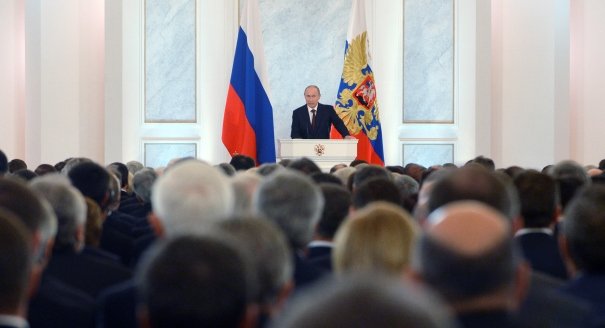
The Kremlin recognizes that decentralization is both necessary and inevitable, but Putin’s proposals for the Russian regions demonstrate that the regime is not quite ready to make decentralization a reality.
Source: The Moscow Times

At his meeting with the Council of Legislators, Putin recommended that the regions be enlarged as a second method. He pointed out that income levels vary widely between regions, and he blamed this on a disruption of the "natural connection that used to unite self-supporting regions." He cited St. Petersburg and the Leningrad region as examples, both of which were managed by a single Communist Party committee during the Soviet era. By the way, the Federal Security Service in that city and region is under a single management — as was the KGB.
Putin also cited small ethnic enclaves that are part of larger regions. Stressing that nobody is being forced into anything, Putin said that "people should themselves come to the conclusion that it makes good sense to combine into larger entities in order to more effectively solve social and economic problems." At the same time, he said, "super-regions are also undesirable," so everything should be within reason.
However, if Putin were to look at a map, he would see that the odd idea of boosting self-sufficiency by joining "weak" regions with "strong" ones does not work. The three largest "donor" regions are Moscow and the Yamal-Nenets and Khanty-Mansiisk autonomous districts. Moscow is already a super-region, and it would be difficult to join anything to the two other regions because of their remote northern location. What's more, the problem is not with the structure of the territories or regional governments. The problem lies first in the overly centralized nature of the tax system and second in the overreliance of the Russian economy on exports of raw materials.
Putin also mentioned ethnic republics in both his state-of-the-nation address and in his meeting with legislators. In the speech, he said, "We will not allow the emergence of closed ethnic enclaves in Russia, with their informal jurisdiction existing outside the country's common legal and cultural norms and disdainfully disregarding the accepted standards, laws and regulations." This might sound like an accurate description of the situation with Chechnya, but the words were probably aimed at Tatarstan.
Putin mentioned that the Kremlin was ready for a major new policy of bringing the leaders of the republics into the power structure. The actual method has yet to be worked out. It might, for example, follow the Dagestan model of indirect elections and be coupled with a consensus of a region's main ethnic groups. In any case, the problem is clear: Holding direct elections in national republics with complex ethnic issues carries the risk of destabilization.
What conclusion can be drawn from this? That the Kremlin realizes that decentralization is both necessary and inevitable but that it is not yet ready to make it a reality. Putin's proposals are inadequate.
Former Scholar-in-Residence, Society and Regions Program, Moscow Center
Nikolay Petrov was the chair of the Carnegie Moscow Center’s Society and Regions Program. Until 2006, he also worked at the Institute of Geography at the Russian Academy of Sciences, where he started to work in 1982.
Recent Work
Nikolay Petrov
Nikolay Petrov
Carnegie does not take institutional positions on public policy issues; the views represented herein are those of the author(s) and do not necessarily reflect the views of Carnegie, its staff, or its trustees.