

Commentary
Judy Dempsey
{
  "authors": [
    "Judy Dempsey"
  ],
  "type": "legacyinthemedia",
  "centerAffiliationAll": "",
  "centers": [
    "Carnegie Endowment for International Peace",
    "Carnegie Europe"
  ],
  "collections": [
    "Transatlantic Cooperation"
  ],
  "englishNewsletterAll": "",
  "nonEnglishNewsletterAll": "",
  "primaryCenter": "Carnegie Europe",
  "programAffiliation": "",
  "programs": [],
  "projects": [],
  "regions": [
    "Europe"
  ],
  "topics": [
    "EU",
    "Security",
    "Economy"
  ]
}
Source: Getty
The armed forces, so far, have gotten away relatively lightly among the drastic cuts that have affected health care, transportation, and education.
Source: New York Times

He said recently that allied defense expenditures had declined by more than $56 billion compared with 2009. Practically all of those cuts happened in Europe, reducing defense spending there by an average of 15 percent.
Speaking at a meeting of the NATO Parliamentary Assembly in Prague, Mr. Rasmussen added that among the European allies, “only two devoted more than 2 percent of the gross domestic product to defense.”
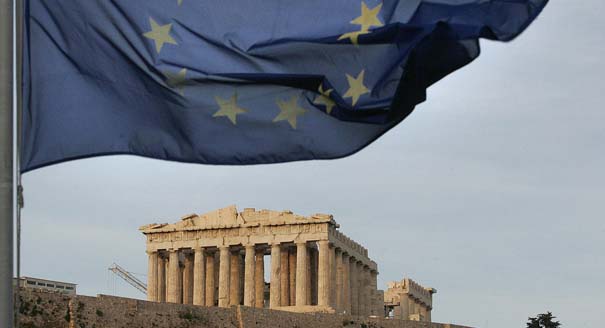
One of those countries was Greece.
That seems astonishing given that Greece is in a deep economic and financial crisis. Greece’s economy has shrunk by 25 percent over the past two years.During that time, the middle and lower classes — not the rich business community — have been hit hardest. The International Monetary Fund and the European Commission have imposed stringent austerity measures in return for loan guarantees. As a result, pensions and health care, transportation and education have all been cut drastically.
The armed forces, so far, have gotten away relatively lightly. During the height of the global financial crisis of 2008, Greek defense expenditures accounted for 3.1 percent of gross domestic product. Over the past two years, Greek defense spending still amounted to 2.1 percent of G.D.P.
“In relative terms, defense expenditure has been reduced given how much gross domestic product has fallen,” said Alexander S. Kritikos, an economics professor at the German Institute for Economic Research in Berlin.
“But the defense budget is still very high. It has been largely insulated from the huge cutbacks borne by the middle classes and poorer people,” he added.
Last August, the €10 billion, or $13 billion, defense budget was trimmed by €516 million. Even at that, Greece is the second-biggest defense spender among the 27 NATO countries after the United States, according to NATO statistics.
More than 73 percent of its budget is for personnel costs alone, making it one of the highest among NATO allies. Furthermore, military and civilian personnel account for 2.7 percent of Greece’s total labor force during, also making it one of the highest in NATO, according to alliance figures.
It is particularly hard to see how the armed forces can justify the current budget, as the money is not spent on supporting NATO or E.U. missions. According to the latest figures from the NATO-led International Security Assistance Force, Greece has 10 soldiers based in Afghanistan, out of a total of 102,011 troops from 50 countries.
In its neighborhood, Greece has 118 soldiers serving in NATO’s stabilization mission in Kosovo, out of a total of 5,565 troops from 30 contributing countries.
NATO does not publicly comment about any ally. But officials, speaking on condition of anonymity, said the Greek government has not used the financial crisis to overhaul its armed forces by making the purchase of military equipment transparent, or reducing the personnel count of 136,000, of whom 90,000 are soldiers.
Curiously, the Greek public, which has often protested against the austerity measures, has yet to demand that the armed forces carry some of the burden. One reason, analysts say, is Greece’s residual fear of Turkey, a leading NATO member — despite the improvement of relations between the two countries over the past decade.
“It’s all very well calling for deeper defense cuts, but geography still matters. Certain fears still run deep,” said Tomas Valasek, president of the Central European Policy Institute, a security think tank in Bratislava, Slovakia.
Other analysts agree that the Greek armed forces can always resist big defense cuts by playing the Turkey card. “The generals will always have an excuse to keep the budget high,” Mr. Kritikos said.
Indeed, over the past several months, the Greek media have written that Turkey violated Greek airspace at least once. In response, the Turkish General Staff said its airspace had been repeatedly violated by Greece, Italy, and Israel.
There is another political reason for exempting the army from cuts. Closing some of the 500 military bases and 17 training centers would mean sending tens of thousands of young soldiers into the ranks of the unemployed, adding a dangerous component to social unrest, according to Sipri, a Swedish research institute. Perhaps, analysts said, the Greek armed forces will have to wait for any major restructuring until the country’s economy picks up.

Nonresident Senior Fellow, Carnegie Europe
Judy Dempsey is a nonresident senior fellow at Carnegie Europe
Recent Work
Judy Dempsey
Judy Dempsey
China has showcased its engineering prowess with small modular reactor demonstration projects. But turning these technological achievements into commercial success will be a greater challenge.

Tong Zhao

The Plaza Accord was not an externally imposed punishment of Japan but part of a broader restructuring that Japanese economists and policymakers themselves recognized was necessary. Its effects were undermined, however, when Tokyo responded to the resulting slowdown with policies that exacerbated investment, credit expansion, and the very imbalances the adjustment was intended to resolve.

Michael Pettis
China’s banking crisis in the 2000s was resolved by transferring the costs to households through financial repression—a decision that recapitalized the banks while exacerbating the structural imbalances that continue to shape the Chinese economy today.
Michael Pettis

In the latest Five-Year Plan, the Chinese president cements the shift to an innovation-driven economy over a consumption-driven one.

Damien Ma

Rather than climate ambitions, compatibility with investment and exports is why China supports both green and high-emission technologies.

Mathias Larsen