

Q&A
- +1
Sheena Chestnut Greitens, Oriana Skylar Mastro, Yukon Huang, …
{
  "authors": [
    "Yukon Huang"
  ],
  "type": "legacyinthemedia",
  "centerAffiliationAll": "dc",
  "centers": [
    "Carnegie Endowment for International Peace"
  ],
  "collections": [],
  "englishNewsletterAll": "asia",
  "nonEnglishNewsletterAll": "",
  "primaryCenter": "Carnegie Endowment for International Peace",
  "programAffiliation": "AP",
  "programs": [
    "Asia"
  ],
  "projects": [],
  "regions": [
    "East Asia",
    "China"
  ],
  "topics": [
    "Economy"
  ]
}
Source: Getty
Urbanization holds the key to a more innovation-driven growth model and sustained consumption demand in China, but the process also presents several challenges.
Source: Financial Times
This session of National People’s Congress will be more memorable for the fact that it marks the transition to the next generation of senior Chinese leaders than for any pronouncements. Premier Wen Jiabao will pass his mantle to Li Keqiang at a time when stalling growth, widening wealth disparities, pervasive corruption and mounting social unrest mean people are anxious for change.
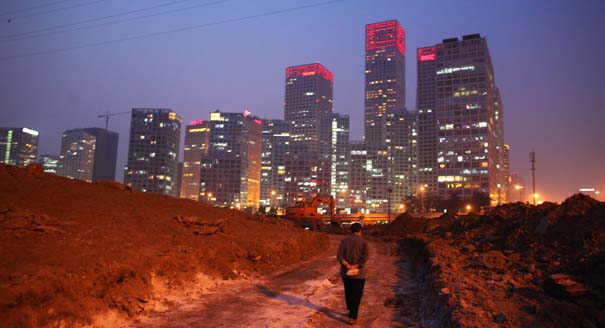
Whereas Mr Wen took a populist approach on taking office a decade ago, emphasising the needs of the rural economy, Mr Li will embrace an ambitious urbanisation programme as the solution for China’s many ills. For the premier-designate, this is more than just a growth driver – it is the key to addressing many of the country’s challenges, from inequality and environmental degradation to exploitative land grabs by local officials.Could urbanisation really prove such a panacea? The average citizen in Beijing these days, stuck in traffic jams and choking on polluted air, would complain that the city is already too crowded.
But with a population of 1.3bn and large portions of its land mass uninhabitable, China is less urbanised than many other developing countries. This is the legacy of a Communist system that controlled settlement patterns. Unrestricted, 60 per cent of China, rather than 52 per cent, might be urbanised. With more supportive policies, it is likely to be 80 per cent urban by 2030, about the same as South Korea today.
Many observers are sceptical about the potential net benefits. Three factors will determine whether Mr Li’s objectives will be realised. Can urbanisation generate the productivity increases needed to benefit rich and poor, rural and urban? Can this be done on a financially sustainable basis? And can China avoid the congestion-related ills that afflict many other big cities in developing Asia? These questions need to be addressed if a blueprint is to be presented as early as the next NPC meeting in October.
Urbanisation can shift China to a new growth path that relies more on productivity and consumption rather than investments and exports. It could also have favourable consequences for distribution. Many workers in rural villages and towns would be better off if they moved to larger cities, where potential productivity gains are much greater. About 40 per cent of the labour force is still underused in rural areas – mostly in agriculture, which accounts for only 10 per cent of gross domestic product. Urbanisation would also reduce income inequalities by giving poorer rural workers attractive income options while making more land available for those who choose to remain behind.
For this to happen, China needs to liberalise its restrictive hukou residency policies to increase labour mobility. This would spur consumption, as migrants would be eligible for housing and social services on the same basis as established residents – creating the demand that would make additional infrastructure investments sustainable. The biggest cities will continue to grow rapidly, given the productivity benefits that come from concentrating skills, financial and marketing services and consumers.
A big question facing the new premier’s urbanisation plan is how it will be financed. The proposal being discussed by the authorities to back it with a Rmb40tn ($6.4tn) municipal bond programme in the coming decade has generated excitement that this could deepen capital markets and allow China to rely less on bank financing. But many are sceptical.
This approach assumes municipalities would issue bonds with terms based on their fiscal capacity. This would encourage development of more sustainable revenue sources, such as property taxes, and reduce reliance on land sales that have spawned abusive practices and a potential debt crisis.
The danger, however, is that a bond-financed programme would turn out to be not much different from the current practice of state banks lending directly to local government financing entities. The purchasers of these bonds would continue to be primarily state banks, and evaluation of risk could be a secondary consideration given politically driven pressures to buy them. Nevertheless, this initiative is a step closer to developing more transparent and sustainable financing vehicles.
More rapid urbanisation can make cities dirty, dangerous and congested. For China, however, the risks have less to do with the size of its cities than poor management and policies that fail to encourage efficient land use. Beijing’s core, for example, is not being appropriately used, while affordable housing is pushed too far out from where the jobs are. A fascination with ring roads impedes rather than facilitates traffic flow. The consequence is excessively long commutes with more traffic-related pollution than necessary and costlier provision of social services because of the higher capital costs of building schools, sewerage systems and other social infrastructure for a dispersed population.
The commercial viability of megacities lies not in dirty industrial production, which is better located in less densely settled areas, but in the provision of services that require concentration of knowledge-intensive activities and proximity to diverse consumer markets. This holds the key to both a more innovation-driven growth model and sustained consumption demand.
Mr Li’s urbanisation initiative deserves support for the potential it offers – but resistance to change should not be underestimated. Opponents include mayors and established residents reluctant to encourage inflows of migrants, as well as bureaucrats and developers who profit from the opaque processes controlling land development. It will take a very determined premier to overcome these vested interests to move forward on such an ambitious agenda.

Senior Fellow, Asia Program
Huang is a senior fellow in the Carnegie Asia Program where his research focuses on China’s economy and its regional and global impact.
Recent Work


Sheena Chestnut Greitens, Oriana Skylar Mastro, Yukon Huang, …


Yukon Huang, Isaac B. Kardon, Matt Sheehan

The Plaza Accord was not an externally imposed punishment of Japan but part of a broader restructuring that Japanese economists and policymakers themselves recognized was necessary. Its effects were undermined, however, when Tokyo responded to the resulting slowdown with policies that exacerbated investment, credit expansion, and the very imbalances the adjustment was intended to resolve.

Michael Pettis

The nuclear relationship between China and the United States is increasingly shaped by widening perception gaps rather than deliberate strategic design.

Tong Zhao
China’s banking crisis in the 2000s was resolved by transferring the costs to households through financial repression—a decision that recapitalized the banks while exacerbating the structural imbalances that continue to shape the Chinese economy today.
Michael Pettis

Chinese biotech companies have been on the receiving end of U.S. economic coercion. Yet their responses have differed significantly because firm and state interests are not uniformly aligned. For Washington, treating all Chinese tech firms the same, irrespective of their actual interests, risks pushing them farther into Beijing’s corner.

Xue Gong

China’s latest energy plan explicitly calls for integrating data centers into the electricity system, particularly connecting them to green energy. It appears Beijing wants to use compute as a source of domestic demand to absorb renewables excess capacity.

Damien Ma