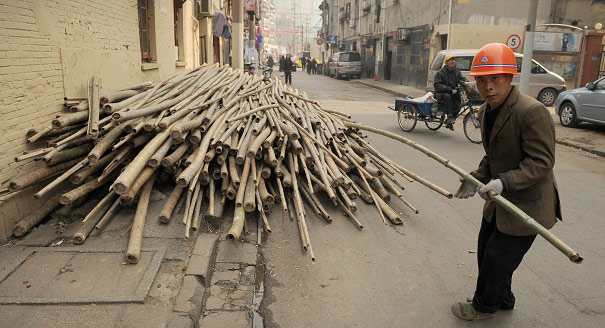
Source: Bloomberg
Xi Jinping and Li Keqiang are taking over China’s leadership at a time when growth has slackened and labor issues have become more complex.
Reports that businesses such as Foxconn Technology Group are raising wages and struggling to recruit workers in China have intensified debate over just how many surplus workers the country still has. Meanwhile, a boom in college-educated Chinese has raised concerns of an impending threat to U.S. competitiveness. These seemingly disparate concerns about China’s labor force are actually linked by common underlying factors, with critical implications for China’s ability to remain the growth engine of the world.
China’s large pool of surplus labor has fueled its rapid industrial growth. Now this “demographic dividend” may be almost exhausted, and its economy reaching a Lewis turning point: a shift named after the Nobel prize-winning Arthur Lewis, who was the first to describe how poor economies can develop by transferring surplus labor from agriculture to the more productive industrial sector until the point when surplus labor disappears, wages begin to rise and growth slows.
Citing periodic labor shortages and unskilled wages that have risen since 2003, prominent Chinese economists suggest that time has come. The International Monetary Fund disagrees and puts the turning point much later -- between 2020 and 2025, based on a model analyzing labor productivity. A third view is that China’s surplus labor is still plentiful, given that about 40 percent of the labor force is still underutilized in the rural sector, mostly in agriculture, which accounts for only 10 percent of gross domestic product.
Mobility Restrictions
In China, many market imperfections impede the mobility and use of labor. Thus, actual availability may fall far short of what is potentially available. The hukou residency system that restricts migrant workers from accessing services where they are employed is the most glaring example of this kind of imperfection. Less obvious is the extent to which China’s rural- support policies, including subsidy programs, may be encouraging workers to stay in agriculture longer than they should.
Surplus workers may not be in agriculture as in the original Lewis model but in smaller towns, underemployed at depressed wages. The result is that China has the highest rural- urban income disparity in the world.
Why don’t these workers move to more productive jobs in more dynamic settings? In formal terms, it is because their “reservation wage” has increased -- that is, the minimum wage they demand to move is much greater than their current wage, because for a generation that didn’t experience the hardships of the Mao Zedong era, the monetary and emotional costs of relocation have risen. Many workers won’t move to major cities that lack affordable housing. They may also have rights to land that can’t be sold for full market value -- thus, staying in familiar surroundings is now a more attractive proposition.
If recent decades saw a huge migration that “brought workers to where the jobs are” along the coast, the future may mean the reverse, involving “bringing the jobs to where the workers are” with profound implications for China’s economic geography.
In lesser known provinces such as Henan, with a country- sized population of 100 million, large numbers of young workers seek factory positions but are unwilling to relocate to seemingly foreign places in coastal China. As China becomes more consumption-oriented with rising incomes and urbanization, the center of economic gravity will naturally move inland where two- thirds of the population resides.
College Graduates
Just as young workers are demanding more satisfying jobs, they also increasingly feel entitled to a college education. Government policy has expanded access to higher education. From 2000 to 2010, the percentage of college-age cohorts enrolled in universities more than tripled in China, a rate of increase far above that of India, Malaysia and Indonesia. China wants to produce 200 million college graduates by 2030; they will make up more than 20 percent of the projected labor force, more than double the current ratio. The push to expand higher education means the number of college-educated has leapfrogged -- and excessively so -- ahead of those holding only vocational or junior college degrees.
These college-educated workers are unwilling to settle for factory work and compete for office-based positions. College graduates are four times as likely to be unemployed as urban residents of the same age with only basic education, even as factories go begging for semi-skilled workers. Given the underdeveloped service sector and still-large roles of manufacturing and construction, China has created a serious mismatch between skills of the labor force and available jobs.
As the economy moves up the value chain, substituting more capital-intensive manufacturing for unskilled labor-intensive assembly, a shortage of semi-skilled workers is appearing. But the excessive growth of college graduates has outpaced the structural transition and prematurely shifted the labor supply from semi-skilled manufacturing workers to more knowledge- intensive service professionals. More emphasis on vocational training and industry-specific engineering skills will help China fill its immediate need for manufacturing workers.
Economists will continue to debate whether China is running out of surplus labor. But pinpointing the timing of the Lewis turning point is less relevant than understanding how policy distortions, shifting labor migration patterns and higher education enrollments are creating labor shortages and skill-mix problems. As China enters a more complicated and less predictable phase of its economic development, its policy makers need to focus on how to encourage use of labor in the right places and with the right skills.
This article was originally published in Bloomberg.