

Research
- +10
Rosa Balfour, Frances Z. Brown, Yasmine Farouk, …
{
  "authors": [
    "Moisés Naím"
  ],
  "type": "legacyinthemedia",
  "centerAffiliationAll": "",
  "centers": [
    "Carnegie Endowment for International Peace"
  ],
  "collections": [],
  "englishNewsletterAll": "",
  "nonEnglishNewsletterAll": "",
  "primaryCenter": "Carnegie Endowment for International Peace",
  "programAffiliation": "",
  "programs": [],
  "projects": [],
  "regions": [
    "East Asia",
    "North Korea",
    "North America"
  ],
  "topics": [
    "Democracy",
    "Nuclear Policy"
  ]
}
Source: Getty
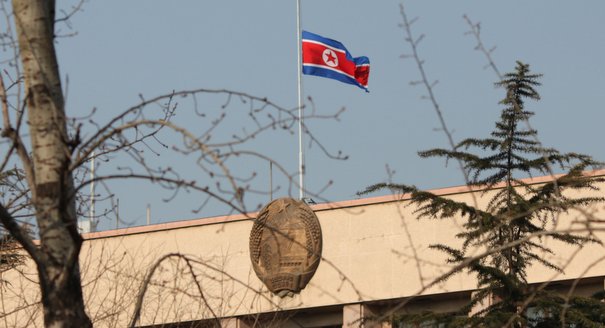
Kim Jong Un’s challenge is to hold power in a world where democracies seem to be overtaking autocracies.
Source: PBS NewsHour
In a continuation of his broadcast interview with the PBS NewsHour's Ray Suarez, author and former Foreign Policy editor Moisés Naím talks about North Korea's Kim Jong Un challenge to hold power in a world where democracies seem to be overtaking autocracies.
"It is becoming harder for him, for people like the North Korean government and the North Korean leader to stay in power. He can get away with it ... but the number of autocracies has been plummeting" in the wake of forces like the democracy movement of the Arab Spring, said Naím, author of the recently released The End of Power: From Boardrooms to Battlefields and Churches to States, Why Being in Charge Isn't What It Used to Be.
More unconventional leaders of democracy, people like Nelson Mandela in South Africa and Myanmar's Aung San Suu Kyi, made headway because they were able to mobilize the energies, hopes, desperation and political power that were against the more dominant structures of power -- South Africa's apartheid and Myanmar's military junta, Naím said.
China offers another complicated picture. It has succeeded in lifting hundreds of millions of people out of poverty, he continued, but now has an emerging middle class that is placing strains and demands on the government that "are in many ways undermining its ability to be that superpower that people fear."

Distinguished Fellow
Moisés Naím is a distinguished fellow at the Carnegie Endowment for International Peace, a best-selling author, and an internationally syndicated columnist.
Recent Work



Rosa Balfour, Frances Z. Brown, Yasmine Farouk, …
Moisés Naím
Carnegie does not take institutional positions on public policy issues; the views represented herein are those of the author(s) and do not necessarily reflect the views of Carnegie, its staff, or its trustees.

The nuclear relationship between China and the United States is increasingly shaped by widening perception gaps rather than deliberate strategic design.

Tong Zhao

Chinese biotech companies have been on the receiving end of U.S. economic coercion. Yet their responses have differed significantly because firm and state interests are not uniformly aligned. For Washington, treating all Chinese tech firms the same, irrespective of their actual interests, risks pushing them farther into Beijing’s corner.

Xue Gong

Across Asia, China is better positioned to withstand energy shocks from the fallout of the Iran war. Its abundant coal capacity can ensure stability in the near term. Yet at the same time, the country’s energy transition away from coal will make it even less vulnerable during the next shock.

Damien Ma
GDP growth means something fundamentally different in China than in most countries.

Michael Pettis
The Trump administration’s effort to reshape the global trading system and reset overseas security commitments is creating an historic inflection point. Less clear is how far China will be able to capitalize on these dynamics.

Li Mingjiang, Le Hong Hiep, Ngeow Chow Bing, …