

Article
C. Raja Mohan, Darshana M. Baruah
{
  "authors": [
    "C. Raja Mohan"
  ],
  "type": "legacyinthemedia",
  "centerAffiliationAll": "dc",
  "centers": [
    "Carnegie Endowment for International Peace",
    "Carnegie India"
  ],
  "collections": [],
  "englishNewsletterAll": "ctw",
  "nonEnglishNewsletterAll": "",
  "primaryCenter": "Carnegie India",
  "programAffiliation": "SAP",
  "programs": [
    "South Asia"
  ],
  "projects": [],
  "regions": [
    "South Asia",
    "India",
    "Pakistan"
  ],
  "topics": [
    "Security",
    "Military",
    "Foreign Policy"
  ]
}
Source: Getty
The shortest road between Islamabad and New Delhi runs through the divided Punjab.
Source: Indian Express
The weekend telephone talk between Prime Minister Manmohan Singh and Nawaz Sharif, who will soon be sworn in as premier of Pakistan, was presumably in Punjabi. There is nothing like the comfort of one's mother-tongue in breaking the political ice between nations.
The origins of the current on-again and off-again peace process between India and Pakistan dates back to the determination of two Punjabi-speaking leaders, Sharif and Inder Kumar Gujral. After Sharif's landslide victory in early 1997, Gujral negotiated the framework for the composite dialogue that still provides the basis for India-Pakistan negotiations.
It is quite easy for cynics to scoff at New Delhi's "Lahore brigade" and the Punjabi peaceniks who light candles at the Wagah border. But no political realist can forget that the shortest road between the two capitals runs through the divided Punjab.Nawaz Sharif, who invited Manmohan Singh to attend his swearing-in ceremony next week, understands that the Indian PM has tied himself into knots over visiting Pakistan and will not make it.
Sharif is also aware that Singh's clock is running down, and that the UPA government headed by him has little political steam left. There is a danger then that the subcontinent's traditional curse—the misalignment of the political cycles in India and Pakistan—might once again compel Delhi to lose yet another moment of opportunity with Islamabad.
As Delhi debates the government's options towards Sharif within the UPA's self-imposed constraints, there is one way out—through the Punjab. It could consider, for example, sending an Indian political delegation headed by Punjab Chief Minister Parkash Singh Badal to attend Sharif's swearing-in next week.
To be sure, many in Delhi are gnashing their teeth over the UPA losing control over foreign policy, thanks to the pressures from such difficult CMs as Mamata Banerjee.
But Bengal and Punjab are two very different stories. Unlike Kolkata, which has seen little political passion for the normalization of relations with Dhaka, there is a strong bipartisan demand in Amritsar and Chandigarh for a rapid normalization of ties with Lahore and Islamabad.
If Banerjee has undercut Delhi's ambitious plans towards Dhaka, Badal could help India move forward with Pakistan. The role strong CMs can play in foreign policy must be viewed from a political perspective rather than the legalist prism of Centre-state relations.
The PM can turn his current political weakness on its head by getting Badal to create diplomatic space with Pakistan. That should also help reduce the foreign policy friction with the BJP in an election year.
After all, the Akali Dal is a political ally of the BJP.
The BJP has its share of "stupid hawks" who oppose every foreign policy initiative of the UPA. The Congress should remind them of the BJP's foreign policy under Atal Bihari Vajpayee, who still remains a political mascot for the party.
When Vajpayee travelled to Lahore in February 1999, defying the hawks in his party, he had the wisdom to ask Parkash Singh Badal, the then CM of Punjab, to join his delegation.
Vajpayee also encouraged Badal's successor, Amarinder Singh of the Congress, to sustain contacts with the Lahore Takht and expand the areas of cooperation between the two Punjabs.
Badal, who returned to power, picked up the threads again. His son and Deputy CM Sukhbir Singh Badal travelled to Lahore last November and articulated with great vigor the shared aspirations for deeper cooperation between the two provinces.
Shahbaz Sharif, Nawaz's brother and the CM of Pakistan's Punjab, was to make a return visit to Amritsar soon after to maintain the momentum in the ties between the two Punjabs. But renewed military tensions on the Indo-Pak border at the end of the year and the UPA's panicked response, saw the postponement of the visit.
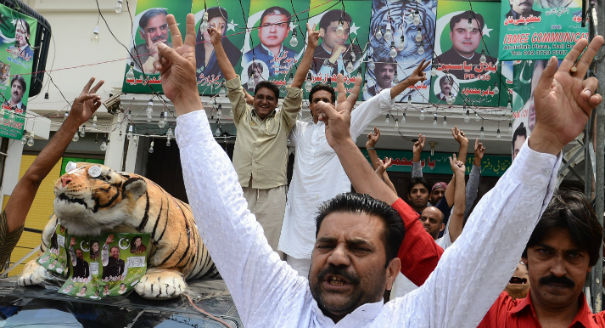
The elections in Pakistan provide a new political basis for re-imagining India-Pakistan relations. Nawaz Sharif's victory is rooted in a comprehensive political sweep in Punjab—Pakistan's largest province.
On this side of the Radcliffe Line, there is a strong government, whose leaders are deeply committed to normalization of relations between the two Punjabs, and between Delhi and Islamabad. The stars in Punjab are in rare alignment for a big political push on the people's agenda in Indo-Pak relations. The only missing element is a bit of political courage in the Congress party.
Former Nonresident Senior Fellow, Carnegie India
A leading analyst of India’s foreign policy, Mohan is also an expert on South Asian security, great-power relations in Asia, and arms control.
Recent Work

C. Raja Mohan, Darshana M. Baruah


Alexander Gabuev, Paul Haenle, C. Raja Mohan, …
Carnegie does not take institutional positions on public policy issues; the views represented herein are those of the author(s) and do not necessarily reflect the views of Carnegie, its staff, or its trustees.

But their "principal to principal" model will only be as effective as the political strength of each leader back home.

Damien Ma

U.S. unpredictability has allowed China to capitalize on its positioning as the “responsible great power”. Paradoxically, the more China wins the perception game, the more likely expectations will rise for Beijing to deliver not just words but to demonstrate with its deeds.

Chong Ja Ian

Hanoi and Beijing have long treated each other as distant cousins rather than comrades in arms. That might be changing as both sides draw closer to hedge against uncertainty and America’s erratic behavior.

Nguyễn Khắc Giang

Across Asia, China is better positioned to withstand energy shocks from the fallout of the Iran war. Its abundant coal capacity can ensure stability in the near term. Yet at the same time, the country’s energy transition away from coal will make it even less vulnerable during the next shock.
Damien Ma

Malaysia’s chairmanship sought to fend off short-term challenges while laying the groundwork for minimizing ASEAN’s longer-term exposure to external stresses.

Elina Noor