

Paper
Douglas H. Paal
{
  "authors": [
    "Douglas H. Paal"
  ],
  "type": "legacyinthemedia",
  "centerAffiliationAll": "dc",
  "centers": [
    "Carnegie Endowment for International Peace",
    "Carnegie China"
  ],
  "collections": [
    "China’s Foreign Relations",
    "U.S.-China Relations"
  ],
  "englishNewsletterAll": "asia",
  "nonEnglishNewsletterAll": "",
  "primaryCenter": "Carnegie Endowment for International Peace",
  "programAffiliation": "AP",
  "programs": [
    "Asia"
  ],
  "projects": [],
  "regions": [
    "North America",
    "United States",
    "East Asia",
    "China"
  ],
  "topics": [
    "Foreign Policy"
  ]
}
Source: Getty
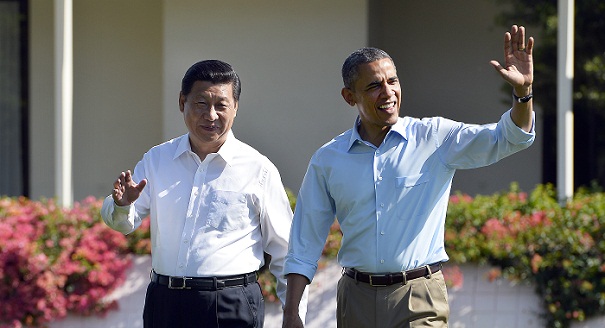
A weekend summit between Presidents Obama and Xi worked to manage friction between the two countries as China’s power grows and extends into America’s traditional spheres of influence.
Source: PBS NewsHour
GWEN IFILL: Now to the U.S. relationship with China and a look at what was and wasn't accomplished at the weekend summit between President Obama and Chinese President Xi Jinping.
JEFFREY BROWN: Outwardly, at least, there was an air of California casual at the two-day summit in Palm Springs between Presidents Obama and Xi.
At one point on Saturday, the two men took a nearly hour-long walk, ditching jackets, ties and advisers. Still, there were no breakthroughs on the issue topping the agenda: U.S. accusations of wide-ranging cyber-attacks by China. Last month, a confidential Pentagon report charged Chinese hackers had stolen design data on more than two dozen American weapons systems, including an advanced Patriot missile system and the F-35 joint strike fighter.
Aides say President Obama confronted Xi with specific evidence. In public, though, the language was measured.
PRESIDENT BARACK OBAMA: We're going to have to work very hard to build a system of defenses and protections, both in the private sector and in the public sector, even as we negotiate with other countries around setting up a common rules of the road.
PRESIDENT XI JINPING, China: We need to pay close attention to this issue and study ways to effectively resolve this issue. And this matter can actually be an area for China and the United States to work together with each other in a pragmatic way.
JEFFREY BROWN: On other issues, the two presidents did agree to work on reducing production of powerful greenhouse gases called hydrofluorocarbons. And they joined in speaking against a nuclear-armed North Korea.
China has criticized Pyongyang for recent threats South Korea and the U.S. And, on Sunday, just a day after the Obama-Xi summit, North Korea held its first official talks with South Korea in two years. A higher-level round of talks is set for Wednesday.
JEFFREY BROWN: More now from Douglas Paal of the Carnegie Endowment for International Peace. He's a former National Security Council staffer and State Department official. And retired Army Col. Larry Wortzel is a commissioner on the congressionally chartered U.S.-China Economic and Security Review Commission. He's also a former military attaché to China.
Larry Wortzel, let me start with you.
And, first, just looking at the meeting itself, the optics of the two leaders walking together casually, how important is that in the broader scheme of things?
RET. COL. LARRY WORTZEL, Commissioner, U.S.-China Economic and Security Review Commission: Well, I think that's important because it helps set the phone for how they will relate to each other and perhaps how the senior government staffs of the two countries will relate to each other. But, beyond that, not a lot was accomplished here.
JEFFREY BROWN: Well, Doug Paal, let me bring you in.
Is it more at this point about fleshing out the larger relationship or about accomplishing specific things along the way?
DOUGLAS PAAL, Former National Security Council Official: It's very much about the larger relationship.
The United States and China, like rising power and the established powers of history, are coming into greater conflict, very -- much more friction between the two of them as China's power grows and extends into America's traditional spheres of influence.
How to manage that, to keep it from becoming out of control and into conflict is a big challenge. Mr. Xi Jinping is coming in for a 10-year tenure of office, by all expectations. Getting him early to think about these big issues and to put before him those big issues, our ambitions and our fears, in a kind of quiet setting, is a way to sort of shape China's responses to this developing situation.
JEFFREY BROWN: But, when you say big issues, you mean the big issue of the relationship between the two, as opposed to, say, cyber-spying?
DOUGLAS PAAL: Well, cyber and spying are part of -- it's a big and important part of it.
But we also have our navies floating nearby their navies. We have intelligence aircrafts and ships near the Chinese coast. We have got important territorial disputes between China and its neighbors. And we have the big issue of North Korea nuclear proliferation.
JEFFREY BROWN: Larry Wortzel, come in on that. Are you suggesting that we should be pushing more on something like cyber-spying, and not worry so much about how that impacts the larger relationship?
LARRY WORTZEL: Well, I think how we push an issue is important.
But, quite frankly, Xi Jinping laid down a number of very strong markers that highlighted where we disagree, on sovereignty in the Senkaku islands, on U.S. arms sales to Taiwan and issues relating to China's sovereignty. And, his foreign minister, Yang Jiechi, made it very clear that, although China may agree that in the long term the Korean Peninsula should be denuclearized, we take very different approaches to it.
So I think in the end what this did for Xi Jinping is to strengthen his own message at home of a strong China, strengthen his Communist Party line about China's dream, and to strengthen the idea that China is now a great power state, which was part of his press release.
JEFFREY BROWN: I'm wondering about that, Doug Paal. Is a meeting like this, picking up on that, more important for the Chinese than it is for us?
DOUGLAS PAAL: I doubt it's more important for them than for us.
I think it's going to be equally important in the long run. This is an era of great interconnected issues. And we have nuclear weapons overhanging us. If we can't work our way through some of these problems, no matter how nationalistic each of our leaders has to be for his respective domestic audience, we could have a disastrous 21st century. So, it's really important to throw the Hail Mary pass, to try to make something work on this.
We're not going to know the results of this for a while. We have had small discussions on cyber-security and on HFCs, which were in some ways positive. But the real test of this is going to be a few years from now.
JEFFREY BROWN: What about on the North Korea issue? Did you see much movement or anything of import there?
DOUGLAS PAAL: There's been important movement by the Chinese on the North Korean issue. Whether it amounts to anything truly substantial will take some time.
China used to always say, our first interest is stability on the peninsula. Our second is denuclearization. They have now shifted those priorities, putting denuclearization first, which means implicitly that they were willing to go take some risk of stability to restrain North Korea's nuclear development.
JEFFREY BROWN: Larry Wortzel, is there -- going back to the kind of larger issue here, is there a potential or a fear of coming to a kind of cold war relationship? Or is that what this is about, trying to avoid that?
LARRY WORTZEL: Well, I mean, we're certainly in a number of areas in a competition, and to a certain extent confrontational relationship.
I think it's useful if both leaders can back away from that. We are not going to agree on a lot of things. And I think, on the Chinese side, they're probably a little bit concerned that the tone of what came out of this gets delivered once the national security adviser changes.
And they're probably a little concerned about what happens when we get a new U.N. ambassador who has focused on human rights.
JEFFREY BROWN: Explain that for us a little bit, I mean, because there's a new team coming in.
LARRY WORTZEL: There's a new team coming in.
Now, in China, you know, you go to -- you go out to Xinjiang, you go out to the far west if you don't follow what the party line says. But in the United States, it's not unusual to have national security advisers being stronger or weaker or running off on what they think ought to be done, despite the president's guidance.
But I am pleased to see that President Obama reinforced the importance of the rebalancing to the Pacific in his remarks about this summit.
JEFFREY BROWN: Doug Paal, just very quickly, before we go, I do want to ask you about Edward Snowden, who we heard discussed in our earlier segment, thought to be in Hong Kong seeking asylum there. What are the chances of that, the relationship with Hong Kong and China?
DOUGLAS PAAL: I suspect that he's getting out of Hong Kong, because he didn't realize until very recently that Hong Kong has a strong extradition arrangement with the United States.
I don't understand how the Chinese would want to keep Snowden there. This would be a huge issue between us if they were to interfere with the extradition process. And they do have that right, but they, I think, will not exercise it.
JEFFREY BROWN: All right, Doug Paal, Larry Wortzel, thank you both very much.
DOUGLAS PAAL: Thank you.

Distinguished Fellow, Asia Program
Paal previously served as vice chairman of JPMorgan Chase International and as unofficial U.S. representative to Taiwan as director of the American Institute in Taiwan.
Recent Work
Douglas H. Paal


Douglas H. Paal, Tong Zhao, Chen Qi, …
Carnegie does not take institutional positions on public policy issues; the views represented herein are those of the author(s) and do not necessarily reflect the views of Carnegie, its staff, or its trustees.

The Plaza Accord was not an externally imposed punishment of Japan but part of a broader restructuring that Japanese economists and policymakers themselves recognized was necessary. Its effects were undermined, however, when Tokyo responded to the resulting slowdown with policies that exacerbated investment, credit expansion, and the very imbalances the adjustment was intended to resolve.

Michael Pettis

The nuclear relationship between China and the United States is increasingly shaped by widening perception gaps rather than deliberate strategic design.
Tong Zhao
China’s banking crisis in the 2000s was resolved by transferring the costs to households through financial repression—a decision that recapitalized the banks while exacerbating the structural imbalances that continue to shape the Chinese economy today.
Michael Pettis

Chinese biotech companies have been on the receiving end of U.S. economic coercion. Yet their responses have differed significantly because firm and state interests are not uniformly aligned. For Washington, treating all Chinese tech firms the same, irrespective of their actual interests, risks pushing them farther into Beijing’s corner.

Xue Gong

China’s latest energy plan explicitly calls for integrating data centers into the electricity system, particularly connecting them to green energy. It appears Beijing wants to use compute as a source of domestic demand to absorb renewables excess capacity.

Damien Ma